



 Chat with AI
Exam 12: General Equilibrium and the Efficiency of Perfect Competition

Exam 1: The Scope and Method of Economics241 Questions
Exam 2: The Economic Problem: Scarcity and Choice218 Questions
Exam 3: Demand, Supply, and Market Equilibrium309 Questions
Exam 4: Demand and Supply Applications173 Questions
Exam 5: Elasticity188 Questions
Exam 6: Household Behavior and Consumer Choice272 Questions
Exam 7: The Production Process: the Behavior of Profit-Maximizing Firms287 Questions
Exam 8: Short-Run Costs and Output Decisions386 Questions
Exam 9: Long-Run Costs and Output Decisions363 Questions
Exam 10: Input Demand: the Labor and Land Markets200 Questions
Exam 11: Input Demand: the Capital Market and the Investment Decision218 Questions
Exam 12: General Equilibrium and the Efficiency of Perfect Competition202 Questions
Exam 13: Monopoly and Antitrust Policy394 Questions
Exam 14: Oligopoly219 Questions
Exam 15: Monopolistic Competition235 Questions
Exam 16: Externalities, Public Goods, and Common Resources275 Questions
Exam 17: Uncertainty and Asymmetric Information134 Questions
Exam 18: Income Distribution and Poverty197 Questions
Exam 19: Public Finance: the Economics of Taxation281 Questions
Exam 20: International Trade, Comparative Advantage, and Protectionism287 Questions
Exam 21: Economic Growth in Developing Economies133 Questions
Exam 22: Critical Thinking About Research104 Questions
Select questions type


Under perfect competition, the efficient level of output is produced because
(Multiple Choice)
4.9/5  (99)
(99) Suppose a policy change generates $90,000 of benefits for low-income families and $150,000 of costs for high-income families. We can best describe the change as
(Multiple Choice)
4.7/5 (88)
(88) Society will produce ________ if price and marginal cost are equated for all firms.
(Multiple Choice)
4.8/5 (67)
(67) When resources are misallocated, or allocated inefficiently,
(Multiple Choice)
4.9/5 (86)
(86) If at the current output of X the PX < MCX, then society gains by
(Multiple Choice)
4.9/5 (79)
(79) A perfectly competitive system results in an efficient allocation of resources among firms and an equal distribution of final products among households.
(True/False)
4.9/5 (82)
(82) The outcome of any free market is ultimately ________ because some people become very rich while others remain very poor.
(Multiple Choice)
4.9/5 (90)
(90) Examining the equilibrium conditions of individual markets and for households and firms separately is referred to as
(Multiple Choice)
4.9/5 (76)
(76) Refer to the information provided in Figure 12.4 below to answer the question(s) that follow. 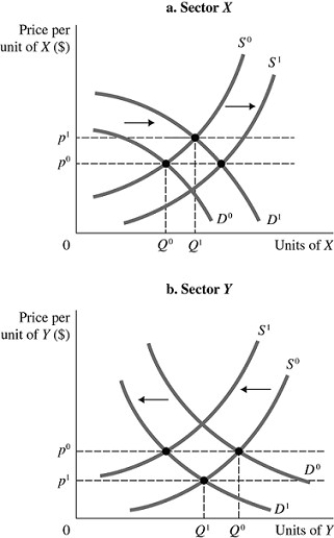 Figure 12.4
There are two sectors in the economy, X and Y, and both are in long-run, zero-profit equilibrium at the intersections of S0 and D0.
-Refer to Figure 12.4. Assume consumer preference changes toward X and away from Y. Ceteris paribus, firms in sector X are now ________ and firms in sector Y are now ________.
Figure 12.4
There are two sectors in the economy, X and Y, and both are in long-run, zero-profit equilibrium at the intersections of S0 and D0.
-Refer to Figure 12.4. Assume consumer preference changes toward X and away from Y. Ceteris paribus, firms in sector X are now ________ and firms in sector Y are now ________. (Multiple Choice)
4.9/5 (63)
(63) Which of the following is not an example of Pareto optimality?
(Multiple Choice)
4.8/5 (77)
(77) Refer to the information provided in Figure 12.2 below to answer the question(s) that follow. 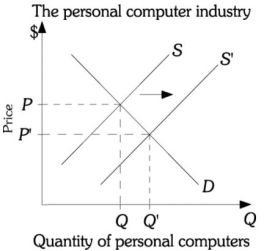 Figure 12.2
-Refer to Figure 12.2. A technological advance causes the supply of personal computers to increase. The graph of this situation represents a
Figure 12.2
-Refer to Figure 12.2. A technological advance causes the supply of personal computers to increase. The graph of this situation represents a (Multiple Choice)
4.8/5 (80)
(80) When one market reaches a new equilibrium, the general equilibrium condition has been satisfied.
(True/False)
4.9/5 (75)
(75) Assume that the price overestimates the value that society places on the flu vaccine. If firms produce where P = MC, firms will be producing ________ the socially efficient amount of flu vaccine.
(Multiple Choice)
4.8/5 (81)
(81) Which of the following statements about public goods is not true?
(Multiple Choice)
4.9/5 (72)
(72) ________ reflects household willingness to pay, and ________ reflects the opportunity cost of the resources needed to produce a good.
(Multiple Choice)
4.8/5 (74)
(74) Refer to the information provided in Figure 12.1 below to answer the question(s) that follow. 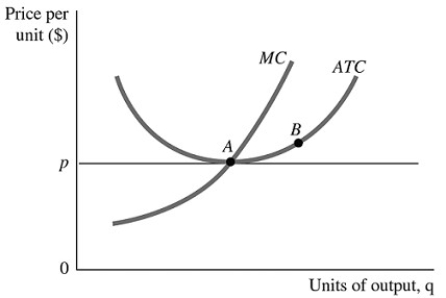 Figure 12.1
-Refer to Figure 12.1. This competitive firm is currently at Point A on the ATC curve. The firm's move toward an output where ATC will be at point B will make the economy
Figure 12.1
-Refer to Figure 12.1. This competitive firm is currently at Point A on the ATC curve. The firm's move toward an output where ATC will be at point B will make the economy (Multiple Choice)
4.9/5 (89)
(89) 
Filters
- Essay(0)
- Multiple Choice(0)
- Short Answer(0)
- True False(0)
- Matching(0)