



 Chat with AI
Exam 12: General Equilibrium and the Efficiency of Perfect Competition

Exam 1: The Scope and Method of Economics241 Questions
Exam 2: The Economic Problem: Scarcity and Choice218 Questions
Exam 3: Demand, Supply, and Market Equilibrium309 Questions
Exam 4: Demand and Supply Applications173 Questions
Exam 5: Elasticity188 Questions
Exam 6: Household Behavior and Consumer Choice272 Questions
Exam 7: The Production Process: the Behavior of Profit-Maximizing Firms287 Questions
Exam 8: Short-Run Costs and Output Decisions386 Questions
Exam 9: Long-Run Costs and Output Decisions363 Questions
Exam 10: Input Demand: the Labor and Land Markets200 Questions
Exam 11: Input Demand: the Capital Market and the Investment Decision218 Questions
Exam 12: General Equilibrium and the Efficiency of Perfect Competition202 Questions
Exam 13: Monopoly and Antitrust Policy394 Questions
Exam 14: Oligopoly219 Questions
Exam 15: Monopolistic Competition235 Questions
Exam 16: Externalities, Public Goods, and Common Resources275 Questions
Exam 17: Uncertainty and Asymmetric Information134 Questions
Exam 18: Income Distribution and Poverty197 Questions
Exam 19: Public Finance: the Economics of Taxation281 Questions
Exam 20: International Trade, Comparative Advantage, and Protectionism287 Questions
Exam 21: Economic Growth in Developing Economies133 Questions
Exam 22: Critical Thinking About Research104 Questions
Select questions type


Relating to the Economics in Practice on page 253: Subsidies for ethanol, a fuel produced from corn, have affected the market for
(Multiple Choice)
4.8/5  (80)
(80) ________ occurs when the economy is producing what people want at least possible cost.
(Multiple Choice)
4.7/5 (86)
(86) An economist estimates that the maintenance of a public recreation center costs $80,000 a year and that the recreation center generates $65,000 a year in revenue from usage fees. From society's point of view, the maintenance of this recreation center is
(Multiple Choice)
4.9/5 (79)
(79) When all markets are in simultaneous equilibrium, the general equilibrium condition has been satisfied.
(True/False)
4.9/5 (72)
(72) A person who chooses not to be in the labor force reveals that
(Multiple Choice)
4.9/5 (78)
(78) Firms stop producing DVDs and start producing Blu-ray discs because people prefer Blu-ray discs discs to DVDs. This will
(Multiple Choice)
4.8/5 (81)
(81) Your upstairs neighbor is the first-chair violinist in the local symphony orchestra. Because you are very fond of violin music, you sit on your balcony each night to listen to her rehearse. In this case, your violin-playing neighbor is an example of a
(Multiple Choice)
4.8/5 (74)
(74) ________ is a good measure of what society gives up by using resources to produce more of a good or service.
(Multiple Choice)
4.7/5 (85)
(85) Refer to the information provided in Figure 12.4 below to answer the question(s) that follow. 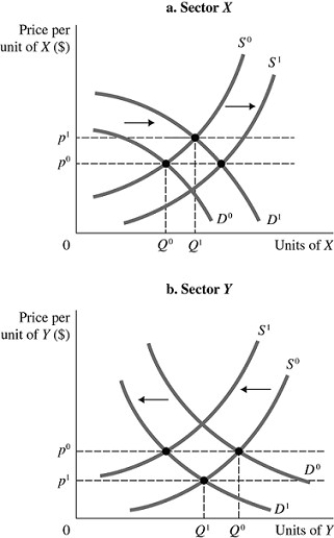 Figure 12.4
There are two sectors in the economy, X and Y, and both are in long-run, zero-profit equilibrium at the intersections of S0 and D0.
-Refer to Figure 12.4. Assume consumer preference changes toward X and away from Y. Ceteris paribus, the equilibrium price of X will ________ and the equilibrium price of Y will ________.
Figure 12.4
There are two sectors in the economy, X and Y, and both are in long-run, zero-profit equilibrium at the intersections of S0 and D0.
-Refer to Figure 12.4. Assume consumer preference changes toward X and away from Y. Ceteris paribus, the equilibrium price of X will ________ and the equilibrium price of Y will ________. (Multiple Choice)
4.8/5 (90)
(90) Suppose there is a permanent shift of consumer preferences away from pretzels and toward potato chips. The most likely result would be
(Multiple Choice)
4.9/5 (80)
(80) The used-car market is an example of an market with imperfect information.
(True/False)
4.8/5 (75)
(75) In making labor supply decisions, ________ weigh the market wage against the value of leisure and time spent in unpaid household production.
(Multiple Choice)
4.9/5 (78)
(78) A person who chooses ________ the labor force reveals that either leisure or the value of nonpaid labor is worth ________ to him or her than the value that society places on his or her potential product in the market.
(Multiple Choice)
4.8/5 (76)
(76) Partial equilibrium analysis is the process of examining the equilibrium conditions for households and firms combined for more than one but not all individual markets.
(True/False)
4.9/5 (83)
(83) Assume that the marginal cost of growing pine trees does not include the benefit to the environment as a result of carbon dioxide reduction. By producing where P = MC, the grower will be producing ________ the efficient amount of pine trees.
(Multiple Choice)
4.8/5 (89)
(89) Equity is the condition in which the economy is producing what people want at the least possible cost.
(True/False)
4.9/5 (71)
(71) 
Filters
- Essay(0)
- Multiple Choice(0)
- Short Answer(0)
- True False(0)
- Matching(0)