



 Chat with AI
Exam 12: General Equilibrium and the Efficiency of Perfect Competition

Exam 1: The Scope and Method of Economics241 Questions
Exam 2: The Economic Problem: Scarcity and Choice218 Questions
Exam 3: Demand, Supply, and Market Equilibrium309 Questions
Exam 4: Demand and Supply Applications173 Questions
Exam 5: Elasticity188 Questions
Exam 6: Household Behavior and Consumer Choice272 Questions
Exam 7: The Production Process: the Behavior of Profit-Maximizing Firms287 Questions
Exam 8: Short-Run Costs and Output Decisions386 Questions
Exam 9: Long-Run Costs and Output Decisions363 Questions
Exam 10: Input Demand: the Labor and Land Markets200 Questions
Exam 11: Input Demand: the Capital Market and the Investment Decision218 Questions
Exam 12: General Equilibrium and the Efficiency of Perfect Competition202 Questions
Exam 13: Monopoly and Antitrust Policy394 Questions
Exam 14: Oligopoly219 Questions
Exam 15: Monopolistic Competition235 Questions
Exam 16: Externalities, Public Goods, and Common Resources275 Questions
Exam 17: Uncertainty and Asymmetric Information134 Questions
Exam 18: Income Distribution and Poverty197 Questions
Exam 19: Public Finance: the Economics of Taxation281 Questions
Exam 20: International Trade, Comparative Advantage, and Protectionism287 Questions
Exam 21: Economic Growth in Developing Economies133 Questions
Exam 22: Critical Thinking About Research104 Questions
Select questions type


A new technology is developed for producing solar panels that reduces production costs by 40%. Which of the following is true?
(Multiple Choice)
4.7/5  (90)
(90) You value your economics textbook at $40. Someone else values it at $30, but that person is willing to pay you $35 for your textbook. Would selling your textbook to this person for $35 be Pareto efficient?
(Multiple Choice)
4.8/5 (83)
(83) You value your favorite shirt at $100. Someone else values it at $80, and that person is willing to pay you $80 for your shirt. Would selling your shirt to this person for $80 be Pareto efficient?
(Multiple Choice)
4.8/5 (82)
(82) We refer to the whole class of goods that firms will ________ in a completely unregulated market economy as public goods.
(Multiple Choice)
4.7/5 (89)
(89) For a change to be potentially efficient, no one can be made worse off.
(True/False)
5.0/5 (90)
(90) If some gain and some lose as the result of a change, and it can be demonstrated that the value of the gains exceeds the value of the losses, then the change is said to be
(Multiple Choice)
4.8/5 (82)
(82) Refer to the information provided in Figure 12.1 below to answer the question(s) that follow. 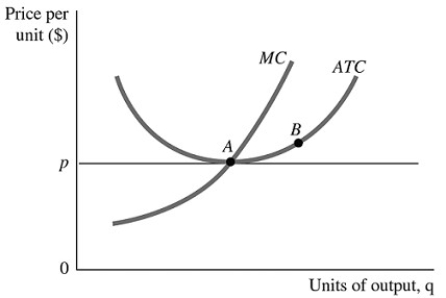 Figure 12.1
-Refer to Figure 12.1. The firm is
Figure 12.1
-Refer to Figure 12.1. The firm is (Multiple Choice)
4.9/5 (78)
(78) Which assumption leads to an efficient allocation of resources among firms?
(Multiple Choice)
4.9/5 (80)
(80) Price reflects the value households place on a good and marginal cost reflects the ________ of the resources needed to produce a good.
(Multiple Choice)
4.9/5 (89)
(89) To conduct a general equilibrium analysis of a change in consumer preferences away from beef and toward chicken, you must consider
(Multiple Choice)
4.9/5 (87)
(87) One criterion used to judge the performance of any economic system is
(Multiple Choice)
4.9/5 (79)
(79) 
Filters
- Essay(0)
- Multiple Choice(0)
- Short Answer(0)
- True False(0)
- Matching(0)