



 Chat with AI
Exam 12: General Equilibrium and the Efficiency of Perfect Competition

Exam 1: The Scope and Method of Economics241 Questions
Exam 2: The Economic Problem: Scarcity and Choice218 Questions
Exam 3: Demand, Supply, and Market Equilibrium309 Questions
Exam 4: Demand and Supply Applications173 Questions
Exam 5: Elasticity188 Questions
Exam 6: Household Behavior and Consumer Choice272 Questions
Exam 7: The Production Process: the Behavior of Profit-Maximizing Firms287 Questions
Exam 8: Short-Run Costs and Output Decisions386 Questions
Exam 9: Long-Run Costs and Output Decisions363 Questions
Exam 10: Input Demand: the Labor and Land Markets200 Questions
Exam 11: Input Demand: the Capital Market and the Investment Decision218 Questions
Exam 12: General Equilibrium and the Efficiency of Perfect Competition202 Questions
Exam 13: Monopoly and Antitrust Policy394 Questions
Exam 14: Oligopoly219 Questions
Exam 15: Monopolistic Competition235 Questions
Exam 16: Externalities, Public Goods, and Common Resources275 Questions
Exam 17: Uncertainty and Asymmetric Information134 Questions
Exam 18: Income Distribution and Poverty197 Questions
Exam 19: Public Finance: the Economics of Taxation281 Questions
Exam 20: International Trade, Comparative Advantage, and Protectionism287 Questions
Exam 21: Economic Growth in Developing Economies133 Questions
Exam 22: Critical Thinking About Research104 Questions
Select questions type


Input and output markets operate independently and thus should be analyzed as separate entities.
(True/False)
4.8/5  (84)
(84) Even if a market outcome is efficient, it may not be equitable.
(True/False)
4.8/5 (79)
(79) Relating to the Economics in Practice on page 253: Ethanol subsidies have increased the supply of corn, and ethanol is a fuel produced from corn. As a result, ________ farm land has increased. Further, supply of ________ has decreased.
(Multiple Choice)
4.8/5 (90)
(90) Assume some gain and some lose as the result of a change. If we can demonstrate the value of the gains are less than the value of the losses, then we say the change is
(Multiple Choice)
4.9/5 (77)
(77) Society will produce the efficient mix of output if all firms equate
(Multiple Choice)
4.8/5 (76)
(76) A condition in which no change is possible that will make some members of society better off without making some other members of society worse off is called
(Multiple Choice)
4.8/5 (81)
(81) Refer to the information provided in Figure 12.4 below to answer the question(s) that follow. 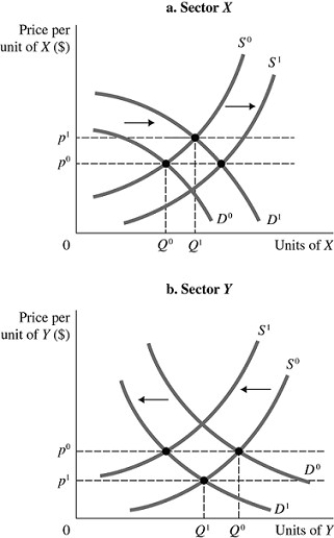 Figure 12.4
There are two sectors in the economy, X and Y, and both are in long-run, zero-profit equilibrium at the intersections of S0 and D0.
-Refer to Figure 12.4. Currently in sector Y, price is
Figure 12.4
There are two sectors in the economy, X and Y, and both are in long-run, zero-profit equilibrium at the intersections of S0 and D0.
-Refer to Figure 12.4. Currently in sector Y, price is (Multiple Choice)
4.9/5 (79)
(79) Refer to the information provided in Figure 12.2 below to answer the question(s) that follow. 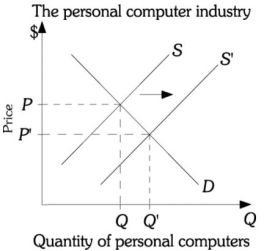 Figure 12.2
-Refer to Figure 12.2. The graph of this situation represents a partial equilibrium analysis because it
Figure 12.2
-Refer to Figure 12.2. The graph of this situation represents a partial equilibrium analysis because it (Multiple Choice)
4.9/5 (85)
(85) Refer to the information provided in Figure 12.5 below to answer the question(s) that follow. 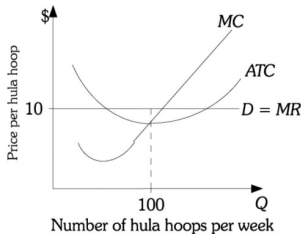 Figure 12.5
-Refer to Figure 12.5. Hula hoops are produced in a perfectly competitive market. This hula hoop firm is currently producing and selling 100 hula hoops per week. Which of the following is true?
Figure 12.5
-Refer to Figure 12.5. Hula hoops are produced in a perfectly competitive market. This hula hoop firm is currently producing and selling 100 hula hoops per week. Which of the following is true? (Multiple Choice)
4.9/5 (84)
(84) Which of the following would be classified as an external cost?
(Multiple Choice)
4.9/5 (71)
(71) If at the current output of X the PX > MCX, then society gains by
(Multiple Choice)
4.8/5 (74)
(74) Refer to the information provided in Figure 12.4 below to answer the question(s) that follow. Figure 12.4
There are two sectors in the economy, X and Y, and both are in long-run, zero-profit equilibrium at the intersections of S0 and D0.
-Refer to Figure 12.4. Currently in sector X, price is
Figure 12.4
There are two sectors in the economy, X and Y, and both are in long-run, zero-profit equilibrium at the intersections of S0 and D0.
-Refer to Figure 12.4. Currently in sector X, price is (Multiple Choice)
5.0/5 (79)
(79) Freely functioning markets in the real world always result in efficient allocations of resources.
(True/False)
4.8/5 (89)
(89) Government involvement in a market may generate more inefficiency than it cures.
(True/False)
4.7/5 (74)
(74) Social goods are goods and services that bestow collective benefits on members of society.
(True/False)
4.7/5 (93)
(93) If a restaurant runs a special and sells a lobster dinner for $4.50, Amy buys one lobster dinner a week. If lobster dinners are not on special and the price is $16.00, Amy buys zero lobster dinners per week. Which of the following is true?
(Multiple Choice)
4.9/5 (92)
(92) Under perfect competition the person that ends up with the ________ unit is the person that values it exactly at its price.
(Multiple Choice)
4.8/5 (87)
(87) Relating to the Economics in Practice on page 253: Which of the following would be an expected result of increased government subsidies for ethanol, a fuel produced from corn?
(Multiple Choice)
4.8/5 (79)
(79) Initially the beef and mutton markets are in equilibrium, then preferences shift away from beef and into mutton. If you are a cattle rancher, the best profit-maximizing strategy is to
(Multiple Choice)
4.8/5 (70)
(70) 
Filters
- Essay(0)
- Multiple Choice(0)
- Short Answer(0)
- True False(0)
- Matching(0)