



 Chat with AI
Exam 20: International Trade, Comparative Advantage, and Protectionism

Exam 1: The Scope and Method of Economics241 Questions
Exam 2: The Economic Problem: Scarcity and Choice218 Questions
Exam 3: Demand, Supply, and Market Equilibrium309 Questions
Exam 4: Demand and Supply Applications173 Questions
Exam 5: Elasticity188 Questions
Exam 6: Household Behavior and Consumer Choice272 Questions
Exam 7: The Production Process: the Behavior of Profit-Maximizing Firms287 Questions
Exam 8: Short-Run Costs and Output Decisions386 Questions
Exam 9: Long-Run Costs and Output Decisions363 Questions
Exam 10: Input Demand: the Labor and Land Markets200 Questions
Exam 11: Input Demand: the Capital Market and the Investment Decision218 Questions
Exam 12: General Equilibrium and the Efficiency of Perfect Competition202 Questions
Exam 13: Monopoly and Antitrust Policy394 Questions
Exam 14: Oligopoly219 Questions
Exam 15: Monopolistic Competition235 Questions
Exam 16: Externalities, Public Goods, and Common Resources275 Questions
Exam 17: Uncertainty and Asymmetric Information134 Questions
Exam 18: Income Distribution and Poverty197 Questions
Exam 19: Public Finance: the Economics of Taxation281 Questions
Exam 20: International Trade, Comparative Advantage, and Protectionism287 Questions
Exam 21: Economic Growth in Developing Economies133 Questions
Exam 22: Critical Thinking About Research104 Questions
Select questions type


The advantage in the production of a product enjoyed by one country over another when it uses ________ to produce that product than the other country does is an absolute advantage.
(Multiple Choice)
4.8/5  (80)
(80) If a nation has most-favored-nation status conferred on it, then exports from that country
(Multiple Choice)
4.8/5 (75)
(75) The software industry depends on highly trained workers, who are abundantly available in Country A. The heavy equipment industry depends on the availability of a large stock of physical capital with which Country B is well endowed. According to Heckscher-Ohlin theorem
(Multiple Choice)
4.8/5 (87)
(87) An argument in favor of free trade is that trade barriers prevent a nation from reaping the benefits of specialization.
(True/False)
4.7/5 (74)
(74) Refer to the information provided in Figure 20.2 below to answer the question(s) that follow. 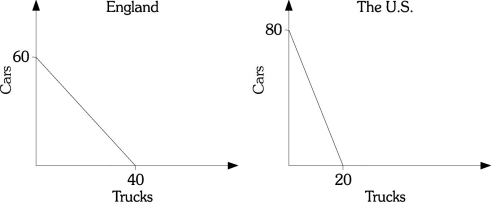 Figure 20.2
-Refer to Figure 20.2. the U.S. has
Figure 20.2
-Refer to Figure 20.2. the U.S. has (Multiple Choice)
4.7/5 (80)
(80) Refer to the information provided in Figure 20.2 below to answer the question(s) that follow. Figure 20.2
-Refer to Figure 20.2. the theory of comparative advantage suggests that
Figure 20.2
-Refer to Figure 20.2. the theory of comparative advantage suggests that (Multiple Choice)
4.9/5 (77)
(77) Country A has a comparative advantage compared to Country B in the production of shoes if
(Multiple Choice)
4.9/5 (83)
(83) Germany placed a limit on the amount of beer that can be imported into Germany. This is an example of
(Multiple Choice)
4.8/5 (81)
(81) It costs a computer manufacturer $1,000 to produce a personal computer. This manufacturer sells these computers abroad for $600. This is an example of
(Multiple Choice)
4.8/5 (83)
(83) Refer to the information provided in Figure 20.1 below to answer the question(s) that follow. 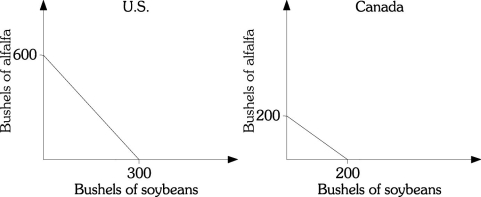 Figure 20.1
-Refer to Figure 20.1. The opportunity cost of producing a bushel of alfalfa in Canada is
Figure 20.1
-Refer to Figure 20.1. The opportunity cost of producing a bushel of alfalfa in Canada is (Multiple Choice)
4.9/5 (85)
(85) Related to the Economics in Practice on page 673: If the candle makers in the petition were able to gain protection for their industry, the French economy would most likely
(Multiple Choice)
4.8/5 (75)
(75) Government payments made to domestic firms in order to encourage exports are called
(Multiple Choice)
4.7/5 (81)
(81) If the opportunity cost of corn to wheat is 3:1 in the United States and 5:1 in France, only the United States would benefit from trade if the actual terms of trade between corn and wheat were 2:1.
(True/False)
4.9/5 (82)
(82) Suppose that Argentina and Chile are both engaged in the production of copper and wheat, and that Argentina has an absolute advantage in the production of both goods. If Chile has a comparative advantage in the production of copper, then Chile
(Multiple Choice)
4.8/5 (73)
(73) The U.S. tariff law that set off an international trade war in the 1930s was the
(Multiple Choice)
4.8/5 (74)
(74) Refer to the information provided in Table 20.6 below to answer the question(s) that follow.
Table 20.6 United States France Peas \ 3 3 euros Carrots \ 4 9 euros
-Refer to Table 20.6. If the exchange rate is $1 = 1 euro, then
(Multiple Choice)
4.9/5 (66)
(66) When one country can produce a product at a lower cost in terms of other goods, that country is said to have
(Multiple Choice)
4.8/5 (88)
(88) 
Filters
- Essay(0)
- Multiple Choice(0)
- Short Answer(0)
- True False(0)
- Matching(0)