



 Chat with AI
Exam 20: International Trade, Comparative Advantage, and Protectionism

Exam 1: The Scope and Method of Economics241 Questions
Exam 2: The Economic Problem: Scarcity and Choice218 Questions
Exam 3: Demand, Supply, and Market Equilibrium309 Questions
Exam 4: Demand and Supply Applications173 Questions
Exam 5: Elasticity188 Questions
Exam 6: Household Behavior and Consumer Choice272 Questions
Exam 7: The Production Process: the Behavior of Profit-Maximizing Firms287 Questions
Exam 8: Short-Run Costs and Output Decisions386 Questions
Exam 9: Long-Run Costs and Output Decisions363 Questions
Exam 10: Input Demand: the Labor and Land Markets200 Questions
Exam 11: Input Demand: the Capital Market and the Investment Decision218 Questions
Exam 12: General Equilibrium and the Efficiency of Perfect Competition202 Questions
Exam 13: Monopoly and Antitrust Policy394 Questions
Exam 14: Oligopoly219 Questions
Exam 15: Monopolistic Competition235 Questions
Exam 16: Externalities, Public Goods, and Common Resources275 Questions
Exam 17: Uncertainty and Asymmetric Information134 Questions
Exam 18: Income Distribution and Poverty197 Questions
Exam 19: Public Finance: the Economics of Taxation281 Questions
Exam 20: International Trade, Comparative Advantage, and Protectionism287 Questions
Exam 21: Economic Growth in Developing Economies133 Questions
Exam 22: Critical Thinking About Research104 Questions
Select questions type


Refer to the information provided in Table 20.1 below to answer the question(s) that follow.
Table 20.1
Oranges Bananas Oranges Bananas bushel/acre bushel/acre bushel/acre bushel/acre 200 0 50 0 160 40 40 20 120 80 30 40 80 120 20 60 40 160 10 80 0 200 0 100
-Refer to Table 20.1. Mexico has
(Multiple Choice)
4.9/5  (75)
(75) Refer to the information provided in Table 20.1 below to answer the question(s) that follow.
Table 20.1
Oranges Bananas Oranges Bananas bushel/acre bushel/acre bushel/acre bushel/acre 200 0 50 0 160 40 40 20 120 80 30 40 80 120 20 60 40 160 10 80 0 200 0 100
-Refer to Table 20.1. In Guatemala, the opportunity cost of 1 bushel of oranges is
(Multiple Choice)
4.7/5 (92)
(92) According to the theory of comparative advantage, a country should
(Multiple Choice)
4.8/5 (72)
(72) Suppose that the United States and Italy both produce wine and shoes. In the United States, wine sells for $10 a bottle and shoes sell for $40 a pair. In Italy, wine sells for 15 euros a bottle and shoes sell for 20 euros a pair. Given this information, trade will flow in both directions if the price of a dollar is between
(Multiple Choice)
4.7/5 (71)
(71) Suppose that the United States and Spain both produce cognac and handbags. In the United States, cognac sells for $20 a bottle and handbags sell for $80. In Spain, cognac sells for 30 euros a bottle and handbags sell for 40 euros. Given this information, trade will flow in both directions if the price of a dollar is between
(Multiple Choice)
4.8/5 (86)
(86) Suppose a U.S. dollar exchanges for 0.8 euros, then each euro is worth
(Multiple Choice)
4.7/5 (65)
(65) Related to the Economics in Practice on page 673: Satirist Frederic Bastiat's essay arguing for a quota on sunlight in order to protect domestic candle makers suggests that it is pointless to
(Multiple Choice)
4.9/5 (80)
(80) If a country has a trade surplus of $60 billion, which of the following can be true?
(Multiple Choice)
4.8/5 (77)
(77) The United States would have an absolute advantage compared to Canada in the production of wheat if
(Multiple Choice)
4.8/5 (88)
(88) Related to the Economics in Practice on page 667: When a country lifts a quota, imports to that country generally ________ and the price of the affected product in that country generally ________.
(Multiple Choice)
4.9/5 (84)
(84) If the exchange rate between the United States and Mexico changes from $1 = 100 pesos to $1 = 5 pesos, ceteris paribus
(Multiple Choice)
4.9/5 (73)
(73) The main advantage of ________ is the ability to move out beyond previous resource and production constraints.
(Multiple Choice)
4.8/5 (94)
(94) Refer to the information provided in Figure 20.1 below to answer the question(s) that follow. 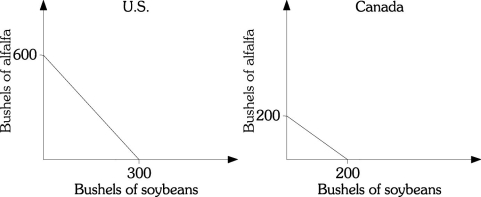 Figure 20.1
-Refer to Figure 20.1. The opportunity cost of producing a bushel of soybeans in the United States is
Figure 20.1
-Refer to Figure 20.1. The opportunity cost of producing a bushel of soybeans in the United States is (Multiple Choice)
4.9/5 (79)
(79) A significant portion of actual world trade patterns results from
(Multiple Choice)
4.8/5 (85)
(85) Refer to the information provided in Figure 20.4 below to answer the question(s) that follow. 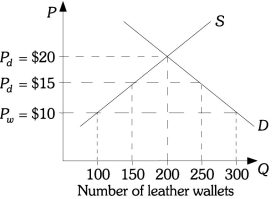 Figure 20.4
-Refer to Figure 20.4. The domestic price of a leather wallet is $20. With free trade the price of a leather wallet is $10 and after a tariff is imposed the price is $15. With free trade domestic production is
Figure 20.4
-Refer to Figure 20.4. The domestic price of a leather wallet is $20. With free trade the price of a leather wallet is $10 and after a tariff is imposed the price is $15. With free trade domestic production is (Multiple Choice)
4.8/5 (85)
(85) When a nation's exports are less than its imports, it has a
(Multiple Choice)
5.0/5 (71)
(71) Refer to the information provided in Figure 20.5 below to answer the question(s) that follow.  Figure 20.5
-Refer to Figure 20.5. The domestic price of oil is $130 per barrel, and the world price of oil is $120 per barrel. If the domestic government imposes a tariff of $________ per barrel, it will eliminate all oil imports and achieve tariff revenues of $________.
Figure 20.5
-Refer to Figure 20.5. The domestic price of oil is $130 per barrel, and the world price of oil is $120 per barrel. If the domestic government imposes a tariff of $________ per barrel, it will eliminate all oil imports and achieve tariff revenues of $________. (Multiple Choice)
4.7/5 (83)
(83) 
Filters
- Essay(0)
- Multiple Choice(0)
- Short Answer(0)
- True False(0)
- Matching(0)