



 Chat with AI
Exam 20: International Trade, Comparative Advantage, and Protectionism

Exam 1: The Scope and Method of Economics241 Questions
Exam 2: The Economic Problem: Scarcity and Choice218 Questions
Exam 3: Demand, Supply, and Market Equilibrium309 Questions
Exam 4: Demand and Supply Applications173 Questions
Exam 5: Elasticity188 Questions
Exam 6: Household Behavior and Consumer Choice272 Questions
Exam 7: The Production Process: the Behavior of Profit-Maximizing Firms287 Questions
Exam 8: Short-Run Costs and Output Decisions386 Questions
Exam 9: Long-Run Costs and Output Decisions363 Questions
Exam 10: Input Demand: the Labor and Land Markets200 Questions
Exam 11: Input Demand: the Capital Market and the Investment Decision218 Questions
Exam 12: General Equilibrium and the Efficiency of Perfect Competition202 Questions
Exam 13: Monopoly and Antitrust Policy394 Questions
Exam 14: Oligopoly219 Questions
Exam 15: Monopolistic Competition235 Questions
Exam 16: Externalities, Public Goods, and Common Resources275 Questions
Exam 17: Uncertainty and Asymmetric Information134 Questions
Exam 18: Income Distribution and Poverty197 Questions
Exam 19: Public Finance: the Economics of Taxation281 Questions
Exam 20: International Trade, Comparative Advantage, and Protectionism287 Questions
Exam 21: Economic Growth in Developing Economies133 Questions
Exam 22: Critical Thinking About Research104 Questions
Select questions type


Which of the following can be considered a free-trade zone?
(Multiple Choice)
4.9/5  (87)
(87) The quantity and quality of a country's labor, land, and natural resources are that country's factor endowments.
(True/False)
4.7/5 (85)
(85) An argument in favor of free trade is that trade barriers force consumers to pay higher prices for protected products than they would otherwise pay.
(True/False)
4.9/5 (90)
(90) Refer to the information provided in Figure 20.3 below to answer the question(s) that follow. 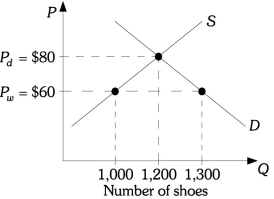 Figure 20.3
-Refer to Figure 20.3. The domestic price of shoes is $80. After trade the price of a pair of shoes is $60. If shoes are a normal good and income in this country rises, then we would expect
Figure 20.3
-Refer to Figure 20.3. The domestic price of shoes is $80. After trade the price of a pair of shoes is $60. If shoes are a normal good and income in this country rises, then we would expect (Multiple Choice)
4.9/5 (84)
(84) According to ________, a country should specialize and export goods with the lowest opportunity cost.
(Multiple Choice)
4.9/5 (90)
(90) Refer to the information provided in Table 20.5 below to answer the question(s) that follow. Cashews are measured in bushels and tea is measured in pounds (lbs.)
Table 20.5
Cashews Tea Cashews Tea 0 600 0 600 20 500 20 450 40 400 40 300 60 300 60 150 80 200 80 0 100 100 - - 120 0 - -
-Refer to Table 20.5. Which terms of trade benefits both countries?
(Multiple Choice)
4.9/5 (77)
(77) ________ looks to relative factor endowments to explain trade flows.
(Multiple Choice)
4.9/5 (75)
(75) Refer to the information provided in Figure 20.1 below to answer the question(s) that follow. 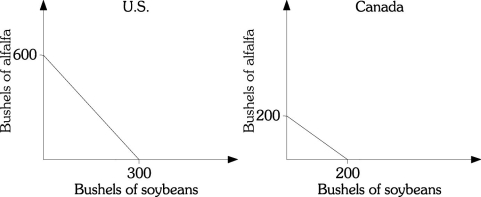 Figure 20.1
-Refer to Figure 20.1. The opportunity cost of producing a bushel of soybeans in the Canada is
Figure 20.1
-Refer to Figure 20.1. The opportunity cost of producing a bushel of soybeans in the Canada is (Multiple Choice)
4.8/5 (78)
(78) Every president who has held office since the General Agreement on Tariffs and Trade was signed has
(Multiple Choice)
4.9/5 (74)
(74) The ratio at which one country trades a domestic product for imported product is that country's
(Multiple Choice)
4.9/5 (73)
(73) Refer to the information provided in Figure 20.4 below to answer the question(s) that follow. 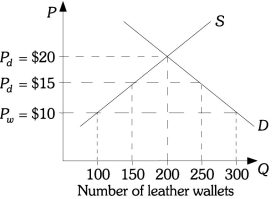 Figure 20.4
-Refer to Figure 20.4. The domestic price of a leather wallet is $20. With free trade the price of a leather wallet is $10 and after a tariff is imposed the price is $15. With free trade domestic consumption is
Figure 20.4
-Refer to Figure 20.4. The domestic price of a leather wallet is $20. With free trade the price of a leather wallet is $10 and after a tariff is imposed the price is $15. With free trade domestic consumption is (Multiple Choice)
4.8/5 (83)
(83) Country A would have an absolute advantage compared to Country B in the production of corn if
(Multiple Choice)
4.8/5 (84)
(84) It is a valid argument that industries need to be protected from foreign competition because foreign wages are substantially lower than wages paid to U.S. workers.
(True/False)
4.9/5 (78)
(78) If Mexico has a exports of 40 billion pesos and imports of 50 billion pesos, it is running a trade surplus.
(True/False)
4.8/5 (86)
(86) Refer to the information provided in Table 20.3 below to answer the question(s) that follow.
Table 20.3 United States Belgium Raspberries \ 9 9 euros Chocolate \ 12 27 euros
-Refer to Table 20.3. If the exchange rate is $1 = 1 euro, then
(Multiple Choice)
4.8/5 (80)
(80) Refer to the information provided in Figure 20.1 below to answer the question(s) that follow. Figure 20.1
-Refer to Figure 20.1. The opportunity cost of producing a bushel of alfalfa in Canada is
Figure 20.1
-Refer to Figure 20.1. The opportunity cost of producing a bushel of alfalfa in Canada is (Multiple Choice)
4.8/5 (68)
(68) Refer to the information provided in Figure 20.2 below to answer the question(s) that follow. 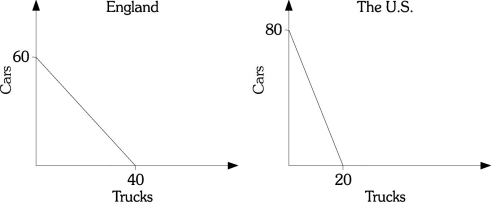 Figure 20.2
-Refer to Figure 20.2. The opportunity cost of 1 ________ is 4 ________ in the United States and 1.5 ________ in England.
Figure 20.2
-Refer to Figure 20.2. The opportunity cost of 1 ________ is 4 ________ in the United States and 1.5 ________ in England. (Multiple Choice)
4.9/5 (77)
(77) If the exchange rate between the United States and Mexico changes from $1 = 8 pesos to $1 = 9 pesos, then, ceteris paribus, the price of American goods in Mexico
(Multiple Choice)
5.0/5 (77)
(77) 
Filters
- Essay(0)
- Multiple Choice(0)
- Short Answer(0)
- True False(0)
- Matching(0)