



 Chat with AI
Exam 20: International Trade, Comparative Advantage, and Protectionism

Exam 1: The Scope and Method of Economics241 Questions
Exam 2: The Economic Problem: Scarcity and Choice218 Questions
Exam 3: Demand, Supply, and Market Equilibrium309 Questions
Exam 4: Demand and Supply Applications173 Questions
Exam 5: Elasticity188 Questions
Exam 6: Household Behavior and Consumer Choice272 Questions
Exam 7: The Production Process: the Behavior of Profit-Maximizing Firms287 Questions
Exam 8: Short-Run Costs and Output Decisions386 Questions
Exam 9: Long-Run Costs and Output Decisions363 Questions
Exam 10: Input Demand: the Labor and Land Markets200 Questions
Exam 11: Input Demand: the Capital Market and the Investment Decision218 Questions
Exam 12: General Equilibrium and the Efficiency of Perfect Competition202 Questions
Exam 13: Monopoly and Antitrust Policy394 Questions
Exam 14: Oligopoly219 Questions
Exam 15: Monopolistic Competition235 Questions
Exam 16: Externalities, Public Goods, and Common Resources275 Questions
Exam 17: Uncertainty and Asymmetric Information134 Questions
Exam 18: Income Distribution and Poverty197 Questions
Exam 19: Public Finance: the Economics of Taxation281 Questions
Exam 20: International Trade, Comparative Advantage, and Protectionism287 Questions
Exam 21: Economic Growth in Developing Economies133 Questions
Exam 22: Critical Thinking About Research104 Questions
Select questions type


Related to the Economics in Practice on p. 667: When a country imposes a quota, imports to that country generally ________ and the price of the affected product in that country generally ________.
(Multiple Choice)
4.7/5  (89)
(89) Refer to the information provided in Figure 20.1 below to answer the question(s) that follow. 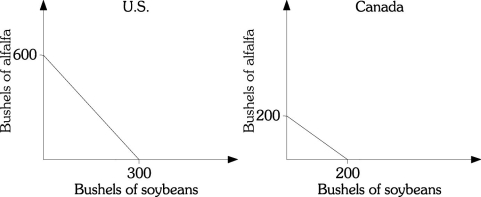 Figure 20.1
-Refer to Figure 20.1. Which of the following statements is true?
Figure 20.1
-Refer to Figure 20.1. Which of the following statements is true? (Multiple Choice)
4.8/5 (74)
(74) If the exchange rate between the United States and Greece changes from $1 = 1 euro to $1 = 2 euros, then holding everything else constant, the price of U.S. goods in Greece will increase.
(True/False)
4.8/5 (63)
(63) Refer to the information provided in Figure 20.4 below to answer the question(s) that follow. 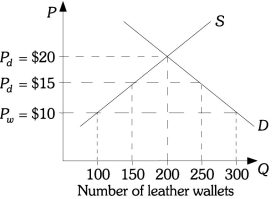 Figure 20.4
-Refer to Figure 20.4. The domestic price of a leather wallet is $20. With free trade the price of a leather wallet is $10 and after a tariff is imposed the price is $15. After the tariff is imposed, this country will ________ 250 leather wallets.
Figure 20.4
-Refer to Figure 20.4. The domestic price of a leather wallet is $20. With free trade the price of a leather wallet is $10 and after a tariff is imposed the price is $15. After the tariff is imposed, this country will ________ 250 leather wallets. (Multiple Choice)
4.9/5 (84)
(84) The case for ________ is based on the theory of comparative advantage.
(Multiple Choice)
4.9/5 (78)
(78) Suppose that Japan and India are both engaged in the production of radios and rice, and that Japan has an absolute advantage in the production of both goods. If India has a lower opportunity cost for producing rice, then
(Multiple Choice)
4.8/5 (87)
(87) The Dominican Republic has a comparative advantage in the production of tobacco, and Panama has a comparative advantage in the production of oranges. If both countries specialize based on the theory of comparative advantage
(Multiple Choice)
4.7/5 (83)
(83) If Japan has exports of 70 billion yen and imports of 60 billion yen, it is running a trade surplus.
(True/False)
4.9/5 (85)
(85) Related to the Economics in Practice on p. 666: When a country opens its markets to free trade, competition ________ and efficiency ________.
(Multiple Choice)
4.9/5 (81)
(81) Refer to the information provided in Table 20.5 below to answer the question(s) that follow. Cashews are measured in bushels and tea is measured in pounds (lbs.)
Table 20.5
Cashews Tea Cashews Tea 0 600 0 600 20 500 20 450 40 400 40 300 60 300 60 150 80 200 80 0 100 100 - - 120 0 - -
-Refer to Table 20.5. If both countries specialize and trade with each other, Vietnam will export ________ and India will import ________.
(Multiple Choice)
4.7/5 (75)
(75) Refer to the information provided in Table 20.2 below to answer the question(s) that follow.
Table 20.2 China Thailand Tractors Motorcycles Tractors Motorcycles 0 300 0 300 5 250 5 225 10 200 10 150 15 150 15 75 20 100 20 0 25 50 - - 30 0 - -
-Refer to Table 20.2. Which terms of trade benefits both countries?
(Multiple Choice)
4.8/5 (82)
(82) For any pair of nations and goods, if each country has an absolute advantage in the production of one product, it is reasonable to expect that specialization and trade will benefit both countries.
(True/False)
4.8/5 (82)
(82) Refer to the information provided in Table 20.2 below to answer the question(s) that follow.
Table 20.2 China Thailand Tractors Motorcycles Tractors Motorcycles 0 300 0 300 5 250 5 225 10 200 10 150 15 150 15 75 20 100 20 0 25 50 - - 30 0 - -
-Refer to Table 20.2. ________ has a comparative advantage in motorcycles and ________ has an absolute advantage in motorcycles.
(Multiple Choice)
4.7/5 (74)
(74) A tariff imposed on imported shoes will cause the domestic price of shoes to ________ and the domestic production of shoes to ________.
(Multiple Choice)
4.8/5 (66)
(66) A country is said to enjoy a comparative advantage over another country in the production of a product if it uses fewer resources to produce that product than the other country does.
(True/False)
4.8/5 (89)
(89) If Spain decreases subsidies to its olive growers, the price of olives in the U.S. will fall.
(True/False)
5.0/5 (84)
(84) 
Filters
- Essay(0)
- Multiple Choice(0)
- Short Answer(0)
- True False(0)
- Matching(0)