



 Chat with AI
Exam 20: International Trade, Comparative Advantage, and Protectionism

Exam 1: The Scope and Method of Economics241 Questions
Exam 2: The Economic Problem: Scarcity and Choice218 Questions
Exam 3: Demand, Supply, and Market Equilibrium309 Questions
Exam 4: Demand and Supply Applications173 Questions
Exam 5: Elasticity188 Questions
Exam 6: Household Behavior and Consumer Choice272 Questions
Exam 7: The Production Process: the Behavior of Profit-Maximizing Firms287 Questions
Exam 8: Short-Run Costs and Output Decisions386 Questions
Exam 9: Long-Run Costs and Output Decisions363 Questions
Exam 10: Input Demand: the Labor and Land Markets200 Questions
Exam 11: Input Demand: the Capital Market and the Investment Decision218 Questions
Exam 12: General Equilibrium and the Efficiency of Perfect Competition202 Questions
Exam 13: Monopoly and Antitrust Policy394 Questions
Exam 14: Oligopoly219 Questions
Exam 15: Monopolistic Competition235 Questions
Exam 16: Externalities, Public Goods, and Common Resources275 Questions
Exam 17: Uncertainty and Asymmetric Information134 Questions
Exam 18: Income Distribution and Poverty197 Questions
Exam 19: Public Finance: the Economics of Taxation281 Questions
Exam 20: International Trade, Comparative Advantage, and Protectionism287 Questions
Exam 21: Economic Growth in Developing Economies133 Questions
Exam 22: Critical Thinking About Research104 Questions
Select questions type


Suppose that Paraguay and Guyana are both engaged in the production of soybeans and grapefruit, and that Paraguay has an absolute advantage in the production of both goods. If Guyana has a comparative advantage in the production of soybeans, then Guyana
(Multiple Choice)
4.9/5  (88)
(88) If the slopes of the production possibility frontiers involving sugar and rice in countries A and B are equal
(Multiple Choice)
4.8/5 (72)
(72) A country enjoys a comparative advantage in the production of a good if that good can be produced at a lower cost in terms of other goods.
(True/False)
4.9/5 (80)
(80) Refer to the information provided in Figure 20.3 below to answer the question(s) that follow. 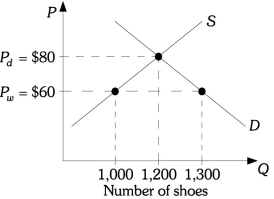 Figure 20.3
-Refer to Figure 20.3. The domestic price of shoes is $80. After trade the price of a pair of shoes is $60. If shoes are a normal good and income in this country falls, then we would expect
Figure 20.3
-Refer to Figure 20.3. The domestic price of shoes is $80. After trade the price of a pair of shoes is $60. If shoes are a normal good and income in this country falls, then we would expect (Multiple Choice)
4.7/5 (61)
(61) If the price of a car in the United States is $22,000, and the exchange rate between the dollar and the Japanese yen falls from 125 yen to 105 yen per dollar, then the price of the American car in Japan will
(Multiple Choice)
4.7/5 (88)
(88) The Heckscher-Ohlin theorem explains why the U.S. both imports and exports cars.
(True/False)
4.8/5 (74)
(74) In general, for any two countries, there are many exchange rates that will lead to gains from trade, based on comparative advantage.
(True/False)
4.7/5 (86)
(86) Refer to the information provided in Table 20.1 below to answer the question(s) that follow.
Table 20.1
Oranges Bananas Oranges Bananas bushel/acre bushel/acre bushel/acre bushel/acre 200 0 50 0 160 40 40 20 120 80 30 40 80 120 20 60 40 160 10 80 0 200 0 100
-Refer to Table 20.1. Guatemala has
(Multiple Choice)
4.8/5 (91)
(91) The quantity and quality of labor, land, and natural resources of a country are its
(Multiple Choice)
4.8/5 (84)
(84) Refer to the information provided in Figure 20.2 below to answer the question(s) that follow. 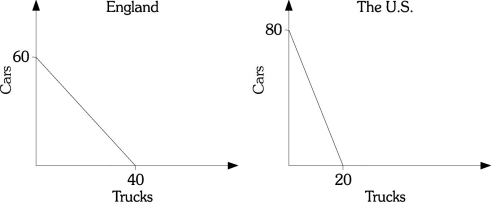 Figure 20.2
-Refer to Figure 20.2. The opportunity cost of a truck is ________ car(s) in England and ________ car(s) in the United States.
Figure 20.2
-Refer to Figure 20.2. The opportunity cost of a truck is ________ car(s) in England and ________ car(s) in the United States. (Multiple Choice)
4.9/5 (67)
(67) Refer to the information provided in Table 20.6 below to answer the question(s) that follow.
Table 20.6 United States France Peas \ 3 3 euros Carrots \ 4 9 euros
-Refer to Table 20.6. If the exchange rate is $1 = 3 euros, then
(Multiple Choice)
4.8/5 (76)
(76) If the price of a car in the United States is $26,000, and the exchange rate between the dollar and the British pound rises from $1.50 to $2.00 per pound, then the price of the American car in Britain will
(Multiple Choice)
4.8/5 (74)
(74) If exchange rates end up in the right ranges, the free market will drive each country to shift resources into those sectors in which it enjoys a comparative advantage.
(True/False)
4.9/5 (84)
(84) In general, free-trade makes the people of a country better off.
(True/False)
4.9/5 (97)
(97) The United States has a comparative advantage in the production of wheat, and Haiti has a comparative advantage in the production of sugar. If both countries specialize based on the theory of comparative advantage
(Multiple Choice)
4.9/5 (82)
(82) In 2003, the ________ ruled that U.S. tariffs on steel imported from the EU were unfair and allowed the EU to issue retaliatory tariffs on U.S. products.
(Multiple Choice)
5.0/5 (81)
(81) Refer to the information provided in Figure 20.1 below to answer the question(s) that follow. 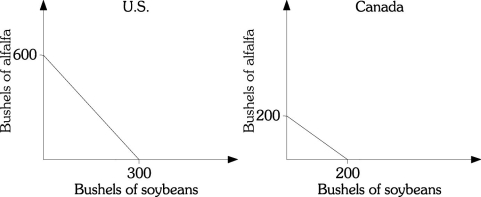 Figure 20.1
-Refer to Figure 20.1. The opportunity cost of producing a bushel of alfalfa in the United States is
Figure 20.1
-Refer to Figure 20.1. The opportunity cost of producing a bushel of alfalfa in the United States is (Multiple Choice)
4.9/5 (81)
(81) ________ involves a country selling its exports at a price lower than its cost of production.
(Multiple Choice)
4.7/5 (82)
(82) 
Filters
- Essay(0)
- Multiple Choice(0)
- Short Answer(0)
- True False(0)
- Matching(0)