



 Chat with AI
Exam 20: International Trade, Comparative Advantage, and Protectionism

Exam 1: The Scope and Method of Economics241 Questions
Exam 2: The Economic Problem: Scarcity and Choice218 Questions
Exam 3: Demand, Supply, and Market Equilibrium309 Questions
Exam 4: Demand and Supply Applications173 Questions
Exam 5: Elasticity188 Questions
Exam 6: Household Behavior and Consumer Choice272 Questions
Exam 7: The Production Process: the Behavior of Profit-Maximizing Firms287 Questions
Exam 8: Short-Run Costs and Output Decisions386 Questions
Exam 9: Long-Run Costs and Output Decisions363 Questions
Exam 10: Input Demand: the Labor and Land Markets200 Questions
Exam 11: Input Demand: the Capital Market and the Investment Decision218 Questions
Exam 12: General Equilibrium and the Efficiency of Perfect Competition202 Questions
Exam 13: Monopoly and Antitrust Policy394 Questions
Exam 14: Oligopoly219 Questions
Exam 15: Monopolistic Competition235 Questions
Exam 16: Externalities, Public Goods, and Common Resources275 Questions
Exam 17: Uncertainty and Asymmetric Information134 Questions
Exam 18: Income Distribution and Poverty197 Questions
Exam 19: Public Finance: the Economics of Taxation281 Questions
Exam 20: International Trade, Comparative Advantage, and Protectionism287 Questions
Exam 21: Economic Growth in Developing Economies133 Questions
Exam 22: Critical Thinking About Research104 Questions
Select questions type


If a country's imports are greater than its exports, a country has a trade deficit.
(True/False)
4.9/5  (77)
(77) A country with a lot of human capital is likely to have a comparative advantage in highly technical goods.
(True/False)
4.9/5 (93)
(93) When countries specialize in producing those goods in which they have ________, they maximize their combined output and allocate their resources more efficiently.
(Multiple Choice)
4.9/5 (96)
(96) When countries specialize in producing those goods in which they have a comparative advantage, they
(Multiple Choice)
4.8/5 (85)
(85) Refer to the information provided in Table 20.1 below to answer the question(s) that follow.
Table 20.1
Oranges Bananas Oranges Bananas bushel/acre bushel/acre bushel/acre bushel/acre 200 0 50 0 160 40 40 20 120 80 30 40 80 120 20 60 40 160 10 80 0 200 0 100
-Refer to Table 20.1. In Guatemala, the opportunity cost of 1 bushel of bananas is
(Multiple Choice)
4.9/5 (83)
(83) If the price of a truck in the United States is $18,000, and the exchange rate between the dollar and the Argentine peso falls from 10 pesos to 8 pesos per dollar, then the price of the American truck in Argentina will
(Multiple Choice)
4.7/5 (77)
(77) Refer to the information provided in Figure 20.5 below to answer the question(s) that follow.  Figure 20.5
-Refer to Figure 20.5. The domestic price of oil is $130 per barrel. If the world price of oil is $135 per barrel, this country will
Figure 20.5
-Refer to Figure 20.5. The domestic price of oil is $130 per barrel. If the world price of oil is $135 per barrel, this country will (Multiple Choice)
4.8/5 (85)
(85) In the mid-1970s, the United States switched from running a trade ________ to running a trade ________.
(Multiple Choice)
4.9/5 (90)
(90) The Smoot-Hawley tariff increased the average tariff rate to ________ percent.
(Multiple Choice)
4.9/5 (64)
(64) Refer to the information provided in Figure 20.1 below to answer the question(s) that follow. 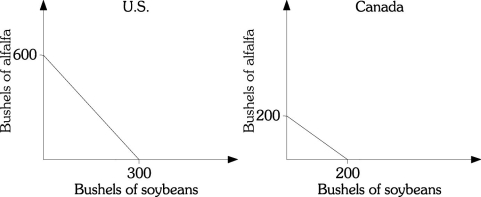 Figure 20.1
-Refer to Figure 20.1. Canada has ________ advantage in the production of soybeans and ________ advantage in the production of alfalfa.
Figure 20.1
-Refer to Figure 20.1. Canada has ________ advantage in the production of soybeans and ________ advantage in the production of alfalfa. (Multiple Choice)
4.9/5 (80)
(80) ________ portion of actual world trade patterns results from different factor endowments between countries.
(Multiple Choice)
4.9/5 (76)
(76) If the exchange rate between the United States and Portugal changes from $1 = 1 euro to $1 = 2 euros, then holding everything else constant, the price of U.S. goods in Portugal will decrease.
(True/False)
4.8/5 (81)
(81) If a nation has ________ status conferred on it, then exports from that country are taxed at the lowest negotiated tariff rates.
(Multiple Choice)
4.8/5 (90)
(90) According to the theory of comparative advantage, a country exports goods when it can produce those goods ________ than other countries.
(Multiple Choice)
4.8/5 (65)
(65) Refer to the information provided in Figure 20.4 below to answer the question(s) that follow. 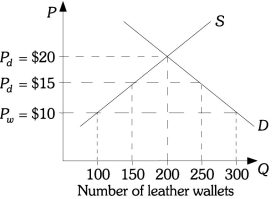 Figure 20.4
-Refer to Figure 20.4. The domestic price of a leather wallet is $20. With free trade the price of a leather wallet is $10 and after a tariff is imposed the price is $15. After the tariff is imposed, ________ revenue in this country will be $500.
Figure 20.4
-Refer to Figure 20.4. The domestic price of a leather wallet is $20. With free trade the price of a leather wallet is $10 and after a tariff is imposed the price is $15. After the tariff is imposed, ________ revenue in this country will be $500. (Multiple Choice)
5.0/5 (92)
(92) ________ allow(s) a country to produce on its production possibility frontier and consume outside it.
(Multiple Choice)
4.8/5 (90)
(90) 
Filters
- Essay(0)
- Multiple Choice(0)
- Short Answer(0)
- True False(0)
- Matching(0)