



 Chat with AI
Exam 6: Household Behavior and Consumer Choice

Exam 1: The Scope and Method of Economics241 Questions
Exam 2: The Economic Problem: Scarcity and Choice218 Questions
Exam 3: Demand, Supply, and Market Equilibrium309 Questions
Exam 4: Demand and Supply Applications173 Questions
Exam 5: Elasticity188 Questions
Exam 6: Household Behavior and Consumer Choice272 Questions
Exam 7: The Production Process: the Behavior of Profit-Maximizing Firms287 Questions
Exam 8: Short-Run Costs and Output Decisions386 Questions
Exam 9: Long-Run Costs and Output Decisions363 Questions
Exam 10: Input Demand: the Labor and Land Markets200 Questions
Exam 11: Input Demand: the Capital Market and the Investment Decision218 Questions
Exam 12: General Equilibrium and the Efficiency of Perfect Competition202 Questions
Exam 13: Monopoly and Antitrust Policy394 Questions
Exam 14: Oligopoly219 Questions
Exam 15: Monopolistic Competition235 Questions
Exam 16: Externalities, Public Goods, and Common Resources275 Questions
Exam 17: Uncertainty and Asymmetric Information134 Questions
Exam 18: Income Distribution and Poverty197 Questions
Exam 19: Public Finance: the Economics of Taxation281 Questions
Exam 20: International Trade, Comparative Advantage, and Protectionism287 Questions
Exam 21: Economic Growth in Developing Economies133 Questions
Exam 22: Critical Thinking About Research104 Questions
Select questions type


If MUx/Px exceeds MUy/Py, then a household can increase its utility by spending more on X and less on Y.
(True/False)
4.9/5  (75)
(75) If the price of a normal good rises, the income effect will result in households buying ________ of the good and the substitution effect will result in households buying ________ of the good.
(Multiple Choice)
4.8/5 (84)
(84) Refer to the information provided in Figure 6.2 below to answer the question(s) that follow. 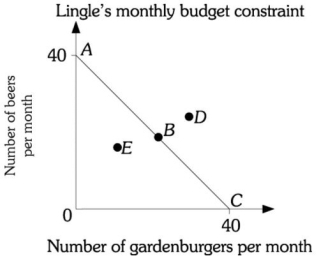 Figure 6.2
-Refer to Figure 6.2. Assume Mr. Lingle is on budget constraint AC. If the price of a beer is $2.50, Mr. Lingle's monthly income is
Figure 6.2
-Refer to Figure 6.2. Assume Mr. Lingle is on budget constraint AC. If the price of a beer is $2.50, Mr. Lingle's monthly income is (Multiple Choice)
4.9/5 (83)
(83) Refer to the information provided in Figure 6.8 below to answer the question(s) that follow. 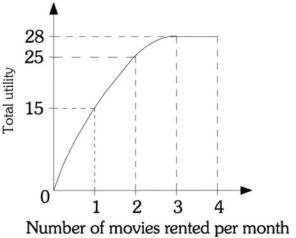 Figure 6.8
-Refer to Figure 6.8. The total utility of the three movies is ________ and the marginal utility of the third movie is ________.
Figure 6.8
-Refer to Figure 6.8. The total utility of the three movies is ________ and the marginal utility of the third movie is ________. (Multiple Choice)
4.9/5 (80)
(80) Refer to the information provided in Figure 6.8 below to answer the question(s) that follow. Figure 6.8
-Refer to Figure 6.8. The marginal utility of the first movie rental is
Figure 6.8
-Refer to Figure 6.8. The marginal utility of the first movie rental is (Multiple Choice)
4.8/5 (82)
(82) Refer to the information provided in Figure 6.14 below to answer the question(s) that follow.  Figure 6.14
-Refer to Figure 6.14. If the price of an ice cream cone is $2, the price of ice cream sandwiches is
Figure 6.14
-Refer to Figure 6.14. If the price of an ice cream cone is $2, the price of ice cream sandwiches is (Multiple Choice)
4.9/5 (84)
(84) Refer to the information provided in Figure 6.1 below to answer the question(s) that follow. 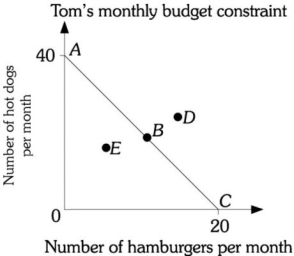 Figure 6.1
-Refer to Figure 6.1. Assume Tom's budget constraint is AC. He will have leftover income if he purchases the bundle represented by point
Figure 6.1
-Refer to Figure 6.1. Assume Tom's budget constraint is AC. He will have leftover income if he purchases the bundle represented by point (Multiple Choice)
4.9/5 (83)
(83) Refer to the information provided in Figure 6.2 below to answer the question(s) that follow. Figure 6.2
-Refer to Figure 6.2. The slope of budget constraint AC is
Figure 6.2
-Refer to Figure 6.2. The slope of budget constraint AC is (Multiple Choice)
4.9/5 (67)
(67) Refer to the information provided in Figure 6.11 below to answer the question that follows.  Figure 6.11
-Refer to Figure 6.11. The opportunity cost for a day's worth of income is ________ of leisure.
Figure 6.11
-Refer to Figure 6.11. The opportunity cost for a day's worth of income is ________ of leisure. (Multiple Choice)
4.9/5 (65)
(65) Refer to the information provided in Figure 6.6 below to answer the question(s) that follow. 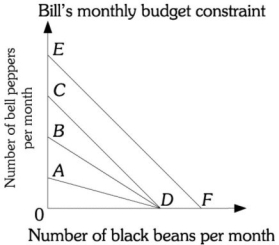 Figure 6.6
-Refer to Figure 6.6. Bill's budget constraint is BD. Bill's income is $800, the price of a bell pepper is $1, and the price of a bag of black beans is $1. At point B Bill is buying ________ bell peppers and ________ bags of black beans.
Figure 6.6
-Refer to Figure 6.6. Bill's budget constraint is BD. Bill's income is $800, the price of a bell pepper is $1, and the price of a bag of black beans is $1. At point B Bill is buying ________ bell peppers and ________ bags of black beans. (Multiple Choice)
4.8/5 (74)
(74) Refer to the information provided in Figure 6.12 below to answer the question that follows.  Figure 6.12
-Refer to Figure 6.12. If Arthur moves from indifference curve 2 to indifference curve 1, then Arthurʹs
Figure 6.12
-Refer to Figure 6.12. If Arthur moves from indifference curve 2 to indifference curve 1, then Arthurʹs (Multiple Choice)
4.7/5 (72)
(72) The law of diminishing marginal utility is in effect when marginal utility is
(Multiple Choice)
5.0/5 (79)
(79) Hector has $1,000 a month to spend on clothing and food. The price of clothing is $50 and the price of food is $20. What is the equation for Hector's budget constraint?
(Multiple Choice)
4.8/5 (79)
(79) Refer to the information provided in Figure 6.14 below to answer the question(s) that follow. Figure 6.14
-Refer to Figure 6.14. At point ________, the slope of the indifference curve is -0.67.
Figure 6.14
-Refer to Figure 6.14. At point ________, the slope of the indifference curve is -0.67. (Multiple Choice)
4.8/5 (80)
(80) Refer to the information provided in Figure 6.4 below to answer the question(s) that follow. 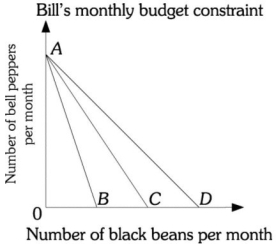 Figure 6.4
-Refer to Figure 6.4. Billʹs budget constraint is AC. His budget constraint would shift to AD if the price of
Figure 6.4
-Refer to Figure 6.4. Billʹs budget constraint is AC. His budget constraint would shift to AD if the price of (Multiple Choice)
4.9/5 (79)
(79) The marginal utility of the first cup of coffee that Tom drinks in the morning is worth $2.00. The marginal utility of the 9th cup of coffee he drinks is positive while the marginal utility of the 10th cup of coffee he drinks in the morning is worth $0. This implies that at a price of $0, Tom would drink
(Multiple Choice)
4.7/5 (79)
(79) Refer to the information provided in Figure 6.9 below to answer the question(s) that follow.  Figure 6.9
-Refer to Figure 6.9. The marginal utility of the first video game rental is
Figure 6.9
-Refer to Figure 6.9. The marginal utility of the first video game rental is (Multiple Choice)
4.8/5 (78)
(78) 
Filters
- Essay(0)
- Multiple Choice(0)
- Short Answer(0)
- True False(0)
- Matching(0)