



 Chat with AI
Exam 6: Household Behavior and Consumer Choice

Exam 1: The Scope and Method of Economics241 Questions
Exam 2: The Economic Problem: Scarcity and Choice218 Questions
Exam 3: Demand, Supply, and Market Equilibrium309 Questions
Exam 4: Demand and Supply Applications173 Questions
Exam 5: Elasticity188 Questions
Exam 6: Household Behavior and Consumer Choice272 Questions
Exam 7: The Production Process: the Behavior of Profit-Maximizing Firms287 Questions
Exam 8: Short-Run Costs and Output Decisions386 Questions
Exam 9: Long-Run Costs and Output Decisions363 Questions
Exam 10: Input Demand: the Labor and Land Markets200 Questions
Exam 11: Input Demand: the Capital Market and the Investment Decision218 Questions
Exam 12: General Equilibrium and the Efficiency of Perfect Competition202 Questions
Exam 13: Monopoly and Antitrust Policy394 Questions
Exam 14: Oligopoly219 Questions
Exam 15: Monopolistic Competition235 Questions
Exam 16: Externalities, Public Goods, and Common Resources275 Questions
Exam 17: Uncertainty and Asymmetric Information134 Questions
Exam 18: Income Distribution and Poverty197 Questions
Exam 19: Public Finance: the Economics of Taxation281 Questions
Exam 20: International Trade, Comparative Advantage, and Protectionism287 Questions
Exam 21: Economic Growth in Developing Economies133 Questions
Exam 22: Critical Thinking About Research104 Questions
Select questions type


Marginal utility is the ________ satisfaction gained by consuming ________ of a good.
(Multiple Choice)
4.8/5  (72)
(72) Refer to the information provided in Table 6.3 below to answer the question(s) that follow.
Table 6.3
Dozens of Oysters per Day Total Utility Marginal Utility 1 60 2 104 3 134 4 152 8 5 Number of Beersper Day Total Utility Marginal Utility 1 40 2 70 3 94 4 114 5 14
-Refer to Table 6.3. Assume that a store is giving oysters and beers away for free. Consumers can have as many beers and oysters (by the dozen) as they want, but the food has to be consumed one unit at a time. If Tyler has already had one beer and two dozen oysters, then Tyler should
(Multiple Choice)
5.0/5 (87)
(87) Refer to the information provided in Table 6.3 below to answer the question(s) that follow.
Table 6.3
Dozens of Oysters per Day Total Utility Marginal Utility 1 60 2 104 3 134 4 152 8 5 Number of Beersper Day Total Utility Marginal Utility 1 40 2 70 3 94 4 114 5 14
-Refer to Table 6.3. If the price of a beer is $4, the price of a dozen oysters is $12, and Tyler has $28 of income, Tyler's utility-maximizing combination of beers and oysters per day is
(Multiple Choice)
4.9/5 (77)
(77) Refer to the information provided in Figure 6.9 below to answer the question(s) that follow.  Figure 6.9
-Refer to Figure 6.9. The ________ video game rental has a marginal utility of zero.
Figure 6.9
-Refer to Figure 6.9. The ________ video game rental has a marginal utility of zero. (Multiple Choice)
4.8/5 (75)
(75) Refer to the information provided in Figure 6.1 below to answer the question(s) that follow. 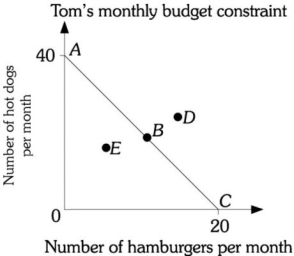 Figure 6.1
-Refer to Figure 6.1. Assume Tom's budget constraint is AC. At which point does Tom consume only hot dogs?
Figure 6.1
-Refer to Figure 6.1. Assume Tom's budget constraint is AC. At which point does Tom consume only hot dogs? (Multiple Choice)
4.9/5 (66)
(66) Refer to the information provided in Figure 6.10 below to answer the question(s) that follow. 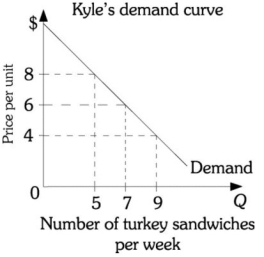 Figure 6.10
-Refer to Figure 6.10. The current price of a turkey sandwich is $8. If Kyle is currently buying seven turkey sandwiches a week, he ________ maximizing utility because the marginal utility ________ than its price.
Figure 6.10
-Refer to Figure 6.10. The current price of a turkey sandwich is $8. If Kyle is currently buying seven turkey sandwiches a week, he ________ maximizing utility because the marginal utility ________ than its price. (Multiple Choice)
4.8/5 (79)
(79) Refer to the information provided in Figure 6.14 below to answer the question(s) that follow.  Figure 6.14
-Refer to Figure 6.14. If the price of an ice cream cone is $3, Jasonʹs income is
Figure 6.14
-Refer to Figure 6.14. If the price of an ice cream cone is $3, Jasonʹs income is (Multiple Choice)
4.9/5 (76)
(76) An assumption underlying indifference curve analysis is that MUx/MUy ________ as less of X and more of Y is consumed.
(Multiple Choice)
4.8/5 (83)
(83) Refer to the information provided in Figure 6.6 below to answer the question(s) that follow. 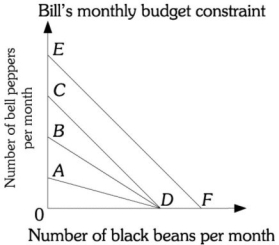 Figure 6.6
-Refer to Figure 6.6. Bill's budget constraint is BD. If the price of bell peppers increases, Bill's new budget constraint is
Figure 6.6
-Refer to Figure 6.6. Bill's budget constraint is BD. If the price of bell peppers increases, Bill's new budget constraint is (Multiple Choice)
4.8/5 (90)
(90) Refer to the information provided in Figure 6.4 below to answer the question(s) that follow. 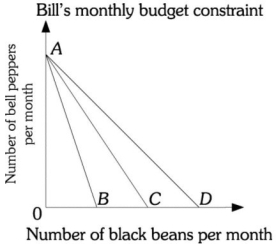 Figure 6.4
-Refer to Figure 6.4. Billʹs budget constraint is AC. If the bell peppers price decreases, Billʹs budget constraint will
Figure 6.4
-Refer to Figure 6.4. Billʹs budget constraint is AC. If the bell peppers price decreases, Billʹs budget constraint will (Multiple Choice)
4.8/5 (80)
(80) Jim has $600 a week to spend on clothing and food. The price of clothing is $30 and the price of food is $5. The clothing and food pairs in Jim's choice set include ________ units of clothing and ________ units of food.
(Multiple Choice)
4.8/5 (78)
(78) Ted has $600 a week to spend on clothing and food. The price of clothing is $30 and the price of food is $5. What is the equation for Ted's budget constraint, assuming he spends his entire budget?
(Multiple Choice)
4.9/5 (81)
(81) A rise in the price of Pepsi that causes a household to shift its purchasing pattern toward Coke and away from Pepsi is the ________ effect of a price change.
(Multiple Choice)
4.8/5 (76)
(76) Tyrell is consuming X and Y so that he is spending his entire income and MUx/Px = 7 and MUy/Py = 7. To maximize utility, he should consume
(Multiple Choice)
5.0/5 (81)
(81) Sonia has $2,400 a month to spend on clothing and food. The price of clothing is $60 and the price of food is $10. The clothing and food pairs in Sonia's choice set include ________ units of clothing and ________ units of food.
(Multiple Choice)
5.0/5 (72)
(72) In the labor market, the income and substitution effects work in the same direction.
(True/False)
4.8/5 (72)
(72) A utility-maximizing consumer buys so as to make ________ for all pairs of goods.
(Multiple Choice)
4.7/5 (77)
(77) Refer to the information provided in Figure 6.5 below to answer the question(s) that follow. 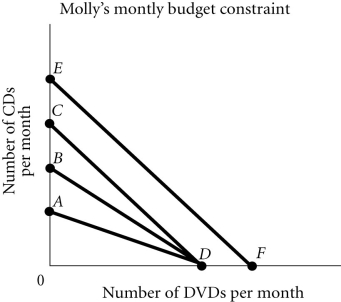 Figure 6.5
-Refer to Figure 6.5. Molly's budget constraint is AD. If the price of CDs decreases, her new budget constraint becomes
Figure 6.5
-Refer to Figure 6.5. Molly's budget constraint is AD. If the price of CDs decreases, her new budget constraint becomes (Multiple Choice)
4.8/5 (93)
(93) 
Filters
- Essay(0)
- Multiple Choice(0)
- Short Answer(0)
- True False(0)
- Matching(0)