



 Chat with AI
Exam 6: Household Behavior and Consumer Choice

Exam 1: The Scope and Method of Economics241 Questions
Exam 2: The Economic Problem: Scarcity and Choice218 Questions
Exam 3: Demand, Supply, and Market Equilibrium309 Questions
Exam 4: Demand and Supply Applications173 Questions
Exam 5: Elasticity188 Questions
Exam 6: Household Behavior and Consumer Choice272 Questions
Exam 7: The Production Process: the Behavior of Profit-Maximizing Firms287 Questions
Exam 8: Short-Run Costs and Output Decisions386 Questions
Exam 9: Long-Run Costs and Output Decisions363 Questions
Exam 10: Input Demand: the Labor and Land Markets200 Questions
Exam 11: Input Demand: the Capital Market and the Investment Decision218 Questions
Exam 12: General Equilibrium and the Efficiency of Perfect Competition202 Questions
Exam 13: Monopoly and Antitrust Policy394 Questions
Exam 14: Oligopoly219 Questions
Exam 15: Monopolistic Competition235 Questions
Exam 16: Externalities, Public Goods, and Common Resources275 Questions
Exam 17: Uncertainty and Asymmetric Information134 Questions
Exam 18: Income Distribution and Poverty197 Questions
Exam 19: Public Finance: the Economics of Taxation281 Questions
Exam 20: International Trade, Comparative Advantage, and Protectionism287 Questions
Exam 21: Economic Growth in Developing Economies133 Questions
Exam 22: Critical Thinking About Research104 Questions
Select questions type


The law of diminishing marginal utility implies that marginal utility never becomes negative.
(True/False)
4.8/5  (79)
(79) As you move down an indifference curve, the absolute value of the slope
(Multiple Choice)
4.8/5 (83)
(83) Refer to the information provided in Table 6.4 below to answer the question(s) that follow.
Table 6.4
Number of Donuts per Day Total Utility Marginal Utility 1 80 2 150 3 200 4 230 5 10 Number of Burritos per Day Total Utility Marginal Utility 1 60 2 108 3 144 4 168 5 12
-Refer to Table 6.4. If the price of a donut is $2, the price of a burrito is $4, and Luigi has $12 of income, Luigi's utility-maximizing combination of donuts and burritos per day is
(Multiple Choice)
4.8/5 (84)
(84) A car's real cost is its opportunity cost. Opportunity cost is determined by
(Multiple Choice)
4.9/5 (87)
(87) Refer to the information provided in Figure 6.5 below to answer the question(s) that follow. 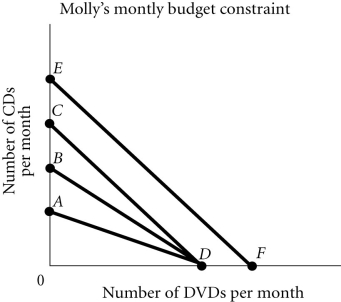 Figure 6.5
-Refer to Figure 6.5. Molly's budget constraint is CD. Molly's income is $75, the price of a DVD is $3 and the price of a CD is $5. At point D, she is buying ________ DVDs and ________ CDs.
Figure 6.5
-Refer to Figure 6.5. Molly's budget constraint is CD. Molly's income is $75, the price of a DVD is $3 and the price of a CD is $5. At point D, she is buying ________ DVDs and ________ CDs. (Multiple Choice)
4.8/5 (79)
(79) Refer to the information provided in Figure 6.2 below to answer the question(s) that follow. 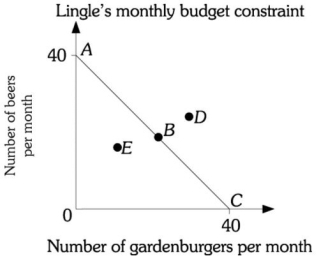 Figure 6.2
-Refer to Figure 6.2. Assume Mr. Lingle's budget constraint is AC. If the price of a gardenburger is $7.50, the price of a beer is
Figure 6.2
-Refer to Figure 6.2. Assume Mr. Lingle's budget constraint is AC. If the price of a gardenburger is $7.50, the price of a beer is (Multiple Choice)
4.9/5 (89)
(89) Refer to the information provided in Figure 6.4 below to answer the question(s) that follow. 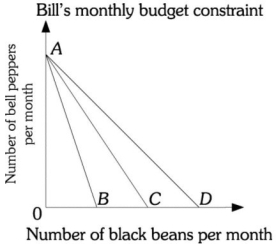 Figure 6.4
-Refer to Figure 6.4. Billʹs budget constraint is AC. If the black bean price increases, Billʹs budget constraint will
Figure 6.4
-Refer to Figure 6.4. Billʹs budget constraint is AC. If the black bean price increases, Billʹs budget constraint will (Multiple Choice)
4.7/5 (76)
(76) Refer to the information provided in Figure 6.2 below to answer the question(s) that follow. Figure 6.2
-Refer to Figure 6.2. Mr. Lingleʹs budget constraint is AC. Point D is
Figure 6.2
-Refer to Figure 6.2. Mr. Lingleʹs budget constraint is AC. Point D is (Multiple Choice)
4.7/5 (79)
(79) Refer to the information provided in Figure 6.4 below to answer the question(s) that follow. Figure 6.4
-Refer to Figure 6.4. Bill's budget constraint is AC. If the bell peppers price increases, Bill's budget constraint will
Figure 6.4
-Refer to Figure 6.4. Bill's budget constraint is AC. If the bell peppers price increases, Bill's budget constraint will (Multiple Choice)
4.8/5 (103)
(103) Assuming that leisure is a normal good, if an individual's labor supply curve is upward sloping, then the
(Multiple Choice)
4.9/5 (78)
(78) Sanjay is consuming X and Y so that he is spending his entire income and MUx/Px = 8 and MUy/Py = 14. To maximize utility, he should consume
(Multiple Choice)
4.9/5 (72)
(72) Ellie is spending her entire income on goods X and Y. Her marginal utility from the last unit of X is 100 and the marginal utility from the last unit of Y that she consumes is 50. Ellie's utility is only maximized if
(Multiple Choice)
4.7/5 (75)
(75) Carlos can buy either sushi or eggrolls. If the prices of sushi and eggrolls triple and so does Carlos's money income, we can deduce that Carlos's budget constraint will
(Multiple Choice)
4.8/5 (71)
(71) Refer to the information provided in Figure 6.2 below to answer the question(s) that follow. Figure 6.2
-Refer to Figure 6.2. Assume Mr. Lingle's budget is AC. At which point does Mr. Lingle spend exactly his income?
Figure 6.2
-Refer to Figure 6.2. Assume Mr. Lingle's budget is AC. At which point does Mr. Lingle spend exactly his income? (Multiple Choice)
4.8/5 (74)
(74) If a household's income is cut in half, its budget constraint will
(Multiple Choice)
4.8/5 (67)
(67) Refer to the information provided in Figure 6.15 below to answer the question that follows. 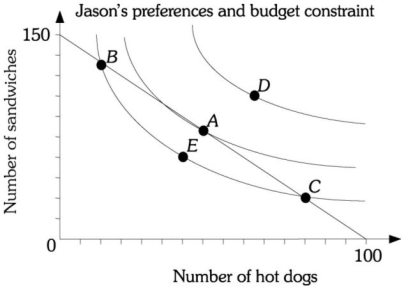 Figure 6.15
-Refer to Figure 6.15. If the price of a hot dog is $4, Jason's income is
Figure 6.15
-Refer to Figure 6.15. If the price of a hot dog is $4, Jason's income is (Multiple Choice)
4.8/5 (81)
(81) For normal goods, the income and substitution effects work in the same direction.
(True/False)
4.8/5 (83)
(83) 
Filters
- Essay(0)
- Multiple Choice(0)
- Short Answer(0)
- True False(0)
- Matching(0)