



 Chat with AI
Exam 6: Household Behavior and Consumer Choice

Exam 1: The Scope and Method of Economics241 Questions
Exam 2: The Economic Problem: Scarcity and Choice218 Questions
Exam 3: Demand, Supply, and Market Equilibrium309 Questions
Exam 4: Demand and Supply Applications173 Questions
Exam 5: Elasticity188 Questions
Exam 6: Household Behavior and Consumer Choice272 Questions
Exam 7: The Production Process: the Behavior of Profit-Maximizing Firms287 Questions
Exam 8: Short-Run Costs and Output Decisions386 Questions
Exam 9: Long-Run Costs and Output Decisions363 Questions
Exam 10: Input Demand: the Labor and Land Markets200 Questions
Exam 11: Input Demand: the Capital Market and the Investment Decision218 Questions
Exam 12: General Equilibrium and the Efficiency of Perfect Competition202 Questions
Exam 13: Monopoly and Antitrust Policy394 Questions
Exam 14: Oligopoly219 Questions
Exam 15: Monopolistic Competition235 Questions
Exam 16: Externalities, Public Goods, and Common Resources275 Questions
Exam 17: Uncertainty and Asymmetric Information134 Questions
Exam 18: Income Distribution and Poverty197 Questions
Exam 19: Public Finance: the Economics of Taxation281 Questions
Exam 20: International Trade, Comparative Advantage, and Protectionism287 Questions
Exam 21: Economic Growth in Developing Economies133 Questions
Exam 22: Critical Thinking About Research104 Questions
Select questions type


Refer to the information provided in Figure 6.5 below to answer the question(s) that follow. 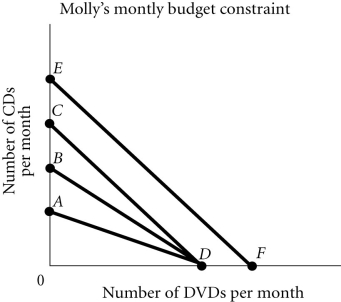 Figure 6.5
-Refer to Figure 6.5. Molly's budget constraint is BD. If the price of CDs decreases, her new budget constraint becomes
Figure 6.5
-Refer to Figure 6.5. Molly's budget constraint is BD. If the price of CDs decreases, her new budget constraint becomes (Multiple Choice)
4.8/5  (83)
(83) If the price of an inferior good falls, the income effect will result in households buying ________ of the good and the substitution effect will result in households buying ________ of the good.
(Multiple Choice)
4.8/5 (66)
(66) Refer to the information provided in Table 6.4 below to answer the question(s) that follow.
Table 6.4
Number of Donuts per Day Total Utility Marginal Utility 1 80 2 150 3 200 4 230 5 10 Number of Burritos per Day Total Utility Marginal Utility 1 60 2 108 3 144 4 168 5 12
-Refer to Table 6.4. The marginal utility of the second donut per day is
(Multiple Choice)
4.9/5 (86)
(86) Refer to the information provided in Figure 6.10 below to answer the question(s) that follow. 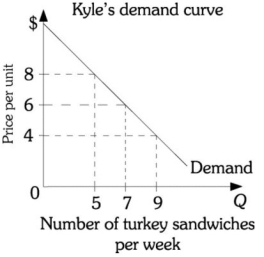 Figure 6.10
-Refer to Figure 6.10. The current price of a turkey sandwich is $4. If Kyle is currently buying seven turkey sandwiches a week, he ________ maximizing utility because the marginal utility ________ than its price.
Figure 6.10
-Refer to Figure 6.10. The current price of a turkey sandwich is $4. If Kyle is currently buying seven turkey sandwiches a week, he ________ maximizing utility because the marginal utility ________ than its price. (Multiple Choice)
4.9/5 (73)
(73) Refer to the information provided in Figure 6.5 below to answer the question(s) that follow. Figure 6.5
-Refer to Figure 6.5. Molly's budget constraint is CD. If her income increases, her new budget constraint is
Figure 6.5
-Refer to Figure 6.5. Molly's budget constraint is CD. If her income increases, her new budget constraint is (Multiple Choice)
4.8/5 (82)
(82) Toby tells you that he prefers hamburgers to hot dogs, hot dogs to tacos, and hamburgers to tacos. This violates what assumption made when analyzing consumer preferences?
(Multiple Choice)
4.9/5 (89)
(89) Refer to the information provided in Figure 6.1 below to answer the question(s) that follow. 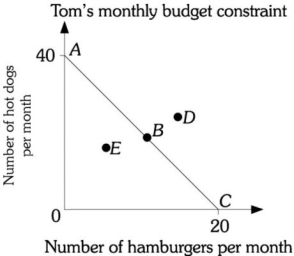 Figure 6.1
-Refer to Figure 6.1. Assume Tom's budget constraint is AC. If the price of a hamburger is $10, the price of a hot dog is
Figure 6.1
-Refer to Figure 6.1. Assume Tom's budget constraint is AC. If the price of a hamburger is $10, the price of a hot dog is (Multiple Choice)
4.9/5 (74)
(74) Jane has $500 a week to spend on clothing and food. The price of clothing is $25 and the price of food is $10. Jane spends her entire income when she purchases ________ units of clothing and ________ units of food.
(Multiple Choice)
4.9/5 (67)
(67) Refer to the information provided in Figure 6.1 below to answer the question(s) that follow. Figure 6.1
-Refer to Figure 6.1. The slope of budget constraint AC is
Figure 6.1
-Refer to Figure 6.1. The slope of budget constraint AC is (Multiple Choice)
4.9/5 (65)
(65) Related to the Economics in Practice on page 129: Harry's Foods claims that you will pay less for groceries by shopping at their stores. As evidence, Harry's Foods points out that the total price of the bundle of goods that a particular shopper purchased at Harry's Foods was lower than the total price of the same bundle of goods purchased at other stores. Which of the following points out a flaw in the grocery store's argument?
(Multiple Choice)
4.9/5 (68)
(68) Refer to the information provided in Figure 6.5 below to answer the question(s) that follow. Figure 6.5
-Refer to Figure 6.5. Molly's budget constraint is EF. If her income decreases and the price of CDs increases, her new budget constraint could be
Figure 6.5
-Refer to Figure 6.5. Molly's budget constraint is EF. If her income decreases and the price of CDs increases, her new budget constraint could be (Multiple Choice)
4.9/5 (69)
(69) Refer to the information provided in Figure 6.1 below to answer the question(s) that follow. Figure 6.1
-Refer to Figure 6.1. AC represents Tom's budget constraint. Point D then represents a point that is
Figure 6.1
-Refer to Figure 6.1. AC represents Tom's budget constraint. Point D then represents a point that is (Multiple Choice)
4.9/5 (83)
(83) Refer to the information provided in Figure 6.13 below to answer the question(s) that follow. 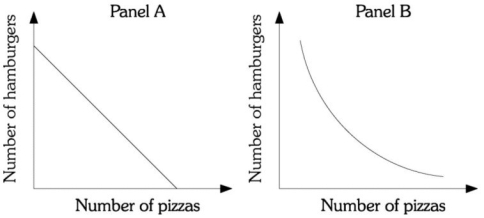
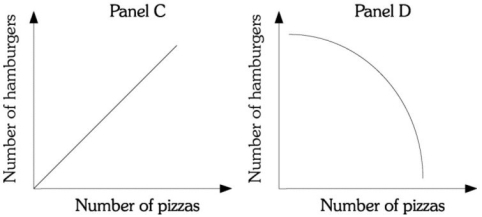 Figure 6.13
-Refer to Figure 6.13. Assume Ellen has two products available, pizza and hamburgers. Ellen must be compensated with more pizzas as she gives up more hamburgers. The curve in Panel ________ represents her indifference curve.
Figure 6.13
-Refer to Figure 6.13. Assume Ellen has two products available, pizza and hamburgers. Ellen must be compensated with more pizzas as she gives up more hamburgers. The curve in Panel ________ represents her indifference curve. (Multiple Choice)
4.7/5 (82)
(82) Refer to the information provided in Figure 6.2 below to answer the question(s) that follow. 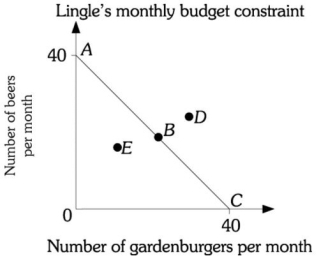 Figure 6.2
-Refer to Figure 6.2. Assume Mr. Lingle's budget constraint is AC. If the price of a beer is $3, the price of a gardenburger is
Figure 6.2
-Refer to Figure 6.2. Assume Mr. Lingle's budget constraint is AC. If the price of a beer is $3, the price of a gardenburger is (Multiple Choice)
4.9/5 (87)
(87) Refer to the information provided in Figure 6.2 below to answer the question(s) that follow. Figure 6.2
-Refer to Figure 6.2. Mr. Lingle's budget constraint is AC. His choice set is all points
Figure 6.2
-Refer to Figure 6.2. Mr. Lingle's budget constraint is AC. His choice set is all points (Multiple Choice)
4.9/5 (89)
(89) Refer to the information provided in Figure 6.1 below to answer the question(s) that follow. Figure 6.1
-Refer to Figure 6.1. Assume Tom's budget constraint is AC. If the price of a hot dog is $3, the price of a hamburger is
Figure 6.1
-Refer to Figure 6.1. Assume Tom's budget constraint is AC. If the price of a hot dog is $3, the price of a hamburger is (Multiple Choice)
4.9/5 (80)
(80) For normal goods, the income and substitution effects help explain the downward slope of the demand curve.
(True/False)
4.8/5 (85)
(85) Refer to the information provided in Figure 6.1 below to answer the question(s) that follow. Figure 6.1
-Refer to Figure 6.1. Assume Tom is on budget constraint AC and the price of a hot dog is $2.00. Tom's monthly income is
Figure 6.1
-Refer to Figure 6.1. Assume Tom is on budget constraint AC and the price of a hot dog is $2.00. Tom's monthly income is (Multiple Choice)
4.8/5 (85)
(85) The ratio of the marginal utility of coffee to the marginal utility of donuts is four for an individual maximizing utility. This implies that
(Multiple Choice)
4.8/5 (94)
(94) 
Filters
- Essay(0)
- Multiple Choice(0)
- Short Answer(0)
- True False(0)
- Matching(0)