



 Chat with AI
Exam 6: Household Behavior and Consumer Choice

Exam 1: The Scope and Method of Economics241 Questions
Exam 2: The Economic Problem: Scarcity and Choice218 Questions
Exam 3: Demand, Supply, and Market Equilibrium309 Questions
Exam 4: Demand and Supply Applications173 Questions
Exam 5: Elasticity188 Questions
Exam 6: Household Behavior and Consumer Choice272 Questions
Exam 7: The Production Process: the Behavior of Profit-Maximizing Firms287 Questions
Exam 8: Short-Run Costs and Output Decisions386 Questions
Exam 9: Long-Run Costs and Output Decisions363 Questions
Exam 10: Input Demand: the Labor and Land Markets200 Questions
Exam 11: Input Demand: the Capital Market and the Investment Decision218 Questions
Exam 12: General Equilibrium and the Efficiency of Perfect Competition202 Questions
Exam 13: Monopoly and Antitrust Policy394 Questions
Exam 14: Oligopoly219 Questions
Exam 15: Monopolistic Competition235 Questions
Exam 16: Externalities, Public Goods, and Common Resources275 Questions
Exam 17: Uncertainty and Asymmetric Information134 Questions
Exam 18: Income Distribution and Poverty197 Questions
Exam 19: Public Finance: the Economics of Taxation281 Questions
Exam 20: International Trade, Comparative Advantage, and Protectionism287 Questions
Exam 21: Economic Growth in Developing Economies133 Questions
Exam 22: Critical Thinking About Research104 Questions
Select questions type


Darius has $1,200 a month to spend on clothing and food. The price of clothing is $60 and the price of food is $10. What is the equation for Darius's budget constraint, assuming he spends his entire budget?
(Multiple Choice)
4.7/5  (90)
(90) Refer to the information provided in Figure 6.13 below to answer the question(s) that follow. 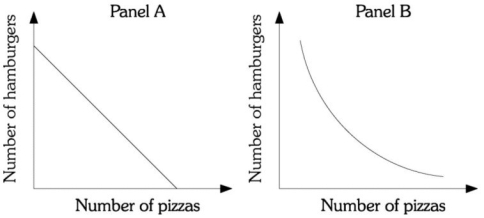
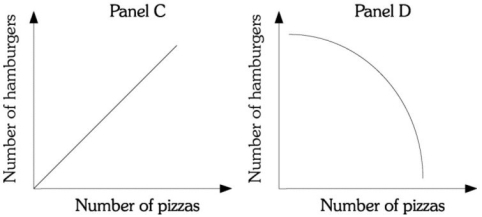 Figure 6.13
-Refer to Figure 6.13. Assume Megan has two products available, pizza and hamburgers. Megan is always willing to trade an equal number of pizzas for hamburgers regardless of how many pizzas and hamburgers she has. The curve in Panel ________ represents her indifference curve.
Figure 6.13
-Refer to Figure 6.13. Assume Megan has two products available, pizza and hamburgers. Megan is always willing to trade an equal number of pizzas for hamburgers regardless of how many pizzas and hamburgers she has. The curve in Panel ________ represents her indifference curve. (Multiple Choice)
4.9/5 (80)
(80) Refer to the information provided in Table 6.4 below to answer the question(s) that follow.
Table 6.4
Number of Donuts per Day Total Utility Marginal Utility 1 80 2 150 3 200 4 230 5 10 Number of Burritos per Day Total Utility Marginal Utility 1 60 2 108 3 144 4 168 5 12
-Refer to Table 6.4. Diminishing marginal utility sets in after the ________ donut per day.
(Multiple Choice)
4.8/5 (71)
(71) Related to the Economics in Practice on p. 129: Suppose Store ABC runs an ad claiming to have "low prices everyday." They even demonstrate that the total expenditure for a basket of groceries is less at their store than at any of their competitors. Which of the following statements is not true?
(Multiple Choice)
4.9/5 (73)
(73) Refer to the information provided in Figure 6.2 below to answer the question(s) that follow. 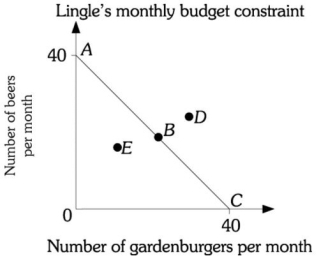 Figure 6.2
-Refer to Figure 6.2. Assume Mr. Lingle is on budget constraint AC. If the price of a gardenburger is $9, Mr. Lingle's monthly income is
Figure 6.2
-Refer to Figure 6.2. Assume Mr. Lingle is on budget constraint AC. If the price of a gardenburger is $9, Mr. Lingle's monthly income is (Multiple Choice)
4.7/5 (85)
(85) Assuming a perfectly competitive market implies that households do not need knowledge of qualities and prices of everything available in the market.
(True/False)
4.9/5 (86)
(86) Assume Sally is initially in equilibrium and that X and Y are normal goods for her. Then the price of X rises. For Sally to move to a new equilibrium point, her consumption of
(Multiple Choice)
4.9/5 (89)
(89) Refer to the information provided in Figure 6.14 below to answer the question(s) that follow.  Figure 6.14
-Refer to Figure 6.14. If the price of an ice cream cone is $2, Jason's income is
Figure 6.14
-Refer to Figure 6.14. If the price of an ice cream cone is $2, Jason's income is (Multiple Choice)
4.7/5 (78)
(78) Refer to the information provided in Figure 6.2 below to answer the question(s) that follow. Figure 6.2
-Refer to Figure 6.2. Assume Mr. Lingle is on budget constraint AC. If the price of a beer is $4, Mr. Lingleʹs monthly income is
Figure 6.2
-Refer to Figure 6.2. Assume Mr. Lingle is on budget constraint AC. If the price of a beer is $4, Mr. Lingleʹs monthly income is (Multiple Choice)
4.8/5 (74)
(74) Refer to the information provided in Table 6.3 below to answer the question(s) that follow.
Table 6.3
Dozens of Oysters per Day Total Utility Marginal Utility 1 60 2 104 3 134 4 152 8 5 Number of Beersper Day Total Utility Marginal Utility 1 40 2 70 3 94 4 114 5 14
-Refer to Table 6.3. The marginal utility of the third dozen oysters per day is
(Multiple Choice)
5.0/5 (78)
(78) The marginal utility of the first smoothie that Jimmy drinks in the morning is worth $3.00. The marginal utility of the 4th smoothie he drinks is positive while the marginal utility of the 5th smoothie he drinks in the morning is worth $0. This implies that at a price of $0, Jimmy would drink
(Multiple Choice)
4.8/5 (74)
(74) 
Filters
- Essay(0)
- Multiple Choice(0)
- Short Answer(0)
- True False(0)
- Matching(0)