



 Chat with AI
Exam 6: Household Behavior and Consumer Choice

Exam 1: The Scope and Method of Economics241 Questions
Exam 2: The Economic Problem: Scarcity and Choice218 Questions
Exam 3: Demand, Supply, and Market Equilibrium309 Questions
Exam 4: Demand and Supply Applications173 Questions
Exam 5: Elasticity188 Questions
Exam 6: Household Behavior and Consumer Choice272 Questions
Exam 7: The Production Process: the Behavior of Profit-Maximizing Firms287 Questions
Exam 8: Short-Run Costs and Output Decisions386 Questions
Exam 9: Long-Run Costs and Output Decisions363 Questions
Exam 10: Input Demand: the Labor and Land Markets200 Questions
Exam 11: Input Demand: the Capital Market and the Investment Decision218 Questions
Exam 12: General Equilibrium and the Efficiency of Perfect Competition202 Questions
Exam 13: Monopoly and Antitrust Policy394 Questions
Exam 14: Oligopoly219 Questions
Exam 15: Monopolistic Competition235 Questions
Exam 16: Externalities, Public Goods, and Common Resources275 Questions
Exam 17: Uncertainty and Asymmetric Information134 Questions
Exam 18: Income Distribution and Poverty197 Questions
Exam 19: Public Finance: the Economics of Taxation281 Questions
Exam 20: International Trade, Comparative Advantage, and Protectionism287 Questions
Exam 21: Economic Growth in Developing Economies133 Questions
Exam 22: Critical Thinking About Research104 Questions
Select questions type


Refer to the information provided in Figure 6.5 below to answer the question(s) that follow. 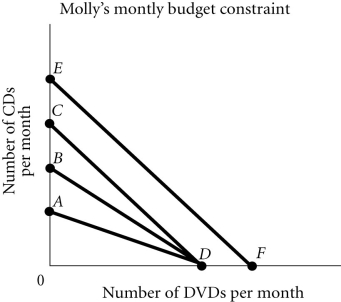 Figure 6.5
-Refer to Figure 6.5. Molly's budget constraint is BD. Molly's income is $375, the price of a DVD is $15 and the price of a CD is $25. At point D she is buying ________ DVDs and ________ CDs.
Figure 6.5
-Refer to Figure 6.5. Molly's budget constraint is BD. Molly's income is $375, the price of a DVD is $15 and the price of a CD is $25. At point D she is buying ________ DVDs and ________ CDs. (Multiple Choice)
4.8/5  (69)
(69) Refer to the information provided in Figure 6.6 below to answer the question(s) that follow. 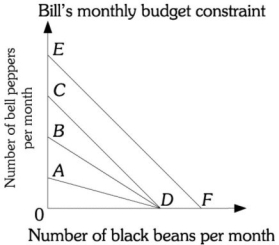 Figure 6.6
-Refer to Figure 6.6. Bill's budget constraint was originally EF. If his new budget constraint is AD, then his income
Figure 6.6
-Refer to Figure 6.6. Bill's budget constraint was originally EF. If his new budget constraint is AD, then his income (Multiple Choice)
4.8/5 (78)
(78) Related to the Economics in Practice on page 125: A reduction in the salience of prices should ________ consumer responses to price increases.
(Multiple Choice)
4.9/5 (77)
(77) The diamond/water paradox helps to illustrate the concept of marginal value.
(True/False)
4.9/5 (84)
(84) Refer to the information provided in Figure 6.3 below to answer the question(s) that follow. 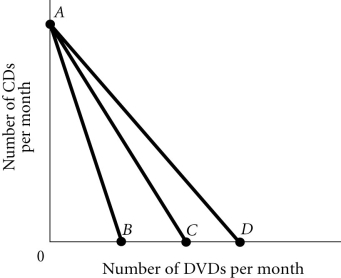 Figure 6.3
-Refer to Figure 6.3. Molly's budget constraint is AC. It would swivel to AB if the price of
Figure 6.3
-Refer to Figure 6.3. Molly's budget constraint is AC. It would swivel to AB if the price of (Multiple Choice)
4.8/5 (79)
(79) If a household's income doubles, its budget constraint will
(Multiple Choice)
5.0/5 (76)
(76) Refer to the information provided in Figure 6.15 below to answer the question that follows. 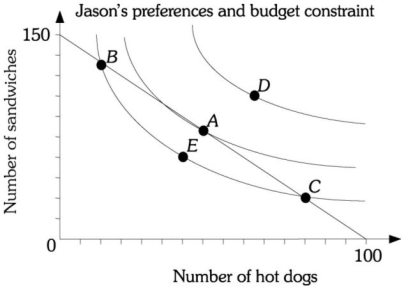 Figure 6.15
-Refer to Figure 6.15. Why is Jason not maximizing his utility at point C?
Figure 6.15
-Refer to Figure 6.15. Why is Jason not maximizing his utility at point C? (Multiple Choice)
5.0/5 (85)
(85) Refer to the information provided in Figure 6.6 below to answer the question(s) that follow. Figure 6.6
-Refer to Figure 6.6. Bill's budget constraint was originally CD. If his new budget constraint is EF, then his income
Figure 6.6
-Refer to Figure 6.6. Bill's budget constraint was originally CD. If his new budget constraint is EF, then his income (Multiple Choice)
4.9/5 (78)
(78) Refer to the information provided in Figure 6.2 below to answer the question(s) that follow. 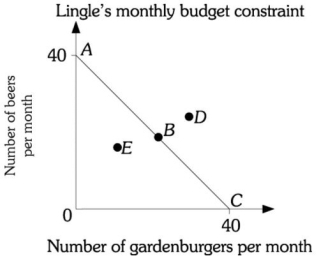 Figure 6.2
-Refer to Figure 6.2. Along budget constraint AC, the opportunity cost of one beer is
Figure 6.2
-Refer to Figure 6.2. Along budget constraint AC, the opportunity cost of one beer is (Multiple Choice)
4.9/5 (76)
(76) Refer to the information provided in Figure 6.2 below to answer the question(s) that follow. Figure 6.2
-Refer to Figure 6.2. Mr. Lingle's budget constraint is AC. Point C is
Figure 6.2
-Refer to Figure 6.2. Mr. Lingle's budget constraint is AC. Point C is (Multiple Choice)
4.9/5 (94)
(94) Refer to the information provided in Figure 6.6 below to answer the question(s) that follow. Figure 6.6
-Refer to Figure 6.6. Bill's budget constraint was originally AD. If his new budget constraint is EF, then his income
Figure 6.6
-Refer to Figure 6.6. Bill's budget constraint was originally AD. If his new budget constraint is EF, then his income (Multiple Choice)
4.9/5 (96)
(96) When the price of a good decreases, the budget constraint does not change.
(True/False)
4.8/5 (66)
(66) Refer to the information provided in Figure 6.2 below to answer the question(s) that follow. Figure 6.2
-Refer to Figure 6.2. Mr. Lingle's budget constraint is AC. Point E is
Figure 6.2
-Refer to Figure 6.2. Mr. Lingle's budget constraint is AC. Point E is (Multiple Choice)
4.8/5 (82)
(82) Refer to the information provided in Figure 6.15 below to answer the question that follows. Figure 6.15
-Refer to Figure 6.15. The highest indifference curve depicted is the one on which point D lies. Why is Jason not maximizing his utility at point D?
Figure 6.15
-Refer to Figure 6.15. The highest indifference curve depicted is the one on which point D lies. Why is Jason not maximizing his utility at point D? (Multiple Choice)
4.8/5 (85)
(85) Ricardo eats 20 pieces of sushi on a Friday night. When he eats the 21st piece, he starts to feel nauseous and realizes he probably should not have eaten the last piece. This suggests that for Ricardo the
(Multiple Choice)
4.8/5 (96)
(96) Hector has $2,000 a month to spend on clothing and food. The price of clothing is $50 and the price of food is $20. Hector spends his entire income when he purchases ________ units of clothing and ________ units of food.
(Multiple Choice)
4.8/5 (61)
(61) Kathy eats five slices of pizza on a Saturday night but admits each slice of pizza doesn't taste as good as the previous one. This suggests that for Kathy the
(Multiple Choice)
4.9/5 (82)
(82) Geneva is spending her entire income on goods X and Y. Her marginal utility from the last units of X and Y that she consumes is 36. Geneva's utility is only maximized if
(Multiple Choice)
4.7/5 (71)
(71) Assume leisure is an inferior good instead of a normal good. The income effect of a wage decrease will lead to a ________ demand for leisure and a ________ labor supply.
(Multiple Choice)
4.7/5 (72)
(72) 
Filters
- Essay(0)
- Multiple Choice(0)
- Short Answer(0)
- True False(0)
- Matching(0)