



 Chat with AI
Exam 16: Renewable Energy Alternatives

Exam 1: Science and Sustainability: an Introduction to Environmental Science61 Questions
Exam 2: Environmental Systems: Matter, Energy, and Ecosystems58 Questions
Exam 3: Evolution, Biodiversity, and Population Ecology52 Questions
Exam 4: Species Interactions and Community Ecology55 Questions
Exam 5: Economics, Policy, and Sustainable Development54 Questions
Exam 6: Human Population62 Questions
Exam 7: Soil, Agriculture, and the Future of Food64 Questions
Exam 8: Biodiversity and Conservation Biology49 Questions
Exam 9: Forests, Forest Management, and Protected Areas51 Questions
Exam 10: Environmental Health and Toxicology62 Questions
Exam 11: Geology, Minerals, and Mining52 Questions
Exam 12: Fresh Water, Oceans, and Coasts70 Questions
Exam 13: Atmospheric Science, Air Quality, and Pollution Control53 Questions
Exam 14: Global Climate Change53 Questions
Exam 15: Nonrenewable Energy Sources, Their Impacts, and Energy Conservation64 Questions
Exam 16: Renewable Energy Alternatives61 Questions
Exam 17: Managing Our Waste56 Questions
Exam 18: The Urban Environment: Creating Sustainable Cities60 Questions
Exam 19: Epilogue45 Questions
Select questions type


The run-of-river approach to hydropower describes ____________
(Multiple Choice)
4.9/5  (66)
(66) Pyrolysis is a way of producing ____________ from ____________.
(Multiple Choice)
4.8/5 (76)
(76) Harnessing energy by designing buildings to maximize or minimize the absorption of incident solar radiation are ____________
(Multiple Choice)
4.9/5 (86)
(86) Biofuels and nuclear power may prove useful as ____________.
(Multiple Choice)
4.8/5 (81)
(81) Ethanol produced from bioenergy starts with produced by ____________
(Multiple Choice)
4.7/5 (90)
(90) Read the following scenario and answer the question below.
The United States consumes 25% of the worldʹs petroleum. Most is used for transportation, and most of it is imported. In 1992, after the first Gulf War, the federal government passed the Energy Policy Act, whose goal was to replace transportation-related petroleum with alternative fuels. Biodiesel made from vegetable oil or animal fat is an economical alternative to petroleum-based fuels. It is safe, biodegradable, nontoxic, and has the highest energy balance of any liquid fuel. Unlike unrefined oils that can be burned directly as fuels, biodiesel can be used in conventional diesel engines without engine modification. It reduces wear without compromising performance, due to its high lubricity. It is renewable and emits far less air pollution when combusted as compared to petrodiesel. The raw material used to produce biodiesel exists in billions of gallons of vegetable oil used by restaurants each year, as well as in crops. Processing biodiesel yields an added benefit-its by-product, glycerine, is used to make soap. Although biodiesel burns well in pure form (B100), commonly it is blended with petrodiesel in mixtures such as B20 and B5, which reduce toxic air pollution proportional to their biodiesel content. Biodiesel is currently available at almost 500 filling stations nationwide. Demand is increasing due to federal and state tax incentives as well as the increased price and decreased availability of petrodiesel. More than 600 domestic fleets use biodiesel, including the military, NASA, Yellowstone National Park, and local governments. Many school districts use biodiesel-powered school buses. Musicians Neil Young, Bonnie Raitt, and Willie Nelson fuel their tour buses with biodiesel. Nelson, a lifelong supporter of American farmers, who benefit when their crops are used for fuel, sells his own brand, BioWillie Biodiesel, at many truck stops. Because biodiesel can be manufactured locally, fuel transportation costs are low, and dependence on foreign petroleum and the need for domestic oil exploration and development of sensitive wildlife areas, such as the Arctic National Wildlife Refuge, can be reduced when biodiesel is used as an alternative fuel. There is concern, however, that biodiesel from crops may not be sustainable in the long term. Crops which are potentially food for humans, such as rape seed and soy, affect the price of foods and also require land, pesticides, fertilizers, and irrigation which may contribute to environmental degradation and stress on already limited resources.
-B20 represents ____________.
(Multiple Choice)
4.9/5 (85)
(85) Worldwide, the most widely used renewable energy resource is ____________
(Multiple Choice)
4.8/5 (86)
(86) Choose the item that best matches each item in the following:
-The worldʹs largest hydroelectric dam
(Multiple Choice)
4.9/5 (82)
(82) Of the following, ____________ represent proper ranking of the U.S. total primary energy consumed from the greatest to least used.
(Multiple Choice)
4.8/5 (76)
(76) Read the following scenario and answer the question below.
The United States consumes 25% of the worldʹs petroleum. Most is used for transportation, and most of it is imported. In 1992, after the first Gulf War, the federal government passed the Energy Policy Act, whose goal was to replace transportation-related petroleum with alternative fuels. Biodiesel made from vegetable oil or animal fat is an economical alternative to petroleum-based fuels. It is safe, biodegradable, nontoxic, and has the highest energy balance of any liquid fuel. Unlike unrefined oils that can be burned directly as fuels, biodiesel can be used in conventional diesel engines without engine modification. It reduces wear without compromising performance, due to its high lubricity. It is renewable and emits far less air pollution when combusted as compared to petrodiesel. The raw material used to produce biodiesel exists in billions of gallons of vegetable oil used by restaurants each year, as well as in crops. Processing biodiesel yields an added benefit-its by-product, glycerine, is used to make soap. Although biodiesel burns well in pure form (B100), commonly it is blended with petrodiesel in mixtures such as B20 and B5, which reduce toxic air pollution proportional to their biodiesel content. Biodiesel is currently available at almost 500 filling stations nationwide. Demand is increasing due to federal and state tax incentives as well as the increased price and decreased availability of petrodiesel. More than 600 domestic fleets use biodiesel, including the military, NASA, Yellowstone National Park, and local governments. Many school districts use biodiesel-powered school buses. Musicians Neil Young, Bonnie Raitt, and Willie Nelson fuel their tour buses with biodiesel. Nelson, a lifelong supporter of American farmers, who benefit when their crops are used for fuel, sells his own brand, BioWillie Biodiesel, at many truck stops. Because biodiesel can be manufactured locally, fuel transportation costs are low, and dependence on foreign petroleum and the need for domestic oil exploration and development of sensitive wildlife areas, such as the Arctic National Wildlife Refuge, can be reduced when biodiesel is used as an alternative fuel. There is concern, however, that biodiesel from crops may not be sustainable in the long term. Crops which are potentially food for humans, such as rape seed and soy, affect the price of foods and also require land, pesticides, fertilizers, and irrigation which may contribute to environmental degradation and stress on already limited resources.
-Vegetable oil ____________.
(Multiple Choice)
4.8/5 (73)
(73) The only energy source(s) from ocean water so far put into commercial production are ____________
(Multiple Choice)
4.9/5 (86)
(86) 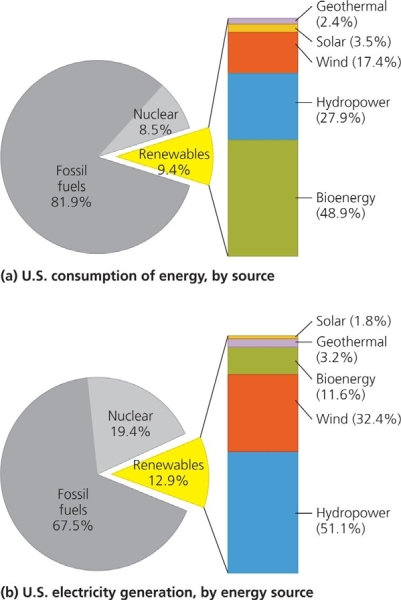 Use the figure above to answer the following question
-What this figure does not tell you is ______________.
Use the figure above to answer the following question
-What this figure does not tell you is ______________. (Multiple Choice)
4.8/5 (70)
(70) Choose the item that best matches each item in the following:
-Made from recycled cooking oil, animal fat and other sources
(Multiple Choice)
4.7/5 (85)
(85) Read the following scenario and answer the question below.
The United States consumes 25% of the worldʹs petroleum. Most is used for transportation, and most of it is imported. In 1992, after the first Gulf War, the federal government passed the Energy Policy Act, whose goal was to replace transportation-related petroleum with alternative fuels. Biodiesel made from vegetable oil or animal fat is an economical alternative to petroleum-based fuels. It is safe, biodegradable, nontoxic, and has the highest energy balance of any liquid fuel. Unlike unrefined oils that can be burned directly as fuels, biodiesel can be used in conventional diesel engines without engine modification. It reduces wear without compromising performance, due to its high lubricity. It is renewable and emits far less air pollution when combusted as compared to petrodiesel. The raw material used to produce biodiesel exists in billions of gallons of vegetable oil used by restaurants each year, as well as in crops. Processing biodiesel yields an added benefit-its by-product, glycerine, is used to make soap. Although biodiesel burns well in pure form (B100), commonly it is blended with petrodiesel in mixtures such as B20 and B5, which reduce toxic air pollution proportional to their biodiesel content. Biodiesel is currently available at almost 500 filling stations nationwide. Demand is increasing due to federal and state tax incentives as well as the increased price and decreased availability of petrodiesel. More than 600 domestic fleets use biodiesel, including the military, NASA, Yellowstone National Park, and local governments. Many school districts use biodiesel-powered school buses. Musicians Neil Young, Bonnie Raitt, and Willie Nelson fuel their tour buses with biodiesel. Nelson, a lifelong supporter of American farmers, who benefit when their crops are used for fuel, sells his own brand, BioWillie Biodiesel, at many truck stops. Because biodiesel can be manufactured locally, fuel transportation costs are low, and dependence on foreign petroleum and the need for domestic oil exploration and development of sensitive wildlife areas, such as the Arctic National Wildlife Refuge, can be reduced when biodiesel is used as an alternative fuel. There is concern, however, that biodiesel from crops may not be sustainable in the long term. Crops which are potentially food for humans, such as rape seed and soy, affect the price of foods and also require land, pesticides, fertilizers, and irrigation which may contribute to environmental degradation and stress on already limited resources.
-As a fuel, biodiesel ____________ .
(Multiple Choice)
4.9/5 (63)
(63) 
Filters
- Essay(0)
- Multiple Choice(0)
- Short Answer(0)
- True False(0)
- Matching(0)