



 Chat with AI
Exam 3: Evolution, Biodiversity, and Population Ecology

Exam 1: Science and Sustainability: an Introduction to Environmental Science61 Questions
Exam 2: Environmental Systems: Matter, Energy, and Ecosystems58 Questions
Exam 3: Evolution, Biodiversity, and Population Ecology52 Questions
Exam 4: Species Interactions and Community Ecology55 Questions
Exam 5: Economics, Policy, and Sustainable Development54 Questions
Exam 6: Human Population62 Questions
Exam 7: Soil, Agriculture, and the Future of Food64 Questions
Exam 8: Biodiversity and Conservation Biology49 Questions
Exam 9: Forests, Forest Management, and Protected Areas51 Questions
Exam 10: Environmental Health and Toxicology62 Questions
Exam 11: Geology, Minerals, and Mining52 Questions
Exam 12: Fresh Water, Oceans, and Coasts70 Questions
Exam 13: Atmospheric Science, Air Quality, and Pollution Control53 Questions
Exam 14: Global Climate Change53 Questions
Exam 15: Nonrenewable Energy Sources, Their Impacts, and Energy Conservation64 Questions
Exam 16: Renewable Energy Alternatives61 Questions
Exam 17: Managing Our Waste56 Questions
Exam 18: The Urban Environment: Creating Sustainable Cities60 Questions
Exam 19: Epilogue45 Questions
Select questions type


Choose the item that best matches each item in the following:
-Species occurring in only one area
(Multiple Choice)
5.0/5  (80)
(80) A species has evolved an asexual mode of reproduction by having offspring develop from unfertilized eggs. Which of the following will be true of this speciesʹ response to natural selection?
(Multiple Choice)
4.8/5 (66)
(66) A population of quail lives in an area of prairie grasslands. In good years, a pair of quail can have four clutches of young, with as many as 12 to 14 eggs in each clutch. Despite this, the population size remains stable over the long term. Discuss the population structure, its potential for growth, and its possible limiting factors, using at least four of the terms you learned in this chapter.
(Essay)
4.8/5 (69)
(69) 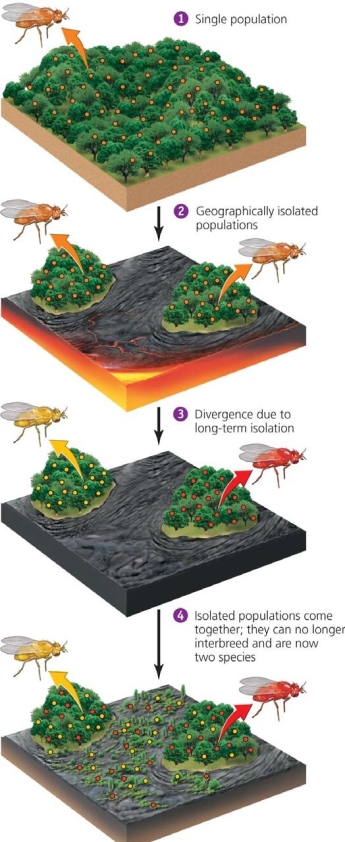 -Assuming the populations are of equal size, the length of time necessary for significant divergence to take place in the populations depends on _____________
 (Multiple Choice)
4.7/5 (93)
(93) When the organisms of a particular population seek habitats or resources that are unevenly spaced, the distribution of the individuals in the population is ______________
(Multiple Choice)
4.9/5 (92)
(92) Of the following, ______________ are the major factors that determine a populationʹs growth rate.
(Multiple Choice)
4.8/5 (94)
(94) Choose the item that best matches each item in the following:
-Number of individuals within a population per unit area
(Multiple Choice)
4.9/5 (71)
(71) Is a carrying capacity a fixed entity? Discuss the role of humans in regulating carrying capacity for the human species and in altering the carrying capacity for other species.
(Essay)
4.8/5 (93)
(93) A small group of leaf-feeding beetles locates a field of snap beans, one of the preferred plants for this species. At first, the population grows rapidly in the snap bean field, but as the beetle population grows larger, predators, such as spiders and birds, discover the beetles and start to remove individuals from the population. Competition for mates, food, and oviposition (egg-laying) sites intensifies for the individuals in the beetle population as population density increases. A fungal disease also starts to kill many of the beetles. The population no longer grows rapidly but levels off. How would you describe the factors limiting the beetle population?
(Multiple Choice)
4.8/5 (66)
(66) The functional role of a species in its community is its ______________
(Multiple Choice)
4.9/5 (76)
(76) A coyote, which can alter its food intake to match seasonal abundance of plants, fruits, or small animals, is considered to be ______________
(Multiple Choice)
4.8/5 (62)
(62) Populations lacking any environmental resistance tend to increase by ______________
(Multiple Choice)
5.0/5 (64)
(64) At Hakalau Forest in ______________, ranchland is being restored to forest, invasive plants are being removed, and native ones are being planted, and native birds are being protected while new populations of them are being established.
(Multiple Choice)
4.9/5 (82)
(82) Heavy rains and mudslides cause a river to change course, isolating two groups of lizards of the same species from one another. Over a long period of time ______________
(Multiple Choice)
4.8/5 (59)
(59) A species of bird had an original range covering the entire eastern half of the United States from New England west to the Mississippi and then south to Florida. During a period of glaciation, the eastern part of the population was cut off from the western part for 2000 years. Then the glacier melted and the birdsʹ range was reestablished. During the separation, the western birds evolved a slightly different song and a darker wing color. Ornithologists are now studying this species to determine whether speciation has taken place. What evidence will they look for in their study?
(Essay)
4.9/5 (81)
(81) 
Filters
- Essay(0)
- Multiple Choice(0)
- Short Answer(0)
- True False(0)
- Matching(0)