



 Chat with AI
Exam 4: Species Interactions and Community Ecology

Exam 1: Science and Sustainability: an Introduction to Environmental Science61 Questions
Exam 2: Environmental Systems: Matter, Energy, and Ecosystems58 Questions
Exam 3: Evolution, Biodiversity, and Population Ecology52 Questions
Exam 4: Species Interactions and Community Ecology55 Questions
Exam 5: Economics, Policy, and Sustainable Development54 Questions
Exam 6: Human Population62 Questions
Exam 7: Soil, Agriculture, and the Future of Food64 Questions
Exam 8: Biodiversity and Conservation Biology49 Questions
Exam 9: Forests, Forest Management, and Protected Areas51 Questions
Exam 10: Environmental Health and Toxicology62 Questions
Exam 11: Geology, Minerals, and Mining52 Questions
Exam 12: Fresh Water, Oceans, and Coasts70 Questions
Exam 13: Atmospheric Science, Air Quality, and Pollution Control53 Questions
Exam 14: Global Climate Change53 Questions
Exam 15: Nonrenewable Energy Sources, Their Impacts, and Energy Conservation64 Questions
Exam 16: Renewable Energy Alternatives61 Questions
Exam 17: Managing Our Waste56 Questions
Exam 18: The Urban Environment: Creating Sustainable Cities60 Questions
Exam 19: Epilogue45 Questions
Select questions type


What ecological traits do successful invasive species possess? How do these traits interact to make controlling them difficult?
(Essay)
4.8/5  (86)
(86) Read the following scenario and answer the question below.
Human activities, including fossil fuel combustion, farming, and deforestation, are known to increase the levels of carbon dioxide, methane, and nitrous oxides in our atmosphere. Measurable warming of Earth due to these greenhouse gases can alter ecosystem dynamics. In addition to the direct climatic effects on organisms within biomes, warming can lower levels of sea ice and increase precipitation in arctic areas. Global warming also can increases sea surface temperatures, which can subsequently melt permafrost in the tundra and increase the intensity of hurricanes in vulnerable areas. Within communities, climatic change can shift interdependent species ʺout-of-sync,ʺ potentially causing indirect loss of species.
-Some models of climate change for North America predict that the grassland regions of the prairie states will become warmer and dryer. This would result in ______________.
(Multiple Choice)
4.8/5 (79)
(79) 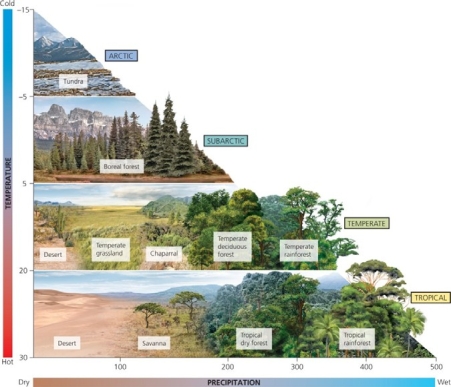 Use the figure above to answer the following question
-If global climate change results in an area of temperate grassland receiving less rainfall and higher temperatures, it will _______________
Use the figure above to answer the following question
-If global climate change results in an area of temperate grassland receiving less rainfall and higher temperatures, it will _______________ (Multiple Choice)
4.7/5 (83)
(83) Why do environmentalists favor the term food web as opposed to food chain?
(Essay)
4.9/5 (76)
(76) ______________ capture solar energy and use photosynthesis to produce sugars.
(Multiple Choice)
4.9/5 (69)
(69) Use the figure above to answer the following question
-What does the diagram illustrate?
Use the figure above to answer the following question
-What does the diagram illustrate? (Multiple Choice)
4.8/5 (87)
(87) Read the following scenario and answer the question below.
Human activities, including fossil fuel combustion, farming, and deforestation, are known to increase the levels of carbon dioxide, methane, and nitrous oxides in our atmosphere. Measurable warming of Earth due to these greenhouse gases can alter ecosystem dynamics. In addition to the direct climatic effects on organisms within biomes, warming can lower levels of sea ice and increase precipitation in arctic areas. Global warming also can increases sea surface temperatures, which can subsequently melt permafrost in the tundra and increase the intensity of hurricanes in vulnerable areas. Within communities, climatic change can shift interdependent species ʺout-of-sync,ʺ potentially causing indirect loss of species.
-If the climate warms significantly, tundra permafrost may melt, exposing underlying rock. This may next lead to ______________ in the community.
(Multiple Choice)
4.7/5 (82)
(82) A community may undergo a regime shift or a phase shift when ______________
(Multiple Choice)
5.0/5 (85)
(85) Of the following, ______________ is (are) an abiotic factor.
(Multiple Choice)
4.7/5 (74)
(74) ______________ carried out research to determine the impact of zebra mussels on fish communities.
(Multiple Choice)
5.0/5 (74)
(74) Read the following scenario and answer the question below.
Human activities, including fossil fuel combustion, farming, and deforestation, are known to increase the levels of carbon dioxide, methane, and nitrous oxides in our atmosphere. Measurable warming of Earth due to these greenhouse gases can alter ecosystem dynamics. In addition to the direct climatic effects on organisms within biomes, warming can lower levels of sea ice and increase precipitation in arctic areas. Global warming also can increases sea surface temperatures, which can subsequently melt permafrost in the tundra and increase the intensity of hurricanes in vulnerable areas. Within communities, climatic change can shift interdependent species ʺout-of-sync,ʺ potentially causing indirect loss of species.
-Of the following, ______________ might be first to populate an area after permafrost melts in response to global climate change.
(Multiple Choice)
4.9/5 (75)
(75) Read the following scenario and answer the question below.
Human activities, including fossil fuel combustion, farming, and deforestation, are known to increase the levels of carbon dioxide, methane, and nitrous oxides in our atmosphere. Measurable warming of Earth due to these greenhouse gases can alter ecosystem dynamics. In addition to the direct climatic effects on organisms within biomes, warming can lower levels of sea ice and increase precipitation in arctic areas. Global warming also can increases sea surface temperatures, which can subsequently melt permafrost in the tundra and increase the intensity of hurricanes in vulnerable areas. Within communities, climatic change can shift interdependent species ʺout-of-sync,ʺ potentially causing indirect loss of species.
-The relationship between flowering plants and caterpillars is best described as ______________.
(Multiple Choice)
4.8/5 (67)
(67) Choose the item that best matches from the following:
-Describes the terrestrial biome bordering the Mediterranean Sea; characterized by wet winters and warm dry summers
(Multiple Choice)
4.9/5 (67)
(67) 
Filters
- Essay(0)
- Multiple Choice(0)
- Short Answer(0)
- True False(0)
- Matching(0)