



 Chat with AI
Exam 6: Human Population

Exam 1: Science and Sustainability: an Introduction to Environmental Science61 Questions
Exam 2: Environmental Systems: Matter, Energy, and Ecosystems58 Questions
Exam 3: Evolution, Biodiversity, and Population Ecology52 Questions
Exam 4: Species Interactions and Community Ecology55 Questions
Exam 5: Economics, Policy, and Sustainable Development54 Questions
Exam 6: Human Population62 Questions
Exam 7: Soil, Agriculture, and the Future of Food64 Questions
Exam 8: Biodiversity and Conservation Biology49 Questions
Exam 9: Forests, Forest Management, and Protected Areas51 Questions
Exam 10: Environmental Health and Toxicology62 Questions
Exam 11: Geology, Minerals, and Mining52 Questions
Exam 12: Fresh Water, Oceans, and Coasts70 Questions
Exam 13: Atmospheric Science, Air Quality, and Pollution Control53 Questions
Exam 14: Global Climate Change53 Questions
Exam 15: Nonrenewable Energy Sources, Their Impacts, and Energy Conservation64 Questions
Exam 16: Renewable Energy Alternatives61 Questions
Exam 17: Managing Our Waste56 Questions
Exam 18: The Urban Environment: Creating Sustainable Cities60 Questions
Exam 19: Epilogue45 Questions
Select questions type


The richest one-fifth of the worldʹs population possesses approximately ________________ times the income of the poorest one-fifth, and the richest one-fifth uses over 86% of the worldʹs resources.
(Multiple Choice)
4.9/5  (77)
(77) Which of the following is not one of the worldʹs top five most populous nations?
(Multiple Choice)
4.7/5 (81)
(81) The annual global growth rate of the human population peaked in the ________________ and has been declining ever since.
(Multiple Choice)
4.9/5 (83)
(83) Most of the world population growth in the near future will be in ________________.
(Multiple Choice)
4.8/5 (73)
(73) If a population roughly doubles in the course of 50 years, its growth rate would be close to ________________%.
(Multiple Choice)
4.7/5 (90)
(90) Which statement most accurately describes the population control efforts in China?
(Multiple Choice)
4.8/5 (77)
(77) The world population growth rate is currently close to ________________%.
(Multiple Choice)
4.8/5 (89)
(89) Define ecological footprint and differentiate between the ecological footprint of a developing country and that of the United States. Support or challenge the following statement: ʺThe population problem does not lie entirely with the developing world.ʺ
(Essay)
4.9/5 (72)
(72) The most serious problem caused by population growth is ________________ .
(Multiple Choice)
4.9/5 (74)
(74) A country with ________________ is not expected to grow quickly in the near future.
(Multiple Choice)
4.8/5 (86)
(86) A population which is not growing will have a TFR of ________________
(Multiple Choice)
4.8/5 (76)
(76) 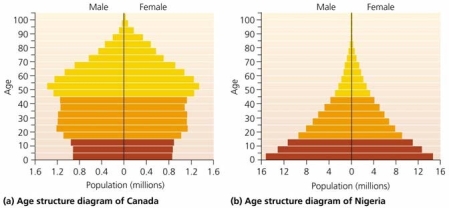 Use the figure above to answer the following question
-The population in part (a) is likely to experience ____________ soon.
Use the figure above to answer the following question
-The population in part (a) is likely to experience ____________ soon. (Multiple Choice)
4.8/5 (82)
(82) A graph of world population growth over the past 500 years most closely resembled the letter ________________.
(Multiple Choice)
4.8/5 (72)
(72) What three-factor model is used for representing the impact on environment? What is a fourth factor that could be added to this? Give a simple explanation for each factor and describe what it means in terms of human impacts on the environment.
(Essay)
4.8/5 (74)
(74) Which of the following best describes the human population from early times to the present?
(Multiple Choice)
4.8/5 (73)
(73) The 1994 Cairo, Egypt, conference was organized ________________.
(Multiple Choice)
4.9/5 (82)
(82) What is a demographic transition? What are its four stages? State why each stage is important and what the consequence is for population growth. Do all countries go through the demographic transition?
(Essay)
4.7/5 (76)
(76) If global fertility rates remain at 2008 levels, the United Nations predicts that world population will surpass ________________ billion in 2050.
(Multiple Choice)
4.8/5 (84)
(84) The view held by both Malthus and Paul Ehrlich suggests that depletion of resource supplies due to greater numbers of people ________________.
(Multiple Choice)
4.8/5 (79)
(79) Diminishing population growth rates in poor countries can be partially attributed to ________________.
(Multiple Choice)
4.8/5 (82)
(82) 
Filters
- Essay(0)
- Multiple Choice(0)
- Short Answer(0)
- True False(0)
- Matching(0)