



 Chat with AI
Exam 7: Soil, Agriculture, and the Future of Food

Exam 1: Science and Sustainability: an Introduction to Environmental Science61 Questions
Exam 2: Environmental Systems: Matter, Energy, and Ecosystems58 Questions
Exam 3: Evolution, Biodiversity, and Population Ecology52 Questions
Exam 4: Species Interactions and Community Ecology55 Questions
Exam 5: Economics, Policy, and Sustainable Development54 Questions
Exam 6: Human Population62 Questions
Exam 7: Soil, Agriculture, and the Future of Food64 Questions
Exam 8: Biodiversity and Conservation Biology49 Questions
Exam 9: Forests, Forest Management, and Protected Areas51 Questions
Exam 10: Environmental Health and Toxicology62 Questions
Exam 11: Geology, Minerals, and Mining52 Questions
Exam 12: Fresh Water, Oceans, and Coasts70 Questions
Exam 13: Atmospheric Science, Air Quality, and Pollution Control53 Questions
Exam 14: Global Climate Change53 Questions
Exam 15: Nonrenewable Energy Sources, Their Impacts, and Energy Conservation64 Questions
Exam 16: Renewable Energy Alternatives61 Questions
Exam 17: Managing Our Waste56 Questions
Exam 18: The Urban Environment: Creating Sustainable Cities60 Questions
Exam 19: Epilogue45 Questions
Select questions type


Read the following scenario and answer the question below.
Despite the high cost of the technology to design genetically modified (GM) crops, American companies have invested in their development. The first genetically engineered crop was the Flavr Savr tomato, which was created by reversing the function of a normal tomato gene. It was approved by the FDA for sale in the United States in 1994. Its grower, the Calgene Corporation, maintained that it would ripen longer on the vine, taste and ship better, and last longer on supermarket shelves compared to conventional tomatoes. It is no longer marketed because of technical problems and public safety concerns.
Today, most engineered crops are modified for insect and herbicide resistance. In 1997, the Monsanto company first marketed GM corn. This Bt corn was engineered using genes from the Bacillus thuringiensis bacteria that made the corn resistant to some pests. In 1999, environmentalists were alarmed when it was reported that pollen from Bt corn could kill monarch butterfly larvae if corn pollen drifted onto milkweed plants that monarchs fed upon. Consumers feared the unknown and were concerned about potential food allergies. Presently, corn, along with soybeans, cotton, and canola dominate the GM food market. These crops are grown and distributed mostly in the United States, Argentina, Canada, Brazil, and China. They are used mostly for animal feed, clothing, or to make oil or other ingredients for processed food, which has helped them gain public acceptance. Although GM crops such as strawberries, potatoes, and lettuce have all been marketed in the United States, GM food field trials involving biotech fruits and vegetables have dropped significantly during the past several years, and the pace of new product introductions has fallen sharply. This narrow range of crops could mean that biotechnology may not realize its full potential in the future.
-Why have most bioengineered crops been modified for ʺresistanceʺ traits?
(Multiple Choice)
4.8/5  (85)
(85) _______________ % of the food we consume comes from crop species.
(Multiple Choice)
4.9/5 (81)
(81) No-till farming would be most beneficial for farmers _______________.
(Multiple Choice)
4.8/5 (77)
(77) Until about 10,000 years ago, our species depended on _______________.
(Multiple Choice)
4.9/5 (85)
(85) 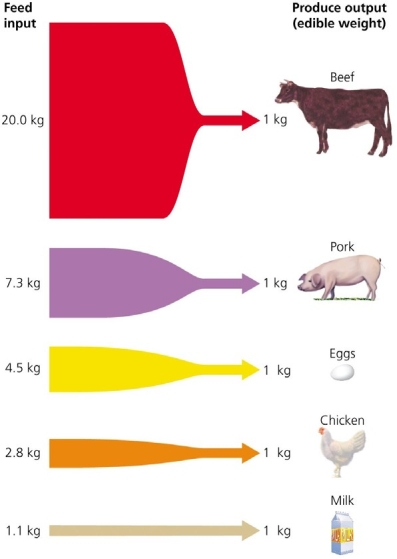 Use the figure above to answer the following question.
-Based on the information in the figure, you decide to make changes in your diet to diminish your ecological footprint (the environmental impact of your food choices) by _____________.
Use the figure above to answer the following question.
-Based on the information in the figure, you decide to make changes in your diet to diminish your ecological footprint (the environmental impact of your food choices) by _____________. (Multiple Choice)
4.7/5 (77)
(77) Read the following scenario and answer the question below.
Despite the high cost of the technology to design genetically modified (GM) crops, American companies have invested in their development. The first genetically engineered crop was the Flavr Savr tomato, which was created by reversing the function of a normal tomato gene. It was approved by the FDA for sale in the United States in 1994. Its grower, the Calgene Corporation, maintained that it would ripen longer on the vine, taste and ship better, and last longer on supermarket shelves compared to conventional tomatoes. It is no longer marketed because of technical problems and public safety concerns.
Today, most engineered crops are modified for insect and herbicide resistance. In 1997, the Monsanto company first marketed GM corn. This Bt corn was engineered using genes from the Bacillus thuringiensis bacteria that made the corn resistant to some pests. In 1999, environmentalists were alarmed when it was reported that pollen from Bt corn could kill monarch butterfly larvae if corn pollen drifted onto milkweed plants that monarchs fed upon. Consumers feared the unknown and were concerned about potential food allergies. Presently, corn, along with soybeans, cotton, and canola dominate the GM food market. These crops are grown and distributed mostly in the United States, Argentina, Canada, Brazil, and China. They are used mostly for animal feed, clothing, or to make oil or other ingredients for processed food, which has helped them gain public acceptance. Although GM crops such as strawberries, potatoes, and lettuce have all been marketed in the United States, GM food field trials involving biotech fruits and vegetables have dropped significantly during the past several years, and the pace of new product introductions has fallen sharply. This narrow range of crops could mean that biotechnology may not realize its full potential in the future.
-The Flavr Savr tomato is no longer marketed because _______________.
(Multiple Choice)
4.8/5 (81)
(81) Match the following:
-Introduced for biological control of caterpillars
(Multiple Choice)
4.8/5 (74)
(74) The breakdown of large rocks into smaller pieces is _______________.
(Multiple Choice)
4.8/5 (81)
(81) Of the following, _______________ best describes integrated pest management (IPM).
(Multiple Choice)
4.9/5 (58)
(58) What was the Green Revolution, and what impact did it have on developing countries? Discuss the impact of the Green Revolution on the environment.
(Essay)
5.0/5 (85)
(85) Seed banks (institutions that store and preserve seeds) are important for _______________.
(Multiple Choice)
4.8/5 (85)
(85) Normal Borlaug, who passed away in 2009, pioneered the development of _______________.
(Multiple Choice)
4.9/5 (68)
(68) Terracing, contour farming, intercropping, and crop rotation all _______________.
(Multiple Choice)
4.8/5 (69)
(69) 
Filters
- Essay(0)
- Multiple Choice(0)
- Short Answer(0)
- True False(0)
- Matching(0)