



 Chat with AI
Exam 6: Unemployment and Inflation

Exam 1: Introduction: What Is Economics144 Questions
Exam 2: The Key Principles of Economics195 Questions
Exam 3: Exchange and Markets135 Questions
Exam 4: Demand, Supply, and Market Equilibrium279 Questions
Exam 5: Measuring a Nations Production and Income161 Questions
Exam 6: Unemployment and Inflation206 Questions
Exam 7: The Economy at Full Employment165 Questions
Exam 8: Why Do Economies Grow203 Questions
Exam 9: Aggregate Demand and Aggregate Supply189 Questions
Exam 10: Fiscal Policy166 Questions
Exam 11: The Income-Expenditure Model265 Questions
Exam 12: Investment and Financial Markets179 Questions
Exam 13: Money and the Banking System184 Questions
Exam 14: The Federal Reserve and Monetary Policy203 Questions
Exam 15: Modern Macroeconomics: From the Short Run to the Long Run176 Questions
Exam 16: The Dynamics of Inflation and Unemployment186 Questions
Exam 17: Macroeconomic Policy Debates143 Questions
Exam 18: International Trade and Public Policy226 Questions
Exam 19: The World of International Finance189 Questions
Select questions type


A person who leaves the labor force because they could not find a job is called:
(Multiple Choice)
4.7/5  (74)
(74) You are an employee of the Bureau of Labor Statistics involved in the monthly survey of households used to estimate the unemployment rate. In each of the following cases, classify the individual as frictionally, structurally, or cyclically unemployed. Explain your classification.
(a) There has been a general economic slowdown. Because of weak demand, Andy Capp has lost his job at the docks.
(b) Phil McCafferty, a newly qualified dental school graduate, is looking for a place to set up practice.
(c) Coal miner Ned Ludd is thrown out of work by the introduction of a more mechanized production process.
(d) Latosha Hogan, a computer programmer with a large bank, quit her job two months ago in search of a better- paid programming position. She is still looking.
(Essay)
4.9/5 (74)
(74) If you expect that the inflation rate is 5 percent and the actual inflation rate turned out to be exactly 5 percent, then:
(Multiple Choice)
4.8/5 (81)
(81) The number of people classified as employed is 220,000 and the number of people classified as unemployed is 30,000. The size of the labor force:
(Multiple Choice)
4.8/5 (69)
(69) The demand for refrigerators falls when the economy enters a downturn. If a refrigerator manufacturer lays off workers during an economic downturn, this would be an example of:
(Multiple Choice)
4.9/5 (79)
(79) The portion of unemployment that is due to the mismatch between skills and jobs is called _______ unemployment.
(Multiple Choice)
4.8/5 (87)
(87) 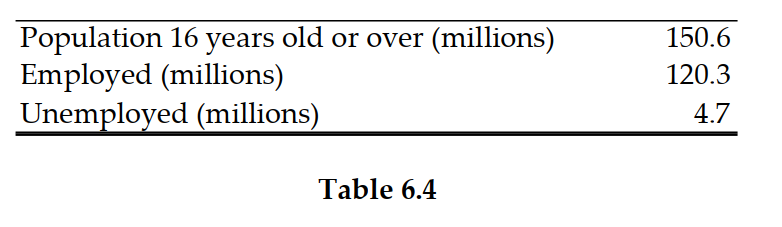 -Refer to Table 6.4. The labor- force participation rate equals:
 (Multiple Choice)
4.8/5 (85)
(85) The CPI somewhat overstates changes in the cost of living while the GDP chain index does not.
(True/False)
4.9/5 (67)
(67) Recall Application 3, "Social Norms, Unemployment ,and Perceived Happiness," to answer the following questions:
-According to the application, men suffered _ in well- being when _ were also unemployed.
(Multiple Choice)
4.7/5 (71)
(71) 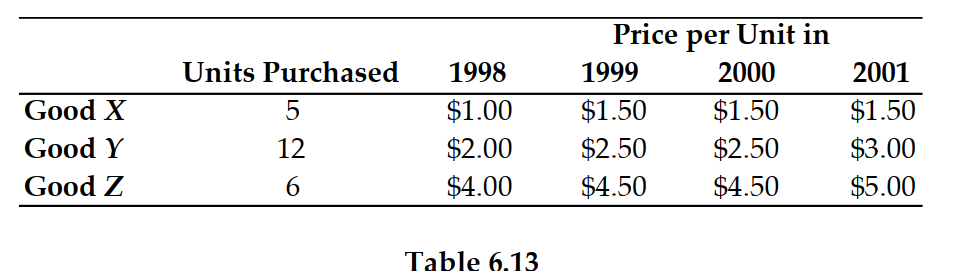 -Refer to Table 6.13. If 2000 is the base year, the inflation rate between 1999 and 2001 is:
 (Multiple Choice)
4.9/5 (90)
(90) Which of the following individuals are hurt when the economy experiences unanticipated inflation?
(Multiple Choice)
4.7/5 (81)
(81) Carla lost her job and immediately started looking for another job. As a result the:
(Multiple Choice)
4.9/5 (79)
(79) 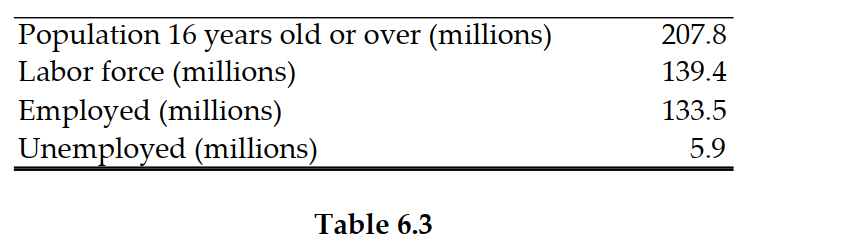 -Refer to Table 6.3. The unemployment rate equals:
When people who are not working start looking for jobs, the labor- force participation rate increases.
(True/False)
4.8/5 (91)
(91) If there were no frictional unemployment the economy would grow faster.
(True/False)
4.9/5 (88)
(88) Which of the following is correct? The unemployment rate is:
(Multiple Choice)
4.8/5 (73)
(73) A man is fired from his job because he was late for work too many times. While taking a break from searching for another job he would be classified as:
(Multiple Choice)
4.9/5 (64)
(64) 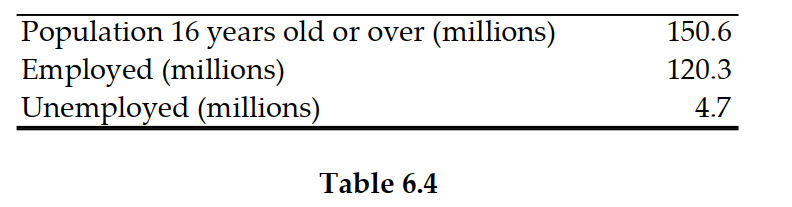 -Refer to Table 6.4. The unemployment rate rate equals:

Filters
- Essay(0)
- Multiple Choice(0)
- Short Answer(0)
- True False(0)
- Matching(0)