



 Chat with AI
Exam 6: Unemployment and Inflation

Exam 1: Introduction: What Is Economics144 Questions
Exam 2: The Key Principles of Economics195 Questions
Exam 3: Exchange and Markets135 Questions
Exam 4: Demand, Supply, and Market Equilibrium279 Questions
Exam 5: Measuring a Nations Production and Income161 Questions
Exam 6: Unemployment and Inflation206 Questions
Exam 7: The Economy at Full Employment165 Questions
Exam 8: Why Do Economies Grow203 Questions
Exam 9: Aggregate Demand and Aggregate Supply189 Questions
Exam 10: Fiscal Policy166 Questions
Exam 11: The Income-Expenditure Model265 Questions
Exam 12: Investment and Financial Markets179 Questions
Exam 13: Money and the Banking System184 Questions
Exam 14: The Federal Reserve and Monetary Policy203 Questions
Exam 15: Modern Macroeconomics: From the Short Run to the Long Run176 Questions
Exam 16: The Dynamics of Inflation and Unemployment186 Questions
Exam 17: Macroeconomic Policy Debates143 Questions
Exam 18: International Trade and Public Policy226 Questions
Exam 19: The World of International Finance189 Questions
Select questions type


If 1999 is the base year and the inflation rate between 1999 and 2000 is - 12%, the price index in 2000 must be equal to:
(Multiple Choice)
4.7/5  (93)
(93) Suppose that Linda wants to calculate a price index for the goods that she commonly purchases each week. The cost of her bundle of goods and services was $350 in 2008, $445 in 1999, and $470 in 2010. If Linda uses 2008 as the base year, what will be the value of her price index for 2008, 2009, and 2010?
(Essay)
4.8/5 (69)
(69) Recall Application 2, "More Disability, Less Unemployment?" to answer the following questions:
-According to the application, the changes in the federal Disability Insurance program:
(Multiple Choice)
4.7/5 (68)
(68) In 1999, the U.S. population 16 years old or older was 207.8 million, the number employed was 133.5 million, the number unemployed was 5.9 million, and the labor force was 139.4 million. The labor- force participation rate in 1999 was _______%.
(Multiple Choice)
4.8/5 (89)
(89) If the price index in 2000 is 120 and the price index in 2001 is 112, then the economy experiences _______ between 2000 and 2001.
(Multiple Choice)
4.8/5 (87)
(87) Which of the following is not an example of seasonal unemployment?
(Multiple Choice)
4.8/5 (71)
(71) Recall Application 1, "After Growing Sharply, Women's Labor Force Participation Has Leveled Off," to answer the
following questions:
-In the application, the labor- force participation rate of women 20 years or older in 1997 has reached:
(Multiple Choice)
4.9/5 (61)
(61) 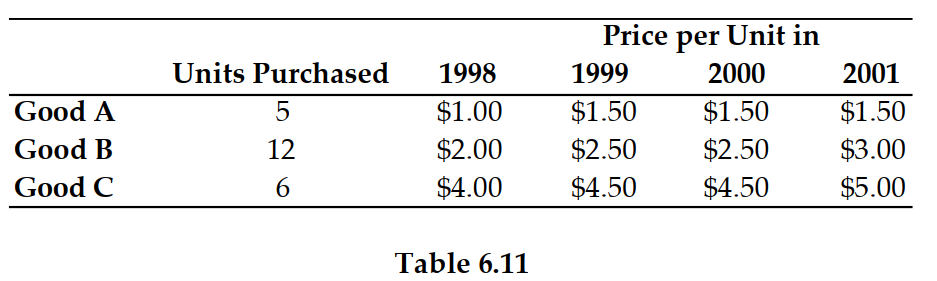 -Refer to Table 6.11. If 1999 is the base year, the price index in 2001 is:
 (Multiple Choice)
4.9/5 (83)
(83) If the labor force is 250,000 and the total population 16 years of age or older is 300,000, the labor- force participation rate is:
(Multiple Choice)
4.7/5 (73)
(73) The unemployment rate is the ratio of the number of people unemployed to the total population 16 years of age or older.
(True/False)
4.8/5 (91)
(91) If the number of unemployed equals 20,000, the number of employed equals 60,000, and the total population 16 years of age and older is 90,000, the labor- force participation rate:
(Multiple Choice)
4.7/5 (72)
(72) For each of the following, indicate if the person would be classified as employed, unemployed, or not in the labor force:
(a) a 70- year- old man who left his job to help his daughter in her business for 10 hours a week,
(b) a 20- year- old college student who is out of school for the summer and is looking for a job,
(c) a 30- year- old woman with a Ph.D. in history who has not been able to find a teaching position and is driving a cab 30 hours a week,
(d) a 40- year- old steel worker who isn't working and has given up searching for a job,
(e) a 14- year- old movie star starts working on a new episode of Star Trek.
(Essay)
4.8/5 (80)
(80) Based on statistics on unemployment, which group of workers experience the highest unemployment rates?
(Multiple Choice)
4.9/5 (71)
(71) Anticipated inflation hurts the lenders and benefits the borrowers.
(True/False)
4.9/5 (86)
(86) Recall Application 4, "The Introduction of Cell Phones and the Bias in the CPI," to answer the following questions:
-According to the application, the failure to include cell phones in the calculation of the CPI creates an upward bias on the telecommunications component of the CPI by 0.8 to 1.9 percent. If the measured inflation for telecommunications was 5%, then the actual inflation was somewhere between:
(Multiple Choice)
4.8/5 (74)
(74) If the number of people classified as unemployed is 50,000 and the number of people classified as employed is 620,000, what is the unemployment rate?
(Multiple Choice)
4.8/5 (78)
(78) NEETS ARE THE NEW DISCOURAGED WORKERS IN JAPAN
Who are the new discouraged workers in Japan?
In Japan, there is growing concern about young people who are not joining the labor force. Young workers who have given up looking for work and often receive support from their parents are known as NEETs—"not in education, employment, or training." Because Japan has an aging population and does not encourage immigration, it is concerned about labor shortages and has focused attention on the NEETs. Many in Japan are concerned over this phenomenon because it potentially signals a change in the strong Japanese work ethic.
However, the number of individuals in this category is quite small, only 2 percent of Japan’s 33 million young people between the ages of 15 and 34. Nonetheless, the fact that the Japanese decided to name this group suggests that it is socially significant to them. In the United States, individuals not seeking work and supported by their parents would be out of the labor force and possibly marginally attached workers.
-Labor shortages in Japan increased focus on the NEETs. This labor shortage is caused by:
(Multiple Choice)
4.8/5 (81)
(81) If you expect that the inflation rate is 5 percent and the actual inflation rate turned out to be exactly 8 percent, then:
(Multiple Choice)
4.8/5 (76)
(76) 
Filters
- Essay(0)
- Multiple Choice(0)
- Short Answer(0)
- True False(0)
- Matching(0)