



 Chat with AI
Exam 13: Chemical Kinetics

Exam 1: Units of Measurement for Physical and Chemical Change192 Questions
Exam 2: Atoms and Elements174 Questions
Exam 3: Molecules, Compounds, and Nomenclature187 Questions
Exam 4: Chemical Reactions and Stoichiometry261 Questions
Exam 5: Gases163 Questions
Exam 6: Thermochemistry161 Questions
Exam 7: The Quantum-Mechanical Model of the Atom170 Questions
Exam 8: Periodic Properties of the Elements144 Questions
Exam 9: Chemical Bonding I: Lewis Theory155 Questions
Exam 10: Chemical Bonding Ii: Molecular Shapes, Valence Bond Theory, and Molecular Orbital Theory180 Questions
Exam 11: Liquids, Solids, and Intermolecular Forces144 Questions
Exam 12: Solutions167 Questions
Exam 13: Chemical Kinetics170 Questions
Exam 14: Chemical Equilibrium150 Questions
Exam 15: Acids and Bases156 Questions
Exam 16: Aqueous Ionic Equilibrium173 Questions
Exam 17: Gibbs Energy and Thermodynamics134 Questions
Exam 18: Electrochemistry122 Questions
Exam 19: Radioactivity and Nuclear Chemistry116 Questions
Exam 20: Organic Chemistry I: Structures109 Questions
Exam 21: Organic Chemistry Ii: Reactions102 Questions
Exam 22: Biochemistry55 Questions
Exam 23: Chemistry of the Nonmetals50 Questions
Exam 24: Metals and Metallurgy49 Questions
Exam 25: Transition Metals and Coordination Compounds55 Questions
Select questions type


What happens to the concentration of reactants and products during a chemical reaction?
(Essay)
4.8/5  (69)
(69) How many half-lives are required for the concentration of reactant to decrease to 12.5% of its original value?
(Multiple Choice)
4.9/5 (84)
(84) The first-order decomposition of N2O5 at 328 K has a rate constant of 1.70 × 10⁻³ s-1. If the initial concentration of N2O5 is 2.88 mol L-1, what is the concentration of N2O5 after 12.5 minutes?
(Multiple Choice)
4.8/5 (82)
(82) For a reaction that follows the general rate law Rate = k[A]-1 [B]2, what will happen to the rate of reaction if the concentration of A and B are increased by a factor of 6?
(Multiple Choice)
4.7/5 (85)
(85) Carbon-14, which is present in all living tissue, radioactively decays via a first-order process. A one-gram sample of wood taken from a living tree gives a rate for carbon-14 decay of 13.6 counts per minute. If the half-life for carbon-14 is 5720 years, how old is a wood sample that gives a rate for carbon-14 decay of 11.9 counts per minute?
(Multiple Choice)
4.9/5 (76)
(76) Without performing complex calculations, determine the order of a reaction that has the following initial rates for the specified starting concentration: 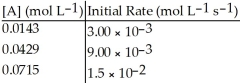
(Multiple Choice)
4.9/5 (78)
(78) Given the following balanced equation, determine the rate of reaction with respect to [O2]. 2O3(g) → 3O2(g)
(Multiple Choice)
4.9/5 (86)
(86) A reaction with an activation energy of 65.4 kJ mol-1 has a rate constant of 1.15 s-1 at 354 K. At what temperature will the rate constant be double?
(Multiple Choice)
4.9/5 (84)
(84) The isomerization reaction, CH3NC → CH3CN, is first order and the rate constant is equal to 0.46 s-1 at 600 K. What is the concentration of CH3NC after 0.20 minutes if the initial concentration is 0. 30 mol L-1?
(Multiple Choice)
4.9/5 (75)
(75) What is the unit of k in the following rate law? Rate = k[X][Y]
(Multiple Choice)
4.9/5 (67)
(67) A reaction is found to have an activation energy of 38.0 kJ mol-1. If the rate constant for this reaction is 1.60 × 10² L mol-1 s-1 at 249 K, what is the rate constant at 436 K?
(Multiple Choice)
5.0/5 (85)
(85) 
 decomposes in the gas phase by the reaction

 (g) →
 (g) +
 (g) The reaction is first order in

 and the rate constant is 3.0 ×

 at 600 K. A vessel is charged with 6.4 atm of
 at 600 K. The partial pressure of

 at
 is ________ atm.
decomposes in the gas phase by the reaction (g) → (g) + (g) The reaction is first order in and the rate constant is 3.0 × at 600 K. A vessel is charged with 6.4 atm of at 600 K. The partial pressure of at is ________ atm. (Multiple Choice)
4.8/5 (74)
(74) Given the following balanced equation, determine the rate of reaction with respect to [H2]. N2(g) + 3H2(g) → 2NH3(g)
(Multiple Choice)
4.8/5 (78)
(78) The second-order decomposition of NO2 has a rate constant of 0.255 L mol-1 s-1. How much NO2 decomposes in 4.00 s if the initial concentration of NO2 (1.00 L volume) is 1.33 mol L-1?
(Multiple Choice)
4.7/5 (86)
(86) The elementary reaction  (g) → 2NO(g) +
 (g) is second order in
 and the rate constant at 515 K is 1.64 × 10⁻²

 . The reaction half-life at this temperature when
 = 0.45 mol L-1 is ________ s.
(g) → 2NO(g) + (g) is second order in and the rate constant at 515 K is 1.64 × 10⁻²
. The reaction half-life at this temperature when = 0.45 mol L-1 is ________ s. (Multiple Choice)
4.8/5 (72)
(72) Which of the following is the characteristic of a first-order reaction having only one reactant?
(Multiple Choice)
4.8/5 (79)
(79) The isomerization of methylisonitrile to acetonitrile  NC(g) →
 CN(g) is first order in
 NC. The rate constant for the reaction is 5.26 × 10⁻³
 at 531 K. The
 of the reaction when the initial [
 NC] is 0.030 mol L-1 is ________ s.
NC(g) → CN(g) is first order in NC. The rate constant for the reaction is 5.26 × 10⁻³ at 531 K. The of the reaction when the initial [ NC] is 0.030 mol L-1 is ________ s. (Multiple Choice)
4.7/5 (77)
(77) 
Filters
- Essay(0)
- Multiple Choice(0)
- Short Answer(0)
- True False(0)
- Matching(0)