



 Chat with AI
Exam 13: Chemical Kinetics

Exam 1: Units of Measurement for Physical and Chemical Change192 Questions
Exam 2: Atoms and Elements174 Questions
Exam 3: Molecules, Compounds, and Nomenclature187 Questions
Exam 4: Chemical Reactions and Stoichiometry261 Questions
Exam 5: Gases163 Questions
Exam 6: Thermochemistry161 Questions
Exam 7: The Quantum-Mechanical Model of the Atom170 Questions
Exam 8: Periodic Properties of the Elements144 Questions
Exam 9: Chemical Bonding I: Lewis Theory155 Questions
Exam 10: Chemical Bonding Ii: Molecular Shapes, Valence Bond Theory, and Molecular Orbital Theory180 Questions
Exam 11: Liquids, Solids, and Intermolecular Forces144 Questions
Exam 12: Solutions167 Questions
Exam 13: Chemical Kinetics170 Questions
Exam 14: Chemical Equilibrium150 Questions
Exam 15: Acids and Bases156 Questions
Exam 16: Aqueous Ionic Equilibrium173 Questions
Exam 17: Gibbs Energy and Thermodynamics134 Questions
Exam 18: Electrochemistry122 Questions
Exam 19: Radioactivity and Nuclear Chemistry116 Questions
Exam 20: Organic Chemistry I: Structures109 Questions
Exam 21: Organic Chemistry Ii: Reactions102 Questions
Exam 22: Biochemistry55 Questions
Exam 23: Chemistry of the Nonmetals50 Questions
Exam 24: Metals and Metallurgy49 Questions
Exam 25: Transition Metals and Coordination Compounds55 Questions
Select questions type


Which of the following represents the equation for a second-order half-life?
(Multiple Choice)
4.9/5  (82)
(82) The rate constant for a first-order reaction is 0.54 L mol-1 s-1. What is the half-life of this reaction if the initial concentration is 0.27 mol L-1?
(Multiple Choice)
4.9/5 (78)
(78) Write a balanced reaction for which the following rate relationships are true. Rate = - 
 =

 =

= = (Multiple Choice)
4.9/5 (71)
(71) Which of the following represents the integrated rate law for a zeroth-order reaction?
(Multiple Choice)
4.9/5 (74)
(74) Given the following balanced equation, determine the rate of reaction with respect to [SO3]. If the rate of O2 loss is 3.56 × 10⁻³ mol L-1 s-1, what is the rate of formation of SO3? 2SO2(g) + O2(g) → 2SO3(g)
(Multiple Choice)
4.8/5 (76)
(76) Given the following balanced equation, determine the rate of reaction with respect to [NOCl]. 2NO(g) + Cl2(g) → 2NOCl(g)
(Multiple Choice)
4.9/5 (98)
(98) The first-order decay of radon has a half-life of 3.823 days. How many grams of radon remain after 7.22 days if the sample initially weighs 250.0 grams?
(Multiple Choice)
4.8/5 (84)
(84) Given the following balanced equation, determine the rate of reaction with respect to [O3]. If the rate of loss of O3 is 3.91 × 10⁻¹ mol L-1 s-1, what is the rate of the formation of O2? 2O3(g) → 3O2(g)
(Multiple Choice)
4.9/5 (79)
(79) The first-order decay of radon has a half-life of 3.823 days. How many grams of radon decomposes after 5.55 days if the sample initially weighs 100.0 grams?
(Multiple Choice)
4.8/5 (75)
(75) How many half-lives are required for the concentration of reactant to decrease to 25% of its original value?
(Multiple Choice)
4.9/5 (79)
(79) Determine the missing initial rate for the following  order reaction given the following information:
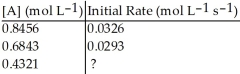
order reaction given the following information: (Multiple Choice)
4.9/5 (84)
(84) Given the following balanced equation, determine the rate of reaction with respect to [NH3]. N2(g) + 3H2(g) → 2NH3(g)
(Multiple Choice)
4.9/5 (81)
(81) Given the following balanced equation, determine the rate of reaction with respect to [O2]. 2SO2(g) + O2(g) → 2SO3(g)
(Multiple Choice)
4.9/5 (72)
(72) Is the activation energy for a forward reaction the same as the activation energy for the reverse of the same reaction?
(Essay)
4.9/5 (90)
(90) Hydrogen iodide decomposes at 800 K via a second-order process to produce hydrogen and iodine according to the following chemical equation: 2HI(g) → H2(g) + I2(g)
At 800 K it takes 142 seconds for the initial concentration of HI to decrease from 6.75 × 10⁻² mol L-1 to 3.50 × 10⁻² mol L-1. What is the rate constant for the reaction at this temperature?
(Multiple Choice)
4.8/5 (85)
(85) Which of the following reactions would you predict to have the smallest orientation factor?
(Multiple Choice)
5.0/5 (84)
(84) A reaction is found to have a rate constant of 3.36 × 10⁴ L mol-1 s-1 at 344 K and a rate constant of 7.69 L mol-1 s-1 at 219 K. Determine the activation energy for this reaction.
(Multiple Choice)
4.8/5 (68)
(68) 
Filters
- Essay(0)
- Multiple Choice(0)
- Short Answer(0)
- True False(0)
- Matching(0)