



 Chat with AI
Exam 13: Chemical Kinetics

Exam 1: Units of Measurement for Physical and Chemical Change192 Questions
Exam 2: Atoms and Elements174 Questions
Exam 3: Molecules, Compounds, and Nomenclature187 Questions
Exam 4: Chemical Reactions and Stoichiometry261 Questions
Exam 5: Gases163 Questions
Exam 6: Thermochemistry161 Questions
Exam 7: The Quantum-Mechanical Model of the Atom170 Questions
Exam 8: Periodic Properties of the Elements144 Questions
Exam 9: Chemical Bonding I: Lewis Theory155 Questions
Exam 10: Chemical Bonding Ii: Molecular Shapes, Valence Bond Theory, and Molecular Orbital Theory180 Questions
Exam 11: Liquids, Solids, and Intermolecular Forces144 Questions
Exam 12: Solutions167 Questions
Exam 13: Chemical Kinetics170 Questions
Exam 14: Chemical Equilibrium150 Questions
Exam 15: Acids and Bases156 Questions
Exam 16: Aqueous Ionic Equilibrium173 Questions
Exam 17: Gibbs Energy and Thermodynamics134 Questions
Exam 18: Electrochemistry122 Questions
Exam 19: Radioactivity and Nuclear Chemistry116 Questions
Exam 20: Organic Chemistry I: Structures109 Questions
Exam 21: Organic Chemistry Ii: Reactions102 Questions
Exam 22: Biochemistry55 Questions
Exam 23: Chemistry of the Nonmetals50 Questions
Exam 24: Metals and Metallurgy49 Questions
Exam 25: Transition Metals and Coordination Compounds55 Questions
Select questions type


Given the following rate law, how does the rate of reaction change if the concentration of Y is doubled? Rate = k [X]2[Y]3
(Multiple Choice)
4.9/5  (80)
(80) Determine the rate law and the value of k for the following reaction using the data provided: CO(g) + Cl2(g) → COCl2(g) [CO]i (M) [Cl2]i (M) Initial Rate (M1 s-1)
0)25 0.40 0.696
0)25 0.80 1.97
0)50 0.80 3.94
(Multiple Choice)
4.9/5 (81)
(81) A particular first-order reaction has a rate constant of 1.35 × 
 at 25.0 °C. What is the magnitude of k at 75.0 °C if
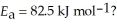
at 25.0 °C. What is the magnitude of k at 75.0 °C if (Multiple Choice)
5.0/5 (72)
(72) If the activation energy for a given compound is found to be 42.0 kJ mol-1 with a frequency factor of 8.0 × 10¹⁰ s-1, what is the rate constant for this reaction at 298 K?
(Multiple Choice)
4.9/5 (73)
(73) What data should be plotted to show that experimental concentration data fit a first-order reaction?
(Multiple Choice)
4.9/5 (76)
(76) Determine the missing initial rate for a reaction with an order of  given the following information:
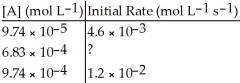
given the following information: (Multiple Choice)
4.9/5 (76)
(76) What is the activation energy for a reaction that has a rate constant of 0.0883 L mol-1 s-1 at 333 K and 0.469 L mol-1 s-1 at 366 K?
(Multiple Choice)
4.9/5 (68)
(68) What is the overall order of the following reaction, given the rate law? NO(g) + O3(g) → NO2(g) + O2(g) Rate = k[NO][O3]
(Multiple Choice)
4.8/5 (82)
(82) If a reaction carried out at 61 °C has an activation energy, Ea, of 67.3 kJ mol-1, a rate constant of 791 s-1, and a frequency factor, A, of 2.65 × 10¹³, what is the value of R? k = A 
(Multiple Choice)
4.8/5 (73)
(73) For a reaction that follows the general rate law Rate = k[A]0[B][C]2, what will happen to the rate of reaction if the concentration of A is increased by a factor of 4, the concentration of B is increased by a factor of 2, and the concentration of C is increased by a factor 6?
(Multiple Choice)
4.9/5 (88)
(88) Write a balanced reaction for which the following rate relationships are true. Rate = 
 =
 = -


= = - (Multiple Choice)
4.8/5 (87)
(87) The decomposition of 
 in solution in carbon tetrachloride proceeds via the reaction 2

 (soln) →
 (soln) +
 (soln)
The reaction is first order and has a rate constant of 4.82 ×

 at 64 °C. If the reaction is initiated with 0.073 mol in a 1.00 L vessel, how many moles remain after 151 s?
in solution in carbon tetrachloride proceeds via the reaction 2 (soln) → (soln) + (soln)
The reaction is first order and has a rate constant of 4.82 × at 64 °C. If the reaction is initiated with 0.073 mol in a 1.00 L vessel, how many moles remain after 151 s? (Multiple Choice)
4.9/5 (97)
(97) The first-order rearrangement of CH3NC is measured to have a rate constant of 3.61 × 10⁻¹⁵ s-1 at 298 K and a rate constant of 8.66 × 10⁻⁷ s-1 at 425 K. Determine the activation energy for this reaction.
(Multiple Choice)
4.8/5 (95)
(95) If the activation energy for a given compound is found to be 103 kJ mol-1 with a frequency factor of 4.0 × 10¹³ s-1, what is the rate constant for this reaction at 398 K?
(Multiple Choice)
4.9/5 (66)
(66) What is the overall order of the following reaction, given the rate law? 2 X + 3 Y → 2 Z Rate = k[X]1[Y]2
(Multiple Choice)
4.7/5 (82)
(82) Which of the following is the characteristic of a second-order reaction having only one reactant?
(Multiple Choice)
4.8/5 (80)
(80) What is the activation energy for a reaction that has a rate constant of 1.087 L mol-1 s-1 at 273 and 12.99 L mol-1 s-1 at 373 K?
(Multiple Choice)
4.9/5 (80)
(80) 
Filters
- Essay(0)
- Multiple Choice(0)
- Short Answer(0)
- True False(0)
- Matching(0)