



 Chat with AI
Exam 13: Chemical Kinetics

Exam 1: Units of Measurement for Physical and Chemical Change192 Questions
Exam 2: Atoms and Elements174 Questions
Exam 3: Molecules, Compounds, and Nomenclature187 Questions
Exam 4: Chemical Reactions and Stoichiometry261 Questions
Exam 5: Gases163 Questions
Exam 6: Thermochemistry161 Questions
Exam 7: The Quantum-Mechanical Model of the Atom170 Questions
Exam 8: Periodic Properties of the Elements144 Questions
Exam 9: Chemical Bonding I: Lewis Theory155 Questions
Exam 10: Chemical Bonding Ii: Molecular Shapes, Valence Bond Theory, and Molecular Orbital Theory180 Questions
Exam 11: Liquids, Solids, and Intermolecular Forces144 Questions
Exam 12: Solutions167 Questions
Exam 13: Chemical Kinetics170 Questions
Exam 14: Chemical Equilibrium150 Questions
Exam 15: Acids and Bases156 Questions
Exam 16: Aqueous Ionic Equilibrium173 Questions
Exam 17: Gibbs Energy and Thermodynamics134 Questions
Exam 18: Electrochemistry122 Questions
Exam 19: Radioactivity and Nuclear Chemistry116 Questions
Exam 20: Organic Chemistry I: Structures109 Questions
Exam 21: Organic Chemistry Ii: Reactions102 Questions
Exam 22: Biochemistry55 Questions
Exam 23: Chemistry of the Nonmetals50 Questions
Exam 24: Metals and Metallurgy49 Questions
Exam 25: Transition Metals and Coordination Compounds55 Questions
Select questions type


What is the activation energy for a reaction that has a rate constant of 5.68 × 10⁻⁸ s-1 at 298 K and 1.73 × 10⁻⁵ s-1 at 348 K?
(Multiple Choice)
4.9/5  (83)
(83) The first-order decomposition of cyclopropane has a rate constant of 6.7 × 10⁻⁴ s-1. If the initial concentration of cyclopropane is 1.33 mol L-1, what is the concentration of cyclopropane after 644 s?
(Multiple Choice)
5.0/5 (79)
(79) Without performing complex calculations, determine the order of a reaction that has the following initial rates for the specified starting concentration: 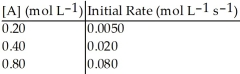
(Multiple Choice)
4.8/5 (83)
(83) A reaction with an activation energy of 71.6 kJ mol-1 has a rate constant of 8.14 L mol-1 s-1 at 350 K. At what temperature will the rate constant be one-half?
(Multiple Choice)
4.9/5 (89)
(89) Calculate the activation energy, Ea, for a reaction with a frequency factor, A, of 6.10 × 10¹⁴ s-1 and a rate constant of 13.0 s-1 at 320 K.
(Multiple Choice)
4.9/5 (86)
(86) Which of the following reactions would you predict to have the largest orientation factor?
(Multiple Choice)
4.8/5 (74)
(74) The half-life for the second-order decomposition of HI is 15.4 s when the initial concentration of HI is 0.67 mol L-1. What is the rate constant for this reaction?
(Multiple Choice)
4.7/5 (76)
(76) Calculate the temperature if a reaction has a rate constant, k, of 841 s-1, a frequency factor, A, of 6.0 × 10¹² s-1, and an activation energy, Ea, of 62 kJ mol-1.
(Multiple Choice)
4.8/5 (70)
(70) Given the following balanced equation, determine the rate of reaction with respect to [SO3]. If the rate of SO2 loss is 1.19 × 10⁻³ mol L-1 s-1, what is the rate of formation of SO3? 2SO2(g) + O2(g) → 2SO3(g)
(Multiple Choice)
4.8/5 (83)
(83) A catalyst is needed in the hydrogenation of double bonds. In the first step, the reactants must come into contact with a metal surface. This step is known as ________.
(Multiple Choice)
5.0/5 (79)
(79) Determine the missing initial rate for the following  order reaction given the following information:
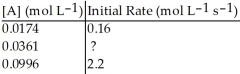
order reaction given the following information: (Multiple Choice)
4.7/5 (81)
(81) A reaction is found to have an activation energy of 108 kJ mol-1. If the rate constant for this reaction is 4.60 × 10⁻⁶ s-1 at 275 K, what is the rate constant at 366 K?
(Multiple Choice)
4.8/5 (85)
(85) For a reaction that follows the general rate law, Rate = k[A][B]2, what will happen to the rate of reaction if the concentration of B is increased by a factor of 3.00?
(Multiple Choice)
4.7/5 (84)
(84) Given the following proposed mechanism, predict the rate law for the overall reaction. 2NO2 + Cl2 → 2NO2Cl (overall reaction)
Mechanism
NO2 + Cl2 → NO2Cl + Cl slow
NO2 + Cl → NO2Cl fast
(Multiple Choice)
4.8/5 (93)
(93) A reaction with an activation energy of 84.6 kJ mol-1 has a rate constant of 0.00681 L mol-1 s-1 at 325 K. What is the rate constant at 375 K?
(Multiple Choice)
4.9/5 (73)
(73) The rate constant, k, for a first-order reaction is equal to 4.2 × 10⁻⁴ s-1. What is the half-life for the reaction?
(Multiple Choice)
4.8/5 (67)
(67) 
Filters
- Essay(0)
- Multiple Choice(0)
- Short Answer(0)
- True False(0)
- Matching(0)