



 Chat with AI
Exam 13: Chemical Kinetics

Exam 1: Units of Measurement for Physical and Chemical Change192 Questions
Exam 2: Atoms and Elements174 Questions
Exam 3: Molecules, Compounds, and Nomenclature187 Questions
Exam 4: Chemical Reactions and Stoichiometry261 Questions
Exam 5: Gases163 Questions
Exam 6: Thermochemistry161 Questions
Exam 7: The Quantum-Mechanical Model of the Atom170 Questions
Exam 8: Periodic Properties of the Elements144 Questions
Exam 9: Chemical Bonding I: Lewis Theory155 Questions
Exam 10: Chemical Bonding Ii: Molecular Shapes, Valence Bond Theory, and Molecular Orbital Theory180 Questions
Exam 11: Liquids, Solids, and Intermolecular Forces144 Questions
Exam 12: Solutions167 Questions
Exam 13: Chemical Kinetics170 Questions
Exam 14: Chemical Equilibrium150 Questions
Exam 15: Acids and Bases156 Questions
Exam 16: Aqueous Ionic Equilibrium173 Questions
Exam 17: Gibbs Energy and Thermodynamics134 Questions
Exam 18: Electrochemistry122 Questions
Exam 19: Radioactivity and Nuclear Chemistry116 Questions
Exam 20: Organic Chemistry I: Structures109 Questions
Exam 21: Organic Chemistry Ii: Reactions102 Questions
Exam 22: Biochemistry55 Questions
Exam 23: Chemistry of the Nonmetals50 Questions
Exam 24: Metals and Metallurgy49 Questions
Exam 25: Transition Metals and Coordination Compounds55 Questions
Select questions type


What is the unit of k in the following rate law? Rate = k[X]2
(Multiple Choice)
4.8/5  (95)
(95) In aqueous solution, hypobromite ion, BrO-, reacts to produce bromate ion, BrO3-, and bromide ion, Br-, according to the following chemical equation:  A plot of 1/[BrO-] vs. time is linear and the slope is equal to 0.056 L mol-1 s-1. If the initial concentration of BrO- is 0.80 mol L-1, how long will it take one-half of the BrO- ion to react?
 (Multiple Choice)
4.7/5 (76)
(76) If the concentration of a reactant is 6.25%, how many half-lives has it gone through?
(Multiple Choice)
4.8/5 (64)
(64) The rate constant for a second-order reaction is 0.54 L mol-1 s-1. What is the half-life of this reaction if the initial concentration is 0.27 mol L-1?
(Multiple Choice)
4.8/5 (93)
(93) Which of the following is the characteristic of a zero-order reaction having only one reactant?
(Multiple Choice)
4.8/5 (72)
(72) What is the overall order of the following reaction, given the rate law? X + 2 Y → 4 Z Rate = k[X][Y]
(Multiple Choice)
4.9/5 (77)
(77) Without performing complex calculations, determine the order of a reaction that has the following initial rates for the specified starting concentration: 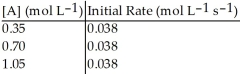
(Multiple Choice)
4.8/5 (84)
(84) The first-order decomposition of N2O at 1000 K has a rate constant of 0.76 s-1. If the initial concentration of N2O is 10.9 mol L-1, what is the concentration of N2O after 9.6 s?
(Multiple Choice)
4.9/5 (80)
(80) The decomposition of dinitrogen pentoxide is described by the chemical equation 2N2O5(g) → 4NO2(g) + O2(g).
If the rate of disappearance of N2O5 is equal to 1.60 mol min-1 at a particular moment, what is the rate of appearance of NO2 at that moment?
(Multiple Choice)
4.8/5 (78)
(78) A reaction with an activation energy of 34.0 kJ mol-1 has a rate constant of 26.8 s-1 at 354 K. What is the rate constant at 314 K?
(Multiple Choice)
4.9/5 (74)
(74) Determine the rate law and the value of k for the following reaction using the data provided: S2O82⁻(aq) + 3 I⁻(aq) → 2 SO42⁻(g) + I3⁻(aq) [S2O82⁻]i (M) [I⁻]i (M) Initial Rate (M-1 s-1)
0)30 0.42 4.54
0)44 0.42 6.65
0)44 0.21 3.33
(Multiple Choice)
4.9/5 (71)
(71) Without performing complex calculations, determine the order of a reaction that has the following initial rates for the specified starting concentration: 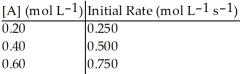
(Multiple Choice)
4.9/5 (69)
(69) Calculate the temperature if a reaction has a rate constant, k, of 21.3 s-1, a frequency factor, A, of 7.98 × 10¹³ s-1, and an activation energy, Ea, of 102 kJ mol-1.
(Multiple Choice)
4.9/5 (78)
(78) The reaction that occurs in a Breathalyzer, a device used to determine the alcohol level in a person's bloodstream, is given below. If the rate of appearance of Cr2(SO4)3 is 1.64 mol min-1 at a particular moment, what is the rate of disappearance of C2H6O at that moment? 2K2Cr2O7 + 8H2SO4 + 3C2H6O → 2Cr2(SO4)3 + 2K2SO4 + 11H2O
(Multiple Choice)
4.7/5 (92)
(92) The second-order decomposition of HI has a rate constant of 1.80 × 10⁻³ L mol-1 s-1. How much HI remains after 27.3 s if the initial concentration of HI is 4.78 mol L-1?
(Multiple Choice)
4.9/5 (75)
(75) What is the unit of k in the following rate law? Rate = k[X][Y]1/2
(Multiple Choice)
4.8/5 (85)
(85) Given the following rate law, how does the rate of reaction change if the concentration of X is doubled? Rate = k [X][Y]2
(Multiple Choice)
4.8/5 (78)
(78) Given the following balanced equation, determine the rate of reaction with respect to [NOCl]. If the rate of NO loss is 1.68 × 10⁻² mol L-1 s-1, what is the rate of formation of NOCl? 2NO(g) + Cl2(g) → 2NOCl(g)
(Multiple Choice)
4.8/5 (83)
(83) 
Filters
- Essay(0)
- Multiple Choice(0)
- Short Answer(0)
- True False(0)
- Matching(0)