



 Chat with AI
Exam 27: The Rise of Animal Diversity

Exam 1: Introduction: Evolution and the Foundations of Biology36 Questions
Exam 2: The Chemical Context of Life135 Questions
Exam 3: Carbon and the Molecular Diversity of Life136 Questions
Exam 4: A Tour of the Cell75 Questions
Exam 5: Membrane Transport and Cell Signaling86 Questions
Exam 6: An Introduction to Metabolism79 Questions
Exam 7: Cellular Respiration and Fermentation99 Questions
Exam 8: Photosynthesis68 Questions
Exam 9: The Cell Cycle57 Questions
Exam 10: Meiosis and Sexual Life Cycles59 Questions
Exam 11: Mendel and the Gene Idea57 Questions
Exam 12: The Chromosomal Basis of Inheritance43 Questions
Exam 13: The Molecular Basis of Inheritance62 Questions
Exam 14: Gene Expression: From Gene to Protein77 Questions
Exam 15: Regulation of Gene Expression48 Questions
Exam 16: Development,stem Cells,and Cancer34 Questions
Exam 17: Viruses35 Questions
Exam 18: Genomes and Their Evolution31 Questions
Exam 19: Descent With Modification61 Questions
Exam 20: Phylogeny72 Questions
Exam 21: The Evolution of Populations81 Questions
Exam 22: The Origin of Species75 Questions
Exam 23: Broad Patterns of Evolution60 Questions
Exam 24: Early Life and the Diversification of Prokaryotes99 Questions
Exam 25: The Origin and Diversification of Eukaryotes80 Questions
Exam 26: The Colonization of Land by Plants and Fungi128 Questions
Exam 27: The Rise of Animal Diversity93 Questions
Exam 28: Plant Structure and Growth67 Questions
Exam 29: Resource Acquisition,nutrition,and Transport in Vascular Plants115 Questions
Exam 30: Reproduction and Domestication of Flowering Plants72 Questions
Exam 31: Plant Responses to Internal and External Signals74 Questions
Exam 32: Homeostasis and Endocrine Signaling116 Questions
Exam 33: Animal Nutrition75 Questions
Exam 34: Circulation and Gas Exchange94 Questions
Exam 35: The Immune System96 Questions
Exam 36: Reproduction and Development123 Questions
Exam 37: Neurons,synapses,and Signaling77 Questions
Exam 38: Nervous and Sensory Systems105 Questions
Exam 39: Motor Mechanisms and Behavior83 Questions
Exam 40: Population Ecology and the Distribution of Organisms93 Questions
Exam 41: Ecological Communities59 Questions
Exam 42: Ecosystems and Energy86 Questions
Exam 43: Conservation Biology and Global Change71 Questions
Select questions type


In the figure below,the Deuterostomia clade is most closely related to which two main clades? 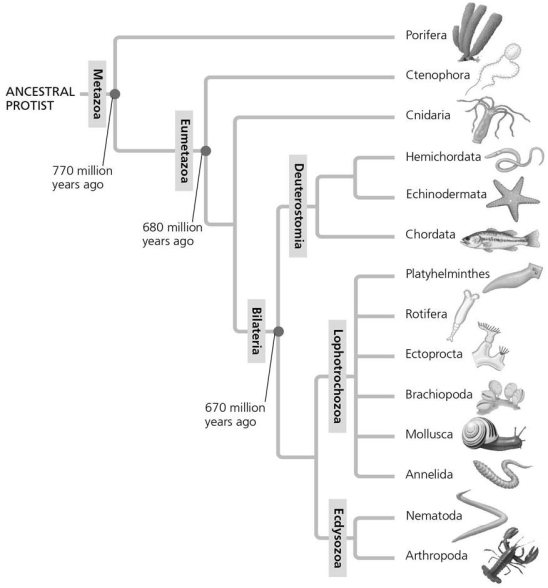
(Multiple Choice)
4.9/5  (81)
(81) If the current molecular evidence regarding animal origins is well substantiated in the future,then what will be true of any contrary evidence regarding the origin of animals derived from the fossil record?
(Multiple Choice)
4.8/5 (68)
(68)  -Use the figure to identify the most recent common ancestor (branch point)of Brachiopods and Echinoderms.How many other common ancestors (branch points)must be considered when comparing these taxa to Sponges?
 (Multiple Choice)
4.9/5 (81)
(81) Evidence indicates that an ancestral finch species from South America arrived on the Galapágos Islands and formed many new species,adapting to the diverse environments on the islands.With the evolution of these new bird species on the Galapágos Islands,we would expect to find a corresponding
(Multiple Choice)
4.8/5 (82)
(82) Which of the following could be considered the most recent common ancestor of living tetrapods?
(Multiple Choice)
4.7/5 (89)
(89) Fossil steroid and molecular clock evidence suggests that animals originated
(Multiple Choice)
5.0/5 (90)
(90) Using similarities in body symmetry and other anatomical features to assign an organism to a clade involves
1)cladistics based on body plan.
2)molecular-based phylogeny.
3)morphology-based phylogeny.
(Multiple Choice)
4.8/5 (84)
(84) Which of the following is true of members of the phylum Cnidaria?
(Multiple Choice)
4.7/5 (87)
(87) Chordate pharyngeal slits appear to have functioned first as
(Multiple Choice)
4.9/5 (85)
(85) Some researchers claim that sponge genomes have homeotic genes (genes that regulate development of anatomical structures)but no Hox genes (genes that regulate development of posterior-anterior axes and body segments).If true,this finding would
(Multiple Choice)
4.9/5 (85)
(85) Both animals and fungi are heterotrophic.The fact below that distinguishes animal heterotrophy from fungal heterotrophy is that only animals derive their nutrition from
(Multiple Choice)
5.0/5 (78)
(78) Why is the amniotic egg considered an important evolutionary breakthrough?
(Multiple Choice)
4.7/5 (87)
(87) 
Filters
- Essay(0)
- Multiple Choice(0)
- Short Answer(0)
- True False(0)
- Matching(0)