



 Chat with AI
Exam 27: The Rise of Animal Diversity

Exam 1: Introduction: Evolution and the Foundations of Biology36 Questions
Exam 2: The Chemical Context of Life135 Questions
Exam 3: Carbon and the Molecular Diversity of Life136 Questions
Exam 4: A Tour of the Cell75 Questions
Exam 5: Membrane Transport and Cell Signaling86 Questions
Exam 6: An Introduction to Metabolism79 Questions
Exam 7: Cellular Respiration and Fermentation99 Questions
Exam 8: Photosynthesis68 Questions
Exam 9: The Cell Cycle57 Questions
Exam 10: Meiosis and Sexual Life Cycles59 Questions
Exam 11: Mendel and the Gene Idea57 Questions
Exam 12: The Chromosomal Basis of Inheritance43 Questions
Exam 13: The Molecular Basis of Inheritance62 Questions
Exam 14: Gene Expression: From Gene to Protein77 Questions
Exam 15: Regulation of Gene Expression48 Questions
Exam 16: Development,stem Cells,and Cancer34 Questions
Exam 17: Viruses35 Questions
Exam 18: Genomes and Their Evolution31 Questions
Exam 19: Descent With Modification61 Questions
Exam 20: Phylogeny72 Questions
Exam 21: The Evolution of Populations81 Questions
Exam 22: The Origin of Species75 Questions
Exam 23: Broad Patterns of Evolution60 Questions
Exam 24: Early Life and the Diversification of Prokaryotes99 Questions
Exam 25: The Origin and Diversification of Eukaryotes80 Questions
Exam 26: The Colonization of Land by Plants and Fungi128 Questions
Exam 27: The Rise of Animal Diversity93 Questions
Exam 28: Plant Structure and Growth67 Questions
Exam 29: Resource Acquisition,nutrition,and Transport in Vascular Plants115 Questions
Exam 30: Reproduction and Domestication of Flowering Plants72 Questions
Exam 31: Plant Responses to Internal and External Signals74 Questions
Exam 32: Homeostasis and Endocrine Signaling116 Questions
Exam 33: Animal Nutrition75 Questions
Exam 34: Circulation and Gas Exchange94 Questions
Exam 35: The Immune System96 Questions
Exam 36: Reproduction and Development123 Questions
Exam 37: Neurons,synapses,and Signaling77 Questions
Exam 38: Nervous and Sensory Systems105 Questions
Exam 39: Motor Mechanisms and Behavior83 Questions
Exam 40: Population Ecology and the Distribution of Organisms93 Questions
Exam 41: Ecological Communities59 Questions
Exam 42: Ecosystems and Energy86 Questions
Exam 43: Conservation Biology and Global Change71 Questions
Select questions type


In the traditional phylogeny (A),the phylum Platyhelminthes is depicted as a sister taxon to the rest of the protostome phyla and as having diverged earlier from the lineage that led to the rest of the protostomes.In the molecular phylogeny (B),Platyhelminthes is depicted as a lophotrochozoan phylum.What probably led to this change?
(Multiple Choice)
4.8/5  (86)
(86) Had the teacher wanted to point out organisms that move and feed using the same structural adaptation,the teacher should have chosen the
(Multiple Choice)
4.9/5 (63)
(63) Which of the following clades contains the greatest number of animal species?
(Multiple Choice)
4.9/5 (81)
(81) During chordate evolution,what is the sequence (from earliest to most recent)in which the following structures arose?
1)amniotic egg
2)paired fins
3)jaws
4)four-chambered heart
(Multiple Choice)
4.9/5 (79)
(79) Which of the following genetic processes may be most helpful in accounting for the Cambrian explosion?
(Multiple Choice)
4.9/5 (59)
(59) Please use the following information to answer the questions below.
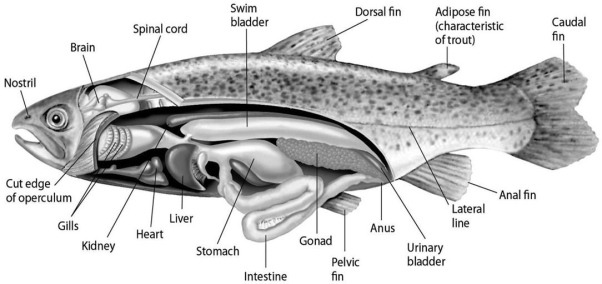 Figure 27.2
Fishes that have swim bladders can regulate their density and thus their buoyancy.There are two types of swim bladder: physostomous and physoclistous.The ancestral version is the physostomous version,in which the swim bladder is connected to the esophagus via a short tube (Figure 27.2).The fish fills this version by swimming to the surface,taking gulps of air,and directing them into the swim bladder.Air is removed from this version by "belching." The physoclistous version is more derived and has lost its connection to the esophagus.Instead,gas enters and leaves the swim bladder via special circulatory mechanisms within the wall of the swim bladder.
-The presence of a swim bladder allows the typical ray-finned fish to stop swimming and still
Figure 27.2
Fishes that have swim bladders can regulate their density and thus their buoyancy.There are two types of swim bladder: physostomous and physoclistous.The ancestral version is the physostomous version,in which the swim bladder is connected to the esophagus via a short tube (Figure 27.2).The fish fills this version by swimming to the surface,taking gulps of air,and directing them into the swim bladder.Air is removed from this version by "belching." The physoclistous version is more derived and has lost its connection to the esophagus.Instead,gas enters and leaves the swim bladder via special circulatory mechanisms within the wall of the swim bladder.
-The presence of a swim bladder allows the typical ray-finned fish to stop swimming and still (Multiple Choice)
4.9/5 (90)
(90) What do all craniates have that earlier chordates did not have?
(Multiple Choice)
5.0/5 (84)
(84) Which tree(s)has (have)been created by emphasizing the structural simplicity of placozoans?
(Multiple Choice)
4.8/5 (86)
(86) On the basis of the information in the paragraph,which of these should be able to be observed in Tp?
(Multiple Choice)
4.7/5 (84)
(84) Which of the following are the only extant animals that descended directly from dinosaurs?
(Multiple Choice)
4.8/5 (91)
(91) Which of these might have been observed in the common ancestor of chondrichthyans and osteichthyans?
(Multiple Choice)
4.7/5 (92)
(92) One important evolutionary change that occurred with the rise of animals is
(Multiple Choice)
4.9/5 (91)
(91) Which statement is most consistent with the hypothesis that the Cambrian explosion was caused by the rise of predator-prey relationships?
(Multiple Choice)
4.8/5 (75)
(75) What is true of the feeding stage of cycliophorans?
1)It is chemoheterotrophic.
2)It is sessile.
3)Its tube feet allow it to feed efficiently.
4)It has radial symmetry.
(Multiple Choice)
4.8/5 (75)
(75) Which of the following characteristics distinguishes modern humans from other modern apes?
1)Humans walk upright.
2)Humans walk on two legs.
3)Humans use simple tools.
4)Humans are capable of symbolic thought.
(Multiple Choice)
4.9/5 (85)
(85) Arrange these taxonomic terms from most inclusive (most general)to least inclusive (most specific).
1)lobe-fins
2)amphibians
3)gnathostomes
4)osteichthyans
5)tetrapods
(Multiple Choice)
4.9/5 (78)
(78)  Table 27.1.Proposed Number of Hox Genes in Various Extant and Extinct Animals
-All things being equal,which of these is the simplest explanation for the change in the number of Hox genes from the last common ancestor of insects and vertebrates to ancestral vertebrates,as shown in Table 27.1?
Table 27.1.Proposed Number of Hox Genes in Various Extant and Extinct Animals
-All things being equal,which of these is the simplest explanation for the change in the number of Hox genes from the last common ancestor of insects and vertebrates to ancestral vertebrates,as shown in Table 27.1? (Multiple Choice)
4.9/5 (70)
(70) 
Filters
- Essay(0)
- Multiple Choice(0)
- Short Answer(0)
- True False(0)
- Matching(0)