



 Chat with AI
Exam 29: Resource Acquisition,nutrition,and Transport in Vascular Plants

Exam 1: Introduction: Evolution and the Foundations of Biology36 Questions
Exam 2: The Chemical Context of Life135 Questions
Exam 3: Carbon and the Molecular Diversity of Life136 Questions
Exam 4: A Tour of the Cell75 Questions
Exam 5: Membrane Transport and Cell Signaling86 Questions
Exam 6: An Introduction to Metabolism79 Questions
Exam 7: Cellular Respiration and Fermentation99 Questions
Exam 8: Photosynthesis68 Questions
Exam 9: The Cell Cycle57 Questions
Exam 10: Meiosis and Sexual Life Cycles59 Questions
Exam 11: Mendel and the Gene Idea57 Questions
Exam 12: The Chromosomal Basis of Inheritance43 Questions
Exam 13: The Molecular Basis of Inheritance62 Questions
Exam 14: Gene Expression: From Gene to Protein77 Questions
Exam 15: Regulation of Gene Expression48 Questions
Exam 16: Development,stem Cells,and Cancer34 Questions
Exam 17: Viruses35 Questions
Exam 18: Genomes and Their Evolution31 Questions
Exam 19: Descent With Modification61 Questions
Exam 20: Phylogeny72 Questions
Exam 21: The Evolution of Populations81 Questions
Exam 22: The Origin of Species75 Questions
Exam 23: Broad Patterns of Evolution60 Questions
Exam 24: Early Life and the Diversification of Prokaryotes99 Questions
Exam 25: The Origin and Diversification of Eukaryotes80 Questions
Exam 26: The Colonization of Land by Plants and Fungi128 Questions
Exam 27: The Rise of Animal Diversity93 Questions
Exam 28: Plant Structure and Growth67 Questions
Exam 29: Resource Acquisition,nutrition,and Transport in Vascular Plants115 Questions
Exam 30: Reproduction and Domestication of Flowering Plants72 Questions
Exam 31: Plant Responses to Internal and External Signals74 Questions
Exam 32: Homeostasis and Endocrine Signaling116 Questions
Exam 33: Animal Nutrition75 Questions
Exam 34: Circulation and Gas Exchange94 Questions
Exam 35: The Immune System96 Questions
Exam 36: Reproduction and Development123 Questions
Exam 37: Neurons,synapses,and Signaling77 Questions
Exam 38: Nervous and Sensory Systems105 Questions
Exam 39: Motor Mechanisms and Behavior83 Questions
Exam 40: Population Ecology and the Distribution of Organisms93 Questions
Exam 41: Ecological Communities59 Questions
Exam 42: Ecosystems and Energy86 Questions
Exam 43: Conservation Biology and Global Change71 Questions
Select questions type


The earliest vascular plants on land had underground stems (rhizomes)but no roots.Water and mineral nutrients were most likely obtained by
(Multiple Choice)
4.8/5  (83)
(83) In west Texas,cotton has become an important crop in the last several decades.However,in this hot,dry part of the country there is little rainfall,so farmers irrigate their cotton fields.They must also regularly fertilize the cotton fields because the soil is very sandy.Figure 29.1 shows the record of annual productivity (measured in kilograms of cotton per hectare of land)since 1960 in a west Texas cotton field.Use these data to answer the following question(s).
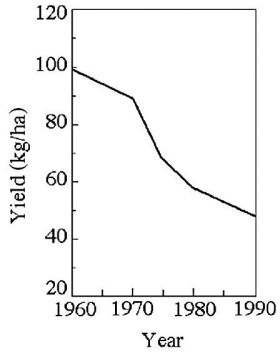 Figure 29.1
-If you were the county agriculture agent,what would be the best advice you could give the farmer who owns the field under study in Figure 29.1?
Figure 29.1
-If you were the county agriculture agent,what would be the best advice you could give the farmer who owns the field under study in Figure 29.1? (Multiple Choice)
4.8/5 (76)
(76) You are weeding your garden when you accidentally expose some roots of your pea plants.You notice swellings (root nodules)on the roots,and there is a reddish tinge to the ones you accidentally damaged.Most likely your pea plants
(Multiple Choice)
4.9/5 (91)
(91) Compared to a cell with few aquaporins in its membrane,a cell containing many aquaporins will have a
(Multiple Choice)
4.9/5 (66)
(66) Which of the following determines the direction of water movement across the membrane?
(Multiple Choice)
4.8/5 (71)
(71) A class of 10 students was divided into two groups.The first group was given a rose leaf,and the second group was given a cactus.Which of these two groups identified the xerophyte based on which characteristic feature(s)?
(Multiple Choice)
4.8/5 (77)
(77) Which of the following ions plays a critical role in transport and cotransport processes in plant cells?
(Multiple Choice)
4.9/5 (84)
(84) The enzyme complex nitrogenase catalyzes the reaction that reduces atmospheric nitrogen to
(Multiple Choice)
4.8/5 (85)
(85) In which plant cell or tissue would the pressure component of water potential most often be negative?
(Multiple Choice)
4.7/5 (75)
(75) Iron deficiency is often indicated by yellowing in newly formed leaves.This suggests that iron is
(Multiple Choice)
4.7/5 (71)
(71) 
Filters
- Essay(0)
- Multiple Choice(0)
- Short Answer(0)
- True False(0)
- Matching(0)