



 Chat with AI
Exam 35: The Immune System

Exam 1: Introduction: Evolution and the Foundations of Biology36 Questions
Exam 2: The Chemical Context of Life135 Questions
Exam 3: Carbon and the Molecular Diversity of Life136 Questions
Exam 4: A Tour of the Cell75 Questions
Exam 5: Membrane Transport and Cell Signaling86 Questions
Exam 6: An Introduction to Metabolism79 Questions
Exam 7: Cellular Respiration and Fermentation99 Questions
Exam 8: Photosynthesis68 Questions
Exam 9: The Cell Cycle57 Questions
Exam 10: Meiosis and Sexual Life Cycles59 Questions
Exam 11: Mendel and the Gene Idea57 Questions
Exam 12: The Chromosomal Basis of Inheritance43 Questions
Exam 13: The Molecular Basis of Inheritance62 Questions
Exam 14: Gene Expression: From Gene to Protein77 Questions
Exam 15: Regulation of Gene Expression48 Questions
Exam 16: Development,stem Cells,and Cancer34 Questions
Exam 17: Viruses35 Questions
Exam 18: Genomes and Their Evolution31 Questions
Exam 19: Descent With Modification61 Questions
Exam 20: Phylogeny72 Questions
Exam 21: The Evolution of Populations81 Questions
Exam 22: The Origin of Species75 Questions
Exam 23: Broad Patterns of Evolution60 Questions
Exam 24: Early Life and the Diversification of Prokaryotes99 Questions
Exam 25: The Origin and Diversification of Eukaryotes80 Questions
Exam 26: The Colonization of Land by Plants and Fungi128 Questions
Exam 27: The Rise of Animal Diversity93 Questions
Exam 28: Plant Structure and Growth67 Questions
Exam 29: Resource Acquisition,nutrition,and Transport in Vascular Plants115 Questions
Exam 30: Reproduction and Domestication of Flowering Plants72 Questions
Exam 31: Plant Responses to Internal and External Signals74 Questions
Exam 32: Homeostasis and Endocrine Signaling116 Questions
Exam 33: Animal Nutrition75 Questions
Exam 34: Circulation and Gas Exchange94 Questions
Exam 35: The Immune System96 Questions
Exam 36: Reproduction and Development123 Questions
Exam 37: Neurons,synapses,and Signaling77 Questions
Exam 38: Nervous and Sensory Systems105 Questions
Exam 39: Motor Mechanisms and Behavior83 Questions
Exam 40: Population Ecology and the Distribution of Organisms93 Questions
Exam 41: Ecological Communities59 Questions
Exam 42: Ecosystems and Energy86 Questions
Exam 43: Conservation Biology and Global Change71 Questions
Select questions type


A patient complaining of watery,itchy eyes and sneezing after being given a flower bouquet as a birthday gift should first be treated with
(Multiple Choice)
4.9/5  (76)
(76) Juan is a 5-year-old boy and recently recovered from the chickenpox.He returned to kindergarten and found out that his friend Tram had chickenpox too.Normally chickenpox is very infectious,but Juan did not acquire it again.Why was Juan protected from a second exposure to chickenpox?
(Multiple Choice)
4.8/5 (82)
(82) An inflammation-causing signal released by mast cells at the site of an infection is (are)
(Multiple Choice)
4.8/5 (70)
(70) Fruit flies normally produce two types of antimicrobial peptides (defensin and drosomycin).Mutant fruit flies were generated that produced no antimicrobial peptides,defensin only,or drosomycin only.Wild-type flies and the mutant flies were then tested for survival after infection with Neurospora crassa fungi.What statement about these data is true? 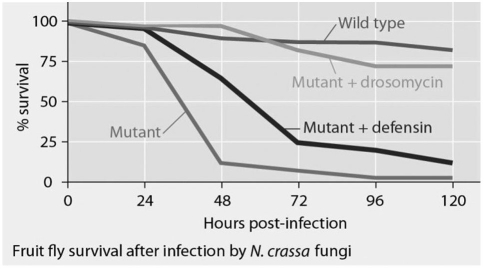
(Multiple Choice)
4.7/5 (74)
(74) Cave art by early humans recognized the existence of the major signs of inflammation.The most inclusive set of symptoms of inflammation that might appear in such early human art is
(Multiple Choice)
4.8/5 (88)
(88) Which statement best describes the difference in responses of effector B cells (plasma cells)and cytotoxic T cells?
(Multiple Choice)
4.9/5 (86)
(86) Among the last line of defenses against prolonged exposure to an extracellular pathogen is
(Multiple Choice)
5.0/5 (76)
(76) Arrange these components of the mammalian immune system as it first responds to a pathogen in the correct sequence.
I.Pathogen is destroyed.
II.Lymphocytes secrete antibodies.
III.Antigenic determinants from pathogen bind to antigen receptors on lymphocytes.
IV.Lymphocytes specific to antigenic determinants from pathogen become numerous.
V.Only memory cells remain.
(Multiple Choice)
5.0/5 (87)
(87) Mammals have Toll-like receptors (TLRs)that can recognize a kind of macromolecule that is absent from vertebrates but present in/on certain groups of pathogens,including viral
(Multiple Choice)
4.8/5 (74)
(74) Normal immune responses can be described as polyclonal because
(Multiple Choice)
4.8/5 (83)
(83) A mutation in the gene for CD4 leads to the production of nonfunctioning CD4 proteins in the plasma membrane of a helper T cell.What role would the helper T cell be unable to perform?
(Multiple Choice)
4.9/5 (64)
(64) Through the evolution of antigenic variation,pathogens are able to
(Multiple Choice)
4.9/5 (79)
(79) 
Filters
- Essay(0)
- Multiple Choice(0)
- Short Answer(0)
- True False(0)
- Matching(0)