



 Chat with AI
Exam 35: The Immune System

Exam 1: Introduction: Evolution and the Foundations of Biology36 Questions
Exam 2: The Chemical Context of Life135 Questions
Exam 3: Carbon and the Molecular Diversity of Life136 Questions
Exam 4: A Tour of the Cell75 Questions
Exam 5: Membrane Transport and Cell Signaling86 Questions
Exam 6: An Introduction to Metabolism79 Questions
Exam 7: Cellular Respiration and Fermentation99 Questions
Exam 8: Photosynthesis68 Questions
Exam 9: The Cell Cycle57 Questions
Exam 10: Meiosis and Sexual Life Cycles59 Questions
Exam 11: Mendel and the Gene Idea57 Questions
Exam 12: The Chromosomal Basis of Inheritance43 Questions
Exam 13: The Molecular Basis of Inheritance62 Questions
Exam 14: Gene Expression: From Gene to Protein77 Questions
Exam 15: Regulation of Gene Expression48 Questions
Exam 16: Development,stem Cells,and Cancer34 Questions
Exam 17: Viruses35 Questions
Exam 18: Genomes and Their Evolution31 Questions
Exam 19: Descent With Modification61 Questions
Exam 20: Phylogeny72 Questions
Exam 21: The Evolution of Populations81 Questions
Exam 22: The Origin of Species75 Questions
Exam 23: Broad Patterns of Evolution60 Questions
Exam 24: Early Life and the Diversification of Prokaryotes99 Questions
Exam 25: The Origin and Diversification of Eukaryotes80 Questions
Exam 26: The Colonization of Land by Plants and Fungi128 Questions
Exam 27: The Rise of Animal Diversity93 Questions
Exam 28: Plant Structure and Growth67 Questions
Exam 29: Resource Acquisition,nutrition,and Transport in Vascular Plants115 Questions
Exam 30: Reproduction and Domestication of Flowering Plants72 Questions
Exam 31: Plant Responses to Internal and External Signals74 Questions
Exam 32: Homeostasis and Endocrine Signaling116 Questions
Exam 33: Animal Nutrition75 Questions
Exam 34: Circulation and Gas Exchange94 Questions
Exam 35: The Immune System96 Questions
Exam 36: Reproduction and Development123 Questions
Exam 37: Neurons,synapses,and Signaling77 Questions
Exam 38: Nervous and Sensory Systems105 Questions
Exam 39: Motor Mechanisms and Behavior83 Questions
Exam 40: Population Ecology and the Distribution of Organisms93 Questions
Exam 41: Ecological Communities59 Questions
Exam 42: Ecosystems and Energy86 Questions
Exam 43: Conservation Biology and Global Change71 Questions
Select questions type


The EBV antigen fragments will be presented by the virus-infected cells along with
(Multiple Choice)
4.8/5  (76)
(76) The major histocompatibility complex (MHC)is important in a T cell's ability to
(Multiple Choice)
4.8/5 (70)
(70) Suppose a T cell had no access to the amino acid cysteine.What consequence would this have with regard to the immune response of the T cell?
(Multiple Choice)
4.8/5 (77)
(77) An invertebrate,such as an insect,has innate immunity activity in its intestine that likely includes
(Multiple Choice)
4.9/5 (82)
(82) A researcher suspects that a weakened immune response may be due to poor antigen presentation.Which experiment would best test this hypothesis?
(Multiple Choice)
4.7/5 (73)
(73) Suppose you get a cut on your finger,and bacteria enter your skin through the cut.What would be the immediate response by your immune system?
(Multiple Choice)
4.9/5 (63)
(63) The ability of some viruses to remain inactive (latent)for a period of time is exemplified by
(Multiple Choice)
4.9/5 (87)
(87) According to the graph,B cells will first produce effector cells 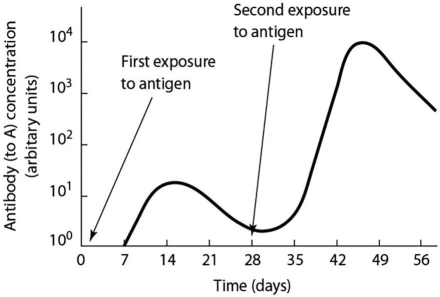
(Multiple Choice)
4.9/5 (75)
(75) Secondary immune responses upon a second exposure to a pathogen are due to the activation of
(Multiple Choice)
4.9/5 (80)
(80) Fruit flies normally produce two types of antimicrobial peptides (defensin and drosomycin).Mutant fruit flies were generated that produced no antimicrobial peptides,defensin only,or drosomycin only.Wild-type flies and the mutant flies were then tested for survival after infection with Micrococcus luteus bacteria.What statement about these data is true? 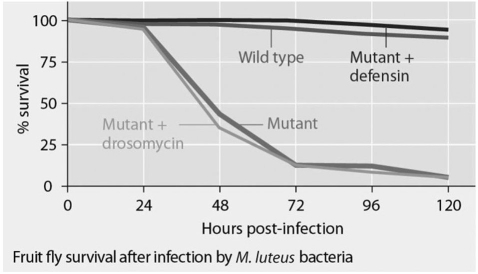
(Multiple Choice)
4.9/5 (92)
(92) An example of a pathogen that undergoes rapid changes resulting in antigenic variation is
(Multiple Choice)
4.8/5 (85)
(85) B cells have antigen receptors that bind to antigens that are either freely dissolved or present on the surface of invading/foreign cells.T cells have antigen receptors that
(Multiple Choice)
4.8/5 (80)
(80) Fruit flies normally produce two types of antimicrobial peptides (defensin and drosomycin).Mutant fruit flies were generated that produced no antimicrobial peptides,defensin only,or drosomycin only.Wild-type flies and the mutant flies were then tested for survival after infection with Neurospora crassa fungi or with Micrococcus luteus bacteria.The results are shown in Figures 35.1 and 35.2. 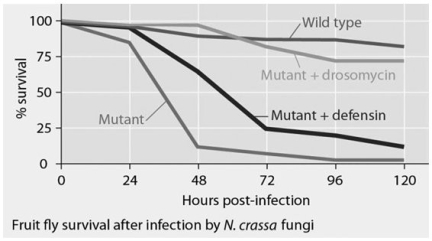 Figure 35.1
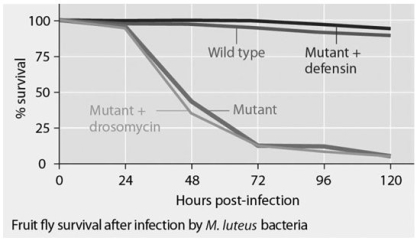 Figure 35.2
The results shown in Figures 35.1 and 35.2 support the hypothesis that
Figure 35.1
Figure 35.2
The results shown in Figures 35.1 and 35.2 support the hypothesis that (Multiple Choice)
4.8/5 (80)
(80) Clonal selection of B cells activated by antigen exposure leads to production of
(Multiple Choice)
4.9/5 (73)
(73) For the successful development of a vaccine to be used against a pathogen,it is necessary that
(Multiple Choice)
4.9/5 (84)
(84) There is a mutation in the gene for CD4 in a helper T cell such that it is transcribed and translated,but it cannot bind to class II MHC molecules.What effect will this have on the adaptive immune response?
(Multiple Choice)
4.9/5 (81)
(81) The number of major histocompatibility complex (MHC)protein combinations possible in a given population is enormous.However,an individual in that diverse population has a far more limited array of MHC molecules because
(Multiple Choice)
5.0/5 (74)
(74) 
Filters
- Essay(0)
- Multiple Choice(0)
- Short Answer(0)
- True False(0)
- Matching(0)