



 Chat with AI
Exam 38: Nervous and Sensory Systems

Exam 1: Introduction: Evolution and the Foundations of Biology36 Questions
Exam 2: The Chemical Context of Life135 Questions
Exam 3: Carbon and the Molecular Diversity of Life136 Questions
Exam 4: A Tour of the Cell75 Questions
Exam 5: Membrane Transport and Cell Signaling86 Questions
Exam 6: An Introduction to Metabolism79 Questions
Exam 7: Cellular Respiration and Fermentation99 Questions
Exam 8: Photosynthesis68 Questions
Exam 9: The Cell Cycle57 Questions
Exam 10: Meiosis and Sexual Life Cycles59 Questions
Exam 11: Mendel and the Gene Idea57 Questions
Exam 12: The Chromosomal Basis of Inheritance43 Questions
Exam 13: The Molecular Basis of Inheritance62 Questions
Exam 14: Gene Expression: From Gene to Protein77 Questions
Exam 15: Regulation of Gene Expression48 Questions
Exam 16: Development,stem Cells,and Cancer34 Questions
Exam 17: Viruses35 Questions
Exam 18: Genomes and Their Evolution31 Questions
Exam 19: Descent With Modification61 Questions
Exam 20: Phylogeny72 Questions
Exam 21: The Evolution of Populations81 Questions
Exam 22: The Origin of Species75 Questions
Exam 23: Broad Patterns of Evolution60 Questions
Exam 24: Early Life and the Diversification of Prokaryotes99 Questions
Exam 25: The Origin and Diversification of Eukaryotes80 Questions
Exam 26: The Colonization of Land by Plants and Fungi128 Questions
Exam 27: The Rise of Animal Diversity93 Questions
Exam 28: Plant Structure and Growth67 Questions
Exam 29: Resource Acquisition,nutrition,and Transport in Vascular Plants115 Questions
Exam 30: Reproduction and Domestication of Flowering Plants72 Questions
Exam 31: Plant Responses to Internal and External Signals74 Questions
Exam 32: Homeostasis and Endocrine Signaling116 Questions
Exam 33: Animal Nutrition75 Questions
Exam 34: Circulation and Gas Exchange94 Questions
Exam 35: The Immune System96 Questions
Exam 36: Reproduction and Development123 Questions
Exam 37: Neurons,synapses,and Signaling77 Questions
Exam 38: Nervous and Sensory Systems105 Questions
Exam 39: Motor Mechanisms and Behavior83 Questions
Exam 40: Population Ecology and the Distribution of Organisms93 Questions
Exam 41: Ecological Communities59 Questions
Exam 42: Ecosystems and Energy86 Questions
Exam 43: Conservation Biology and Global Change71 Questions
Select questions type


Suppose a person could go days between eating but not feel hungry.What part of his or her brain may be affected?
(Multiple Choice)
4.7/5  (80)
(80) The activation of the parasympathetic branch of the autonomic nervous system is associated with
(Multiple Choice)
4.9/5 (85)
(85) The cochlea is an organ of auditory transduction that contains
(Multiple Choice)
4.7/5 (90)
(90) Juan is a 67-year-old male who has been diagnosed with a brain tumor.Notably,Juan experiences rapid fluctuations in his heart rate even when at rest.Where is his tumor likely located?
(Multiple Choice)
4.8/5 (73)
(73) 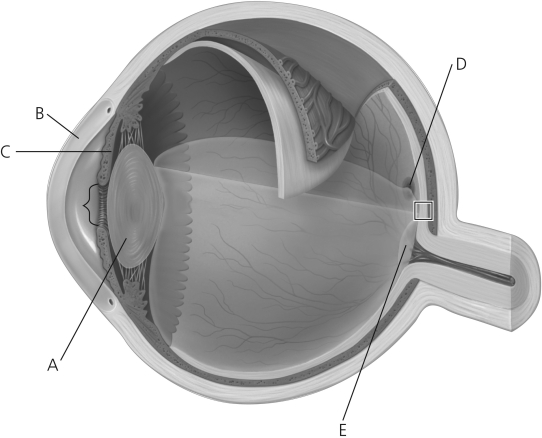 -Cataracts are a medical condition that result in clouding of the eye structure that focuses light and can be caused by aging,trauma,and radiation.What structure is most affected in cataracts?
 (Multiple Choice)
5.0/5 (75)
(75) Artificial electrical stimulation of a human's menthol-sensitive neurons would likely produce the sensation of
(Multiple Choice)
4.8/5 (80)
(80) What would you expect to see in an fMRI analysis of person who is experiencing hunger?
(Multiple Choice)
4.8/5 (80)
(80) Amar is a 67-year-old male who has been diagnosed with a brain tumor.Notably,Amar experiences rapid fluctuations in his breathing patterns even when at rest.Where is his tumor likely located?
(Multiple Choice)
5.0/5 (85)
(85) 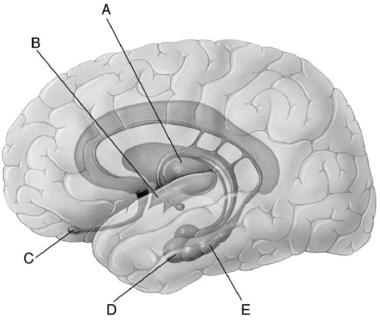 Figure 38.1
-A person is having trouble deciphering emotions.Which structure labeled in Figure 38.1 would be affected?
Figure 38.1
-A person is having trouble deciphering emotions.Which structure labeled in Figure 38.1 would be affected? (Multiple Choice)
4.8/5 (79)
(79) The coordination of groups of skeletal muscles is driven by activity in the
(Multiple Choice)
4.8/5 (74)
(74) While attempting to capture the scorpion,the mouse's heart rate increases,and there is an increase in epinephrine in the mouse's blood.What nervous system division is responsible for the mouse's physiological state?
(Multiple Choice)
4.8/5 (82)
(82) Tastes and smells are distinct kinds of environmental information in that
(Multiple Choice)
4.9/5 (73)
(73) Please use the following information to answer the questions below.
The southern grasshopper mouse feeds regularly on the Arizona bark scorpion,the most venomous scorpion in the United States.While attempting to capture the scorpion,the mouse usually gets stung multiple times by the scorpion but does not seem to be affected.
-What type of sensory receptor in the mouse seems to be immune to the scorpion's sting and venom?
(Multiple Choice)
4.8/5 (79)
(79) 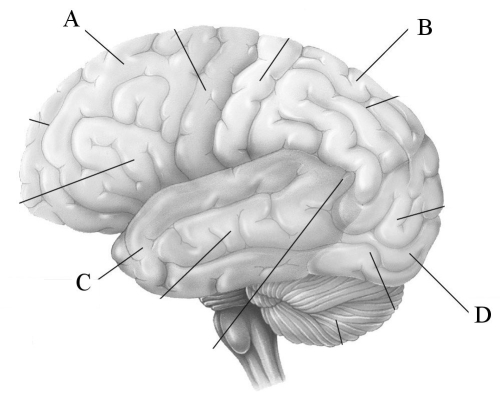 -Amyotrophic lateral sclerosis (ALS)is a progressive neurodegenerative disorder that results in skeletal muscle wasting and weakness.What lobe is most affected in ALS?
 (Multiple Choice)
4.9/5 (77)
(77) What would be the best experiment to conduct to determine if the grasshopper mouse is unique among mouse species in that it does not feel pain when stung by the bark scorpion?
(Multiple Choice)
5.0/5 (71)
(71) What nervous system components would you expect to find in a cephalized invertebrate such as a beetle?
(Multiple Choice)
5.0/5 (71)
(71) 
Filters
- Essay(0)
- Multiple Choice(0)
- Short Answer(0)
- True False(0)
- Matching(0)