



 Chat with AI
Exam 15: Monetary Policy

Exam 1: What Economics Is About168 Questions
Exam 2: Production Possibilities Frontier Framework152 Questions
Exam 3: Supply and Demand: Theory227 Questions
Exam 4: Prices: Free, Controlled, and Relative107 Questions
Exam 5: Supply, Demand, and Price: Applications83 Questions
Exam 6: Macroeconomic Measurements: Prices and Unemployment129 Questions
Exam 7: Macroeconomic Measurements: GDP and Real GDP138 Questions
Exam 8: Aggregate Demand and Aggregate Supply208 Questions
Exam 9: Classical Macroeconomics and the Self Regulating Economy167 Questions
Exam 10: Keynesian Macroeconomics and Economic Instability: A Critique of the Self-Regulating Economy198 Questions
Exam 11: Fiscal Policy and the Federal Budget164 Questions
Exam 12: Money, Banking,and the Financial System124 Questions
Exam 13: The Federal Reserve System184 Questions
Exam 14: Money and the Economy125 Questions
Exam 15: Monetary Policy176 Questions
Exam 16: Expectations Theory and the Economy146 Questions
Exam 17: Economic Growth: Resources, Technology, Ideas, and Institutions82 Questions
Exam 18: The Financial Crisis of 2007-200970 Questions
Exam 19: Debates in Macroeconomics Over the Role and Effects of Government69 Questions
Exam 20: Elasticity198 Questions
Exam 21: Consumer Choice: Maximizing Utility and Behavioral Economics176 Questions
Exam 22: Production and Costs247 Questions
Exam 23: Perfect Competition191 Questions
Exam 24: Monopoly191 Questions
Exam 25: Monopolistic Competition, Oligopoly, and Game Theory167 Questions
Exam 26: Government and Product Markets: Antitrust and Regulation165 Questions
Exam 27: Factor Markets: With Emphasis on the Labor Market181 Questions
Exam 28: Wages,Unions,and Labor134 Questions
Exam 29: The Distribution of Income and Poverty93 Questions
Exam 30: Interest, Rent, and Profit199 Questions
Exam 31: Market Failure: Externalities, Public Goods, and Asymmetric Information185 Questions
Exam 32: Public Choice and Special-Interest-Group Politics131 Questions
Exam 33: Building Theories to Explain Everyday Life: From Observations to Questions to Theories to Predictions60 Questions
Exam 34: International Trade152 Questions
Exam 35: International Finance119 Questions
Exam 36: Globalization and International Impacts on the Economy136 Questions
Exam 37: The Economic Case For and Against Government: Five Topics Considered82 Questions
Exam 38: Stocks, Bonds, Futures, and Options108 Questions
Exam 39: Agriculture: Problems, Policies, and Unintended Effects149 Questions
Select questions type


Exhibit 15-l
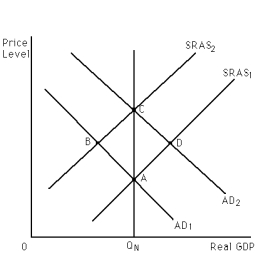 -Refer to Exhibit 15-l.A Keynesian monetary policy to eliminate an inflationary gap can be portrayed as a movement between point
 (Multiple Choice)
4.7/5  (79)
(79) According to the Keynesian transmission mechanism,if the Fed conducts an open market purchase of government securities,it may cause which of the following in the investment goods market?
(Multiple Choice)
4.8/5 (72)
(72) Exhibit 15-l
-Refer to Exhibit 15-1.A Keynesian would say that market forces work more quickly in taking the economy from point______________ than from point _______________.
-Refer to Exhibit 15-1.A Keynesian would say that market forces work more quickly in taking the economy from point______________ than from point _______________. (Multiple Choice)
4.8/5 (79)
(79) Under a constant growth rate of money rule of 4 percent in an economy in which Real GDP grows at an average rate of 3 percent and velocity is constant,the inflation rate is
(Multiple Choice)
4.9/5 (73)
(73) Economists who favor activist monetary policy often argue that
(Multiple Choice)
4.9/5 (71)
(71) Exhibit 15-4
 Assume that people have only two choices when it comes to holding their wealth: in money or in bonds.
-Refer to Exhibit 15-4. In the row of this table containing blank (B),people are holding ______________ of their wealth in bonds and ________________ of their wealth in money.
Assume that people have only two choices when it comes to holding their wealth: in money or in bonds.
-Refer to Exhibit 15-4. In the row of this table containing blank (B),people are holding ______________ of their wealth in bonds and ________________ of their wealth in money. (Multiple Choice)
4.9/5 (74)
(74) Buddy bought a bond last year for $10,000.His bond pays $1,000 a year.This year a bond that sells for $10,000 pays $900 a year. If Buddy were to sell his (old)bond,its price would be approximately
(Multiple Choice)
4.9/5 (65)
(65) The demand for money rises.According to the Keynesian transmission mechanism,the interest rate __________,investment spending __________ (assuming it is interest-sensitive),the AD curve shifts to the __________ and if the AS curve is horizontal,Real GDP __________.
(Multiple Choice)
4.8/5 (79)
(79) Exhibit 15-4
Assume that people have only two choices when it comes to holding their wealth: in money or in bonds.
-Refer to Exhibit 15-4. In the row of this table containing blank (A),people are holding ______________ of their wealth in bonds and ________________ of their wealth in money.
Assume that people have only two choices when it comes to holding their wealth: in money or in bonds.
-Refer to Exhibit 15-4. In the row of this table containing blank (A),people are holding ______________ of their wealth in bonds and ________________ of their wealth in money. (Multiple Choice)
4.9/5 (95)
(95) Exhibit 15-3
 -Refer to Exhibit 15-3.The economy is initially at point 1.Ideally,__________ monetary policy will move the economy to point __________.
 (Multiple Choice)
5.0/5 (81)
(81) If people have only two ways of holding their wealth,money or bonds,a surplus in the money market implies a surplus in the bond market.
(True/False)
5.0/5 (72)
(72) According to the Taylor Rule: if the inflation rate is 2% and the GDP gap is 3%,what does the federal funds rate target equal?
(Multiple Choice)
4.9/5 (84)
(84) If the interest rate falls,the opportunity cost of holding money __________ and the quantity demanded of money __________.
(Multiple Choice)
4.9/5 (76)
(76) The rules-based monetary policy reads: The annual growth rate in the money supply will be equal to the average annual growth rate in Real GDP minus the growth rate in velocity.If the average growth rate in Real GDP this year is 3 percent and the growth rate in velocity is 2 percent,then the money supply will increase by ______________ percent this year.
(Multiple Choice)
4.9/5 (101)
(101) The economy is in a recessionary gap and there is complete crowding out.Furthermore,there is no evidence that the economy is in a liquidity trap or that investment is interest-insensitive.This makes the case for the use of __________ policy stronger than it might be otherwise.
(Multiple Choice)
4.7/5 (86)
(86) 
Filters
- Essay(0)
- Multiple Choice(0)
- Short Answer(0)
- True False(0)
- Matching(0)