



 Chat with AI
Exam 15: Monetary Policy

Exam 1: What Economics Is About168 Questions
Exam 2: Production Possibilities Frontier Framework152 Questions
Exam 3: Supply and Demand: Theory227 Questions
Exam 4: Prices: Free, Controlled, and Relative107 Questions
Exam 5: Supply, Demand, and Price: Applications83 Questions
Exam 6: Macroeconomic Measurements: Prices and Unemployment129 Questions
Exam 7: Macroeconomic Measurements: GDP and Real GDP138 Questions
Exam 8: Aggregate Demand and Aggregate Supply208 Questions
Exam 9: Classical Macroeconomics and the Self Regulating Economy167 Questions
Exam 10: Keynesian Macroeconomics and Economic Instability: A Critique of the Self-Regulating Economy198 Questions
Exam 11: Fiscal Policy and the Federal Budget164 Questions
Exam 12: Money, Banking,and the Financial System124 Questions
Exam 13: The Federal Reserve System184 Questions
Exam 14: Money and the Economy125 Questions
Exam 15: Monetary Policy176 Questions
Exam 16: Expectations Theory and the Economy146 Questions
Exam 17: Economic Growth: Resources, Technology, Ideas, and Institutions82 Questions
Exam 18: The Financial Crisis of 2007-200970 Questions
Exam 19: Debates in Macroeconomics Over the Role and Effects of Government69 Questions
Exam 20: Elasticity198 Questions
Exam 21: Consumer Choice: Maximizing Utility and Behavioral Economics176 Questions
Exam 22: Production and Costs247 Questions
Exam 23: Perfect Competition191 Questions
Exam 24: Monopoly191 Questions
Exam 25: Monopolistic Competition, Oligopoly, and Game Theory167 Questions
Exam 26: Government and Product Markets: Antitrust and Regulation165 Questions
Exam 27: Factor Markets: With Emphasis on the Labor Market181 Questions
Exam 28: Wages,Unions,and Labor134 Questions
Exam 29: The Distribution of Income and Poverty93 Questions
Exam 30: Interest, Rent, and Profit199 Questions
Exam 31: Market Failure: Externalities, Public Goods, and Asymmetric Information185 Questions
Exam 32: Public Choice and Special-Interest-Group Politics131 Questions
Exam 33: Building Theories to Explain Everyday Life: From Observations to Questions to Theories to Predictions60 Questions
Exam 34: International Trade152 Questions
Exam 35: International Finance119 Questions
Exam 36: Globalization and International Impacts on the Economy136 Questions
Exam 37: The Economic Case For and Against Government: Five Topics Considered82 Questions
Exam 38: Stocks, Bonds, Futures, and Options108 Questions
Exam 39: Agriculture: Problems, Policies, and Unintended Effects149 Questions
Select questions type


If the interest rate increases,the opportunity cost of holding money __________,and the quantity demanded of money __________.
(Multiple Choice)
4.8/5  (79)
(79) According to Keynesians,__________ monetary policy will not remove the economy from a(an)__________ gap if __________.
(Multiple Choice)
4.8/5 (88)
(88) The predetermined-money-growth-rate rule states that the annual growth rate in the money supply will be constant at the average annual growth rate of Real GDP.
(True/False)
4.7/5 (76)
(76) Exhibit 15-2
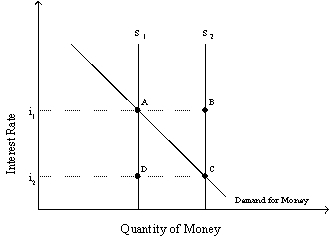 -Refer to Exhibit 15-2. If the interest rate is i1 and the relevant money supply curve is S2,then there is a
 (Multiple Choice)
4.8/5 (87)
(87) As the opportunity cost of holding money decreases,the quantity demanded of money
(Multiple Choice)
4.9/5 (84)
(84) Which of the following statements is likely to be made by an economist who believes in activist monetary policy? (1)The more closely monetary policy can be designed to meet the particulars of a given economic environment,the better.(2)Because of long and uncertain time lags,activist monetary policy may be destabilizing rather than stabilizing.(3)There is sufficient flexibility in wages and prices in modern economies to allow the economy to equilibrate in reasonable speed at the natural level of Real GDP.(4)The "same-for-all-seasons" monetary policy is the way to proceed.(5)There is evidence that monetary policy in the mid-1970s caused a recession.
(Multiple Choice)
4.7/5 (79)
(79) Suppose that the bond market and the money market both start out in equilibrium,then the Federal Reserve decreases the money supply. The result will be a ______________ in the money market and a _________________ in the bond market,which will push bond prices _________________ and interest rates will ___________________ until a new equilibrium is reached.
(Multiple Choice)
4.9/5 (85)
(85) According to the monetarist transmission mechanism,a decrease in the supply of money will result in
(Multiple Choice)
4.9/5 (96)
(96) The money supply increased and the AD curve did not shift to the right.This is consistent with the
(Multiple Choice)
5.0/5 (78)
(78) An individual buys a bond for $1,000 and sells it one year later for $1,050.What is the annual interest rate return that this individual has received on this bond?
(Multiple Choice)
4.8/5 (71)
(71) The SRAS curve is upward sloping,there is a liquidity trap,and investment spending is sensitive to changes in the interest rate.According to the monetarist transmission mechanism,if the money supply increases the AD curve __________ and the price level __________.
(Multiple Choice)
4.8/5 (72)
(72) Exhibit 15-2
-Refer to Exhibit 15-2.A(n)__________ in the money supply from S1 to S2 would have a tendency to __________ the opportunity cost of holding money.
-Refer to Exhibit 15-2.A(n)__________ in the money supply from S1 to S2 would have a tendency to __________ the opportunity cost of holding money. (Multiple Choice)
4.8/5 (71)
(71) Suppose that a rules-based monetary policy proposal specifies that the money supply will grow 3 percent each year.If velocity grows 1 percent this year and Real GDP grows 2 percent,the price level will __________ by __________ percent.
(Multiple Choice)
4.9/5 (79)
(79) Exhibit 15-l
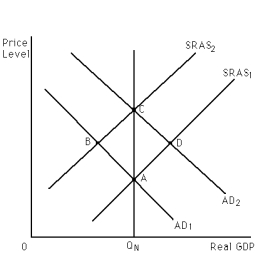 -Refer to Exhibit 15-l.A Keynesian monetary policy to eliminate a recessionary gap can be portrayed as a move between points
 (Multiple Choice)
4.8/5 (71)
(71) The supply of bonds rises,ceteris paribus,and the price of bonds __________.This __________ the interest rate and __________ the quantity demanded of money.
(Multiple Choice)
4.8/5 (89)
(89) 
Filters
- Essay(0)
- Multiple Choice(0)
- Short Answer(0)
- True False(0)
- Matching(0)