



 Chat with AI
Exam 18: Glaciers and Glaciation

Exam 1: An Introduction to Geology66 Questions
Exam 2: Plate Tectonics: a Scientific Revolution Unfolds77 Questions
Exam 3: Matter and Minerals74 Questions
Exam 4: Magma, Igneous Rocks, and Intrusive Activity76 Questions
Exam 5: Volcanoes and Volcanic Hazards81 Questions
Exam 6: Weathering and Soil67 Questions
Exam 7: Sedimentary Rocks72 Questions
Exam 8: Metamorphism and Metamorphic Rocks76 Questions
Exam 9: Geologic Time70 Questions
Exam 10: Crustal Deformation66 Questions
Exam 11: Earthquakes67 Questions
Exam 12: Earths Interior74 Questions
Exam 13: Divergent Boundaries83 Questions
Exam 14: Convergent Boundaries79 Questions
Exam 15: Mass Wasting83 Questions
Exam 16: Running Water75 Questions
Exam 17: Groundwater81 Questions
Exam 18: Glaciers and Glaciation84 Questions
Exam 19: Deserts and Winds72 Questions
Exam 20: Shorelines69 Questions
Exam 21: Global Climate Change82 Questions
Exam 22: Earths Evolution Through Geologic Time74 Questions
Exam 23: Energy and Mineral Resources80 Questions
Exam 24: Touring Our Solar System76 Questions
Select questions type


The only continental ice sheets left on Earth today are in Greenland and Antarctica.
(True/False)
4.8/5  (78)
(78) When did the ice-free corridor open in North America, allowing a path for human migration from Asia?
(Multiple Choice)
4.7/5 (78)
(78) ________ is unsorted, unstratified, bimodal sediment directly deposited by the glacial ice.
(Multiple Choice)
4.7/5 (91)
(91) Arêtes, horns, and hanging valleys are evidence of ________ glaciation.
(Multiple Choice)
4.9/5 (86)
(86) What bodies of water are formed when a stagnant block of glacial ice near the terminus becomes partly or completely buried in glacial sediments, eventually melting to create a lake?
(Multiple Choice)
4.8/5 (79)
(79) The Mississippi River currently makes up the western boundary of the state of Illinois.However, the Ancient Mississippi River Valley once flowed through the center of the state, cutting off one-quarter of the state from its modern boundaries.How did the Mississippi River shift from its ancestral location to its present one? How did it end up staying in its current location? Explain.
(Essay)
4.8/5 (78)
(78) 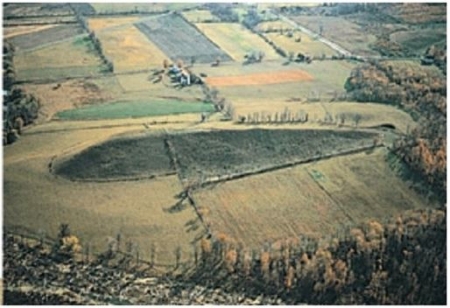 The landform visible in this image is a drumlin.Based on the shape of the drumlin, which direction was the ice coming from? Assume that the top of the figure is north.
 (Multiple Choice)
4.9/5 (81)
(81) ________ refers to the change in the angle Earth's axis makes with the plane of our planet's orbit.
(Multiple Choice)
4.8/5 (72)
(72) Which of the following scenarios can lead to the formation of a kame?
(Multiple Choice)
4.9/5 (81)
(81) Read the following excerpt from The Works of John Playfair (1822).What glacial landform is being described? "…For the moving of large masses of rock, the most powerful engines without doubt that nature employs are the glaciers….[Rock] fragments they gradually transport to their utmost boundaries, where a formidable wall ascertains the magnitude, and attests the force, of the great engine by which it was erected."
(Multiple Choice)
4.8/5 (82)
(82) 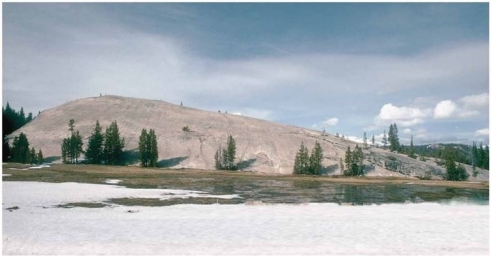 How did erosion shape this glacial feature? (Hint: It is bedrock.)
 (Multiple Choice)
4.8/5 (64)
(64) The Zone of Fracture in a glacier is found in the uppermost 50 m of glacial ice.Explain why ice fractures above this depth, but not below.
(Essay)
4.9/5 (91)
(91) The Laurentide Ice Sheet is an example of ________ glaciation.
(Multiple Choice)
4.8/5 (77)
(77) Which of the following ice bodies is an example of alpine glaciation?
(Multiple Choice)
5.0/5 (78)
(78) Glaciers in arctic regions that are frozen to their beds move via internal deformation.
(True/False)
5.0/5 (86)
(86) Glaciers are a single, solid piece of ice that flows from the Zone of Accumulation to the Zone of Saturation.
(True/False)
4.7/5 (80)
(80) What percentage of the Earth's land surface is currently covered by glacial ice?
(Multiple Choice)
4.8/5 (72)
(72) 
Filters
- Essay(0)
- Multiple Choice(0)
- Short Answer(0)
- True False(0)
- Matching(0)