



 Chat with AI
Exam 20: Shorelines

Exam 1: An Introduction to Geology66 Questions
Exam 2: Plate Tectonics: a Scientific Revolution Unfolds77 Questions
Exam 3: Matter and Minerals74 Questions
Exam 4: Magma, Igneous Rocks, and Intrusive Activity76 Questions
Exam 5: Volcanoes and Volcanic Hazards81 Questions
Exam 6: Weathering and Soil67 Questions
Exam 7: Sedimentary Rocks72 Questions
Exam 8: Metamorphism and Metamorphic Rocks76 Questions
Exam 9: Geologic Time70 Questions
Exam 10: Crustal Deformation66 Questions
Exam 11: Earthquakes67 Questions
Exam 12: Earths Interior74 Questions
Exam 13: Divergent Boundaries83 Questions
Exam 14: Convergent Boundaries79 Questions
Exam 15: Mass Wasting83 Questions
Exam 16: Running Water75 Questions
Exam 17: Groundwater81 Questions
Exam 18: Glaciers and Glaciation84 Questions
Exam 19: Deserts and Winds72 Questions
Exam 20: Shorelines69 Questions
Exam 21: Global Climate Change82 Questions
Exam 22: Earths Evolution Through Geologic Time74 Questions
Exam 23: Energy and Mineral Resources80 Questions
Exam 24: Touring Our Solar System76 Questions
Select questions type


The ________ is the line that marks the contact between land and sea.
(Multiple Choice)
4.8/5  (82)
(82) What combination of incoming waves and backwash will result in a longshore drift? Explain.
(Essay)
4.8/5 (90)
(90) Due to the crashing of waves and the backwash of water from shore, beaches can be thought of as areas where material is in transit.
(True/False)
4.9/5 (85)
(85) 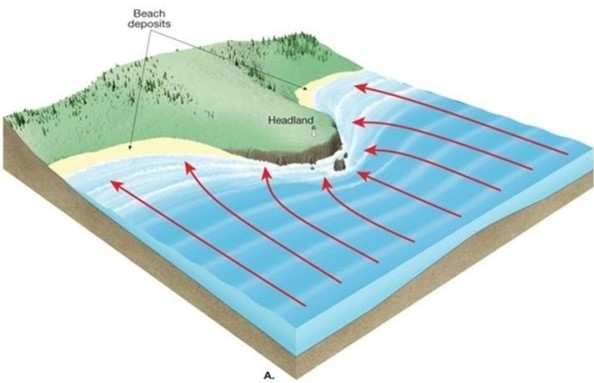 What process is illustrated by the arrows in this image?
Which circumstance will force a wave displaying circular orbital motion to slow down at the base, which allows the wave to break?
(Multiple Choice)
4.9/5 (83)
(83) How does the rotation of the earth give coastlines a high tide and a low tide?
(Essay)
4.9/5 (78)
(78) 
Filters
- Essay(0)
- Multiple Choice(0)
- Short Answer(0)
- True False(0)
- Matching(0)