



 Chat with AI
Exam 21: Global Climate Change

Exam 1: An Introduction to Geology66 Questions
Exam 2: Plate Tectonics: a Scientific Revolution Unfolds77 Questions
Exam 3: Matter and Minerals74 Questions
Exam 4: Magma, Igneous Rocks, and Intrusive Activity76 Questions
Exam 5: Volcanoes and Volcanic Hazards81 Questions
Exam 6: Weathering and Soil67 Questions
Exam 7: Sedimentary Rocks72 Questions
Exam 8: Metamorphism and Metamorphic Rocks76 Questions
Exam 9: Geologic Time70 Questions
Exam 10: Crustal Deformation66 Questions
Exam 11: Earthquakes67 Questions
Exam 12: Earths Interior74 Questions
Exam 13: Divergent Boundaries83 Questions
Exam 14: Convergent Boundaries79 Questions
Exam 15: Mass Wasting83 Questions
Exam 16: Running Water75 Questions
Exam 17: Groundwater81 Questions
Exam 18: Glaciers and Glaciation84 Questions
Exam 19: Deserts and Winds72 Questions
Exam 20: Shorelines69 Questions
Exam 21: Global Climate Change82 Questions
Exam 22: Earths Evolution Through Geologic Time74 Questions
Exam 23: Energy and Mineral Resources80 Questions
Exam 24: Touring Our Solar System76 Questions
Select questions type


Changes that occur in one part of the climate system are isolated and will have no part on the remainder of the system.
(True/False)
4.8/5  (78)
(78) Compare and contrast positive climate-feedback mechanisms and negative climate-feedback mechanisms.
(Essay)
4.8/5 (86)
(86) Compare and contrast fossil pollen, tree-growth rings, and corals as three proxies for determining paleoclimate.
(Essay)
4.8/5 (80)
(80) How will melting permafrost in polar regions lead to a positive feedback loop that will continue to warm the climate, which will allow for more permafrost to melt?
(Multiple Choice)
4.8/5 (64)
(64) If CFCs have not been widely used since the late 20th century, why are they considered a major greenhouse gas in the 21st century?
(Multiple Choice)
4.8/5 (97)
(97) Which process has been largely responsible for increasing the amount of CO2 in the last 200 years?
(Multiple Choice)
4.8/5 (85)
(85) How does the residence time of aerosols in the atmosphere compare to that of greenhouse gases?
(Essay)
4.8/5 (77)
(77) How can agriculture be responsible for increasing the amount of methane in the atmosphere?
(Multiple Choice)
4.9/5 (90)
(90) Which of the following spheres is not part of the climate system?
(Multiple Choice)
4.9/5 (77)
(77) 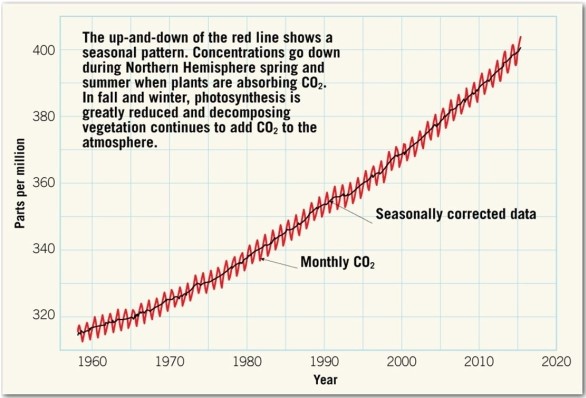 What was the approximate concentration of CO2 in the atmosphere in 1965? Use the smoothed curve for seasonally corrected data to make the determination.
 (Multiple Choice)
4.8/5 (70)
(70) How can the ratios of oxygen isotopes be used to indicate past climate change? What marine substance can be tested for its oxygen ratios?
(Essay)
4.9/5 (68)
(68) Which of the following trace gases is not natural to the atmosphere and is purely the result of human activities?
(Multiple Choice)
4.8/5 (74)
(74) Nearly all the energy that drives the Earth's climate comes from the Sun.
(True/False)
4.9/5 (81)
(81) The ________ refers to water in solid form, such as ice and snow that exists on the Earth's surface.
(Multiple Choice)
4.8/5 (75)
(75) Explain how melting glacial ice will result in a positive feedback mechanism for climate.
(Essay)
4.7/5 (97)
(97) Increasing amounts of CO2 in the atmosphere results in increased global temperatures.
(True/False)
4.8/5 (77)
(77) The concentration of methane in the atmosphere has been shown to be increasing for the last 1,000 years, indicating that humans are not responsible for its generation.
(True/False)
4.9/5 (83)
(83) Trapped air in glaciers record atmospheric composition through time.
(True/False)
4.8/5 (101)
(101) What was the approximate increase in global temperature during the 20th century?
(Multiple Choice)
4.8/5 (91)
(91) 
Filters
- Essay(0)
- Multiple Choice(0)
- Short Answer(0)
- True False(0)
- Matching(0)