



 Chat with AI
Exam 5: Volcanoes and Volcanic Hazards

Exam 1: An Introduction to Geology66 Questions
Exam 2: Plate Tectonics: a Scientific Revolution Unfolds77 Questions
Exam 3: Matter and Minerals74 Questions
Exam 4: Magma, Igneous Rocks, and Intrusive Activity76 Questions
Exam 5: Volcanoes and Volcanic Hazards81 Questions
Exam 6: Weathering and Soil67 Questions
Exam 7: Sedimentary Rocks72 Questions
Exam 8: Metamorphism and Metamorphic Rocks76 Questions
Exam 9: Geologic Time70 Questions
Exam 10: Crustal Deformation66 Questions
Exam 11: Earthquakes67 Questions
Exam 12: Earths Interior74 Questions
Exam 13: Divergent Boundaries83 Questions
Exam 14: Convergent Boundaries79 Questions
Exam 15: Mass Wasting83 Questions
Exam 16: Running Water75 Questions
Exam 17: Groundwater81 Questions
Exam 18: Glaciers and Glaciation84 Questions
Exam 19: Deserts and Winds72 Questions
Exam 20: Shorelines69 Questions
Exam 21: Global Climate Change82 Questions
Exam 22: Earths Evolution Through Geologic Time74 Questions
Exam 23: Energy and Mineral Resources80 Questions
Exam 24: Touring Our Solar System76 Questions
Select questions type


Which of the following lavas make up 90 percent of the total volume of lava on Earth?
(Multiple Choice)
4.8/5  (94)
(94) How does a volcanic neck form? What happens to the rest of the volcano that originally surrounded it?
(Essay)
4.9/5 (60)
(60) Kilauea, a volcano in Hawaii, generates fluid, extensive lava flows.Mount St.Helens, a volcano in Washington State, can produce lava flows that are short and thick, but that can also erupt violently and generate large volumes of ash.What might these differences indicate about each lava's silica content and temperature?
(Essay)
4.8/5 (83)
(83) 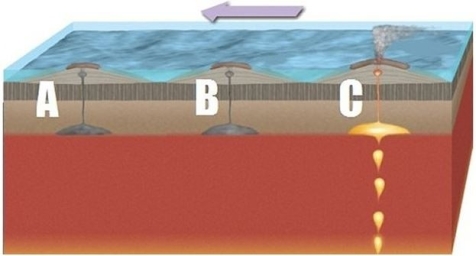 The volcanic islands visible here formed as a result of a mantle plume.Which volcanic island is the oldest and subsiding into the sea?
 (Multiple Choice)
4.7/5 (86)
(86) 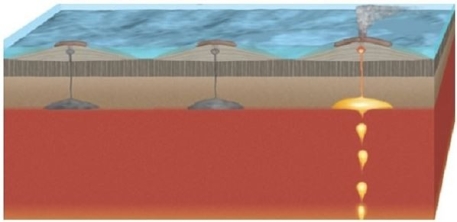 How is this chain of volcanic islands forming?
Composite cones are famous for their conical shapes with steep summits, sloping flanks, and broad base.How might the composition of eruptive materials have changed for the volcano to transition from something with a broad base to something with a smaller base and steeper slopes?
(Essay)
4.8/5 (88)
(88) Explain what will happen to the flanks of the volcano as magma moves into the magma chamber.
(Essay)
4.9/5 (72)
(72) What is the difference between a quiescent and an explosive eruption?
(Essay)
4.8/5 (79)
(79) Which of the following choices best explains the difference between a crater and a caldera?
(Multiple Choice)
4.8/5 (88)
(88) 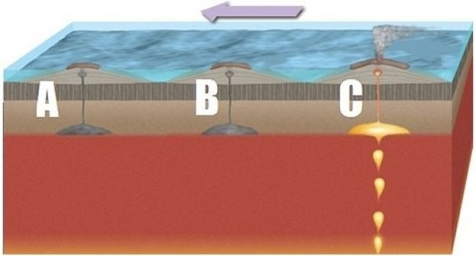 The volcanic islands visible here formed as a result of a mantle plume.Researchers working on these volcanic islands have collected basalt samples for potassium-argon dating to determine when these islands formed Volcanic Island A has been dated to 7.6 million years ago.Volcanic Island C dates back to 3.4 million years ago and is 200 km away from A.Using the equation Rate = Distance/Time, calculate the rate of plate motion for this region.
 (Multiple Choice)
4.9/5 (80)
(80) GPS units, satellites, and lasers are some of the tools used to monitor the ________ of the volcanic flanks, which indicates magma accumulating in the magma chamber.
(Multiple Choice)
4.8/5 (86)
(86) Which of the following is not a method of caldera formation?
(Multiple Choice)
4.7/5 (90)
(90) A ________ is a cone-shaped structure created by successive eruptions of volcanic materials such as lava or pyroclastic materials.
(Multiple Choice)
4.8/5 (71)
(71) What interpretations can be made about the maturity of a volcano where most eruptions occur from basal fissures and there are a number of parasitic cones along the volcano's flanks?
(Multiple Choice)
4.8/5 (90)
(90) What is the importance of monitoring volcanic activity? Why should we pay attention to what volcanoes are doing?
(Essay)
4.9/5 (87)
(87) Based on the information visible, what kind of volcano is this?
(Multiple Choice)
4.9/5 (88)
(88) What kind of volcano is most closely associated with pyroclastic flows?
(Multiple Choice)
4.7/5 (82)
(82) 
Filters
- Essay(0)
- Multiple Choice(0)
- Short Answer(0)
- True False(0)
- Matching(0)