



 Chat with AI
Exam 8: Sustaining Biodiversity - the Species Approach

Exam 1: Environmental Problems - Their Causes - and Sustainability95 Questions
Exam 2: Science - Matter - and Energy97 Questions
Exam 3: Ecosystems - What Are They and How Do They Work100 Questions
Exam 4: Biodiversity and Evolution100 Questions
Exam 5: Biodiversity - Species Interactions - and Population Control98 Questions
Exam 6: The Human Population and Urbanization102 Questions
Exam 7: Climate and Biodiversity101 Questions
Exam 8: Sustaining Biodiversity - the Species Approach99 Questions
Exam 9: Sustaining Biodiversity - the Ecosystem Approach100 Questions
Exam 10: Food - Soil - and Pest Management100 Questions
Exam 11: Water Resources and Water Pollution99 Questions
Exam 12: Geology and Nonrenewable Minerals100 Questions
Exam 13: Energy98 Questions
Exam 14: Environmental Hazards and Human Health100 Questions
Exam 15: Air Pollution Climate Change and Ozone Depletion96 Questions
Exam 16: Solid and Hazardous Waste100 Questions
Exam 17: Environmental Economics Politics and Worldviews99 Questions
Select questions type


Birds contaminated with ____________________ have been unable to successfully reproduce because of excessively fragile eggshells.
(Short Answer)
4.8/5  (82)
(82) What is to the best approach to preserving genetic information for endangered plant species?
(Multiple Choice)
4.7/5 (76)
(76) Argentina fire ants have developed a genetic resistance to pesticides.
(True/False)
5.0/5 (80)
(80) The decline in approximately 70% of the world's bird species is particularly alarming to scientists because ____.
(Multiple Choice)
4.8/5 (77)
(77) There are an estimated 50,000 to 60,000 orangutans in the wild that are ____ at a rate of 1,000 to 2,000 per year.
(Multiple Choice)
4.9/5 (87)
(87) The world's wild species provide ecological resources and services that keep us alive and support human economies.
(True/False)
4.7/5 (75)
(75) Recent genetic research indicates that ____ or more individuals are needed for an endangered species to maintain its capacity for biological evolution.
(Multiple Choice)
4.7/5 (80)
(80) Explain the concept of a national park; in particular,discuss how a national park can be a habitat island.
(Essay)
4.8/5 (91)
(91) Describe the three primary challenges for scientists when attempting to estimate extinction rates.
(Essay)
4.9/5 (86)
(86) The primary reason polar bear population are declining is because their fur keeps their body temperature too warm in light of global warming trends.
(True/False)
4.8/5 (76)
(76) The butchering and eating of some forms of bushmeat has helped to spread diseases such as HIV/AIDS and the Ebola virus.
(True/False)
5.0/5 (87)
(87) Various plant species provide value as food crops,fuelwood,lumber,and paper from trees,and useful scientific knowledge.What term best describes this type of value?
(Multiple Choice)
4.9/5 (76)
(76) The current rate of extinction is ____ compared to the rate that existed before humans arrived on the earth.
(Multiple Choice)
4.8/5 (66)
(66) What is the best way to reduce threats from invasive species?
(Multiple Choice)
4.8/5 (85)
(85) 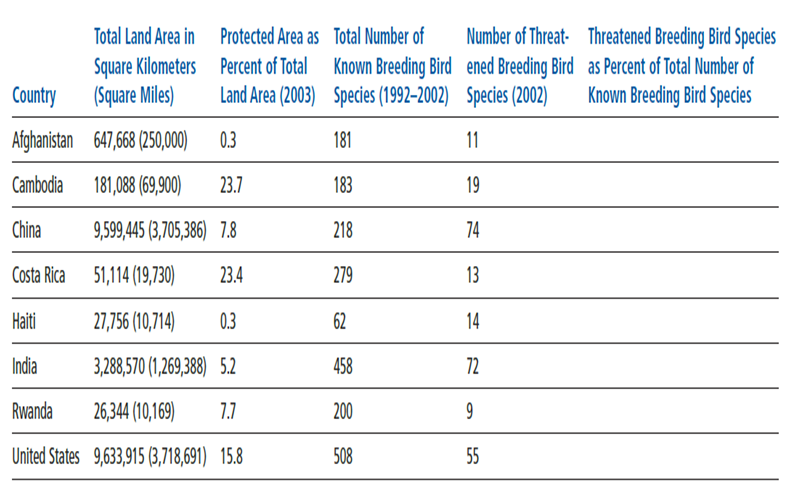 -Refer to the accompanying table.A traveling biologist decides to contribute money to the two developing countries that seems to be most focused on their threatened bird species,based on the percentage of land area that is set aside for conservation.What two countries will be recipients of her donations?
 (Essay)
4.8/5 (88)
(88) The species-area relationship suggests that if 90% of a coral reef is lost,then ____.
(Multiple Choice)
4.8/5 (83)
(83) Biologists conservatively estimate that the current extinction rate is at least ____________________ times the normal background extinction rate.
(Short Answer)
4.8/5 (83)
(83) 
Filters
- Essay(0)
- Multiple Choice(0)
- Short Answer(0)
- True False(0)
- Matching(0)