



 Chat with AI
Exam 3: Supply and Demand

Exam 1: Economics: the Core Issues152 Questions
Exam 2: The Useconomy: a Global View146 Questions
Exam 3: Supply and Demand164 Questions
Exam 4: The Role of Government153 Questions
Exam 5: National Income Accounting152 Questions
Exam 6: Unemployment147 Questions
Exam 7: Inflation152 Questions
Exam 8: The Business Cycle153 Questions
Exam 9: Aggregate Demand149 Questions
Exam 10: Self-Adjustment or Instability140 Questions
Exam 11: Fiscal Policy151 Questions
Exam 12: Deficits and Debt151 Questions
Exam 13: Money and Banks146 Questions
Exam 14: The Federal Reserve System146 Questions
Exam 15: Monetary Policy149 Questions
Exam 16: Supply-Side Policy: Short-Run Options147 Questions
Exam 17: Growth and Productivity: Long-Run Possibilities143 Questions
Exam 18: Theory Versus Reality146 Questions
Exam 19: Consumer Choice136 Questions
Exam 20: Elasticity141 Questions
Exam 21: The Costs of Production151 Questions
Exam 22: The Competitive Firm148 Questions
Exam 23: Competitive Markets150 Questions
Exam 24: Monopoly147 Questions
Exam 25: Oligopoly145 Questions
Exam 26: Monopolistic Competition144 Questions
Exam 27: Natural Monopolies: Deregulation144 Questions
Exam 28: Environmental Protection144 Questions
Exam 29: The Farm Problem132 Questions
Exam 30: The Labor Market137 Questions
Exam 31: Labor Unions144 Questions
Exam 32: Financial Markets146 Questions
Exam 33: Taxes: Equity Versus Efficiency146 Questions
Exam 34: Transfer Payments: Welfare and Social Security146 Questions
Exam 35: International Trade149 Questions
Exam 36: International Finance142 Questions
Exam 37: Global Poverty141 Questions
Select questions type


In the United States,market shortages of human organs are the result of price ceilings.
(True/False)
4.9/5  (73)
(73) Restaurants like to give away free salty peanuts while you wait for your food in order to encourage you to
(Multiple Choice)
4.9/5 (86)
(86) Money is critical in facilitating market exchanges and the specialization that these exchanges permit.
(True/False)
4.8/5 (71)
(71) The goal of the consumer in a market economy is to use his or her limited income to buy
(Multiple Choice)
4.8/5 (76)
(76) If the actual market price were fixed at $15 per unit in Figure 3.2, 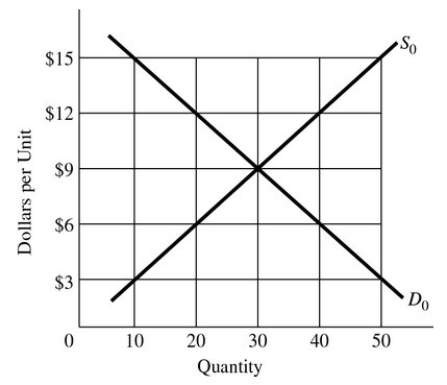 Figure 3.2 Supply and Demand
 (Multiple Choice)
4.8/5 (80)
(80) Choose the letter of the diagram in Figure 3.1 that best describes the type of shift that would occur in each situation for the market listed on the left,ceteris paribus.Figure 3.1 Shifts of Supply and Demand Steel: the government introduces environmental restrictions on the dumping of wastes from producing steel. 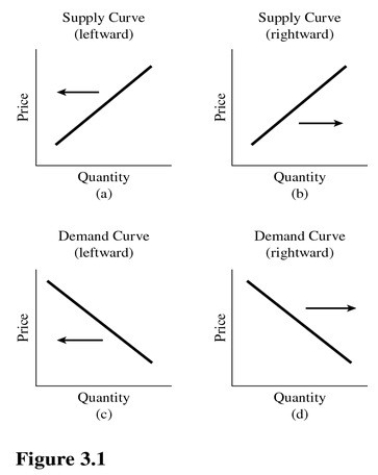
(Multiple Choice)
4.7/5 (78)
(78) Ceteris paribus,which of the following is most likely to shift both the demand and the supply curves?
(Multiple Choice)
4.8/5 (65)
(65) Refer to Table 3.1 to answer the following question Table 3.1 Individual Demand and Supply Schedules
Quartity Dernarded by Price Alejandro Ben Carl Market \ 8.00 8 4 2 6.00 12 4 4 4.00 20 4 6 2.00 22 4 6
Quartity Supplied by Price Avery Brandon Cassandra \ 8.00 60 4 6 \6 .00 42 4 4 \4 .00 24 4 2 \ 2.00 6 4 0
In Table 3.1,the equilibrium market price is
(Multiple Choice)
4.8/5 (78)
(78) Assume that steel is used to produce monkey wrenches.Ceteris paribus,if the price of steel rises,then
(Multiple Choice)
5.0/5 (72)
(72) A rightward shift of the market demand curve for drones,ceteris paribus,causes equilibrium
(Multiple Choice)
4.9/5 (77)
(77) Suppose both the demand for and supply of salsa increase (although not necessarily by the same amount).What can we conclude about changes in the price and quantity of salsa?
(Multiple Choice)
4.9/5 (90)
(90) In the United States,price ceilings on human organs have caused an increase in demand.
(True/False)
4.9/5 (74)
(74) If corn products are found to cause cancer,then the most immediate effect will be that the
(Multiple Choice)
4.8/5 (81)
(81) Choose the letter of the diagram in Figure 3.1 that best describes the type of shift that would occur in each situation for the market listed on the left,ceteris paribus.Figure 3.1 Shifts of Supply and Demand Candy bars: People become more health-conscious and prefer vegetables instead of candy bars. 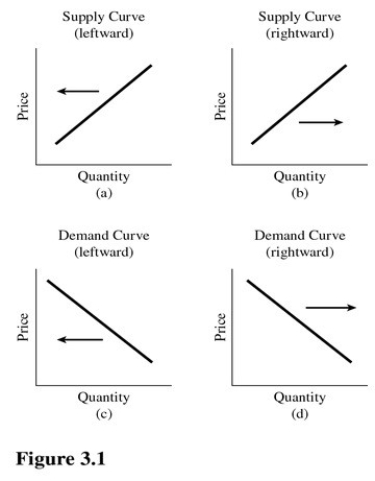
(Multiple Choice)
5.0/5 (92)
(92) Refer to Table 3.1 to answer the following question Table 3.1 Individual Demand and Supply Schedules
Quartity Dernarded by Price Alejandro Ben Carl Market \ 8.00 8 4 2 6.00 12 4 4 4.00 20 4 6 2.00 22 4 6
Quartity Supplied by Price Avery Brandon Cassandra \ 8.00 60 4 6 \6 .00 42 4 4 \4 .00 24 4 2 \ 2.00 6 4 0
In Table 3.1,if government held the price at $3,
(Multiple Choice)
4.8/5 (64)
(64) 
Filters
- Essay(0)
- Multiple Choice(0)
- Short Answer(0)
- True False(0)
- Matching(0)