



 Chat with AI
Exam 28: Environmental Protection

Exam 1: Economics: the Core Issues152 Questions
Exam 2: The Useconomy: a Global View146 Questions
Exam 3: Supply and Demand164 Questions
Exam 4: The Role of Government153 Questions
Exam 5: National Income Accounting152 Questions
Exam 6: Unemployment147 Questions
Exam 7: Inflation152 Questions
Exam 8: The Business Cycle153 Questions
Exam 9: Aggregate Demand149 Questions
Exam 10: Self-Adjustment or Instability140 Questions
Exam 11: Fiscal Policy151 Questions
Exam 12: Deficits and Debt151 Questions
Exam 13: Money and Banks146 Questions
Exam 14: The Federal Reserve System146 Questions
Exam 15: Monetary Policy149 Questions
Exam 16: Supply-Side Policy: Short-Run Options147 Questions
Exam 17: Growth and Productivity: Long-Run Possibilities143 Questions
Exam 18: Theory Versus Reality146 Questions
Exam 19: Consumer Choice136 Questions
Exam 20: Elasticity141 Questions
Exam 21: The Costs of Production151 Questions
Exam 22: The Competitive Firm148 Questions
Exam 23: Competitive Markets150 Questions
Exam 24: Monopoly147 Questions
Exam 25: Oligopoly145 Questions
Exam 26: Monopolistic Competition144 Questions
Exam 27: Natural Monopolies: Deregulation144 Questions
Exam 28: Environmental Protection144 Questions
Exam 29: The Farm Problem132 Questions
Exam 30: The Labor Market137 Questions
Exam 31: Labor Unions144 Questions
Exam 32: Financial Markets146 Questions
Exam 33: Taxes: Equity Versus Efficiency146 Questions
Exam 34: Transfer Payments: Welfare and Social Security146 Questions
Exam 35: International Trade149 Questions
Exam 36: International Finance142 Questions
Exam 37: Global Poverty141 Questions
Select questions type


Which of the following is not a market incentive to discourage pollution?
(Multiple Choice)
4.8/5  (71)
(71) Emission charges,user fees,and pollution fines increase the ________ of polluting.
(Multiple Choice)
4.8/5 (93)
(93) In order to maximize social welfare,a firm's production of a good should occur at the output where
(Multiple Choice)
4.9/5 (93)
(93) An emission charge decreases private marginal cost and encourages greater output.
(True/False)
4.8/5 (72)
(72) Table 28.1 Reduction in Emissions (in tons) MC to Reduce Emissions by SteelPlant MC to Reduce Emissions by Paper Plant 1 \ 400 \ 200 2 500 280 3 600 320
Refer to Table 28.1.Suppose the government allows these two firms to trade pollution permits.The most efficient transaction would result in
(Multiple Choice)
4.9/5 (65)
(65) One World View article titled "Paying to Pollute" reports that the price of a marketable pollution permit in Europe for a ton of carbon dioxide is about $32.The principal advantage of pollution permits is to
(Multiple Choice)
4.8/5 (82)
(82) Table 28.2 For which firm are all costs internalized in Table 28.2?
(Multiple Choice)
4.8/5 (72)
(72) The marginal cost to society of reducing pollution increases as the level of pollution reduction increases because of the law of
(Multiple Choice)
4.9/5 (85)
(85) 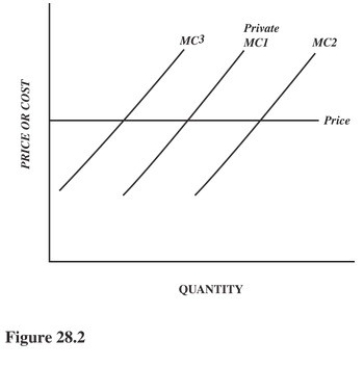 Refer to Figure 28.2.Assume this firm initially has marginal costs equal to Private MC1.If this firm is producing a product that does not generate any externalities,the allocatively efficient output would occur where
 (Multiple Choice)
4.9/5 (87)
(87) Which of the following is a market incentive to discourage pollution?
(Multiple Choice)
4.8/5 (68)
(68) A chemical-producing firm is located just upstream from an electric power plant.Instead of the more expensive procedure of burying its wastes,the chemical-producing firm begins dumping its waste into the stream.This causes increased variable costs for the power plant,which uses water from the stream to cool its turbines.The chemical producer's dumping of waste into the stream causes
(Multiple Choice)
4.8/5 (80)
(80) 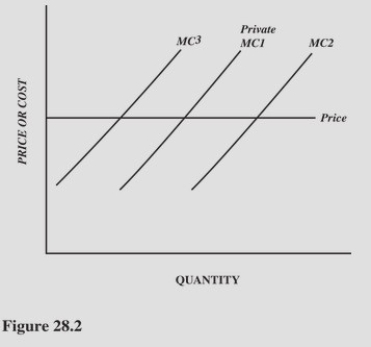 Refer to Figure 28.2.Assume this firm initially has marginal costs equal to Private MC1 and is polluting.If the government decides to use emission charges to reduce pollution,the firm's MC curve will shift to
 (Multiple Choice)
4.8/5 (64)
(64) The command-and-control strategy for pollution reduction refers to
(Multiple Choice)
4.8/5 (82)
(82) Firm A finds it very expensive to reduce its sulfur dioxide emissions,while Firm B finds it very cheap to reduce its sulfur dioxide emissions.If a program of tradable pollution permits was enacted,we would most likely see
(Multiple Choice)
4.9/5 (98)
(98) The key to pollution abatement lies in forcing polluters to externalize their pollution costs.
(True/False)
4.9/5 (72)
(72) 
Filters
- Essay(0)
- Multiple Choice(0)
- Short Answer(0)
- True False(0)
- Matching(0)