



 Chat with AI
Exam 29: The Farm Problem

Exam 1: Economics: the Core Issues152 Questions
Exam 2: The Useconomy: a Global View146 Questions
Exam 3: Supply and Demand164 Questions
Exam 4: The Role of Government153 Questions
Exam 5: National Income Accounting152 Questions
Exam 6: Unemployment147 Questions
Exam 7: Inflation152 Questions
Exam 8: The Business Cycle153 Questions
Exam 9: Aggregate Demand149 Questions
Exam 10: Self-Adjustment or Instability140 Questions
Exam 11: Fiscal Policy151 Questions
Exam 12: Deficits and Debt151 Questions
Exam 13: Money and Banks146 Questions
Exam 14: The Federal Reserve System146 Questions
Exam 15: Monetary Policy149 Questions
Exam 16: Supply-Side Policy: Short-Run Options147 Questions
Exam 17: Growth and Productivity: Long-Run Possibilities143 Questions
Exam 18: Theory Versus Reality146 Questions
Exam 19: Consumer Choice136 Questions
Exam 20: Elasticity141 Questions
Exam 21: The Costs of Production151 Questions
Exam 22: The Competitive Firm148 Questions
Exam 23: Competitive Markets150 Questions
Exam 24: Monopoly147 Questions
Exam 25: Oligopoly145 Questions
Exam 26: Monopolistic Competition144 Questions
Exam 27: Natural Monopolies: Deregulation144 Questions
Exam 28: Environmental Protection144 Questions
Exam 29: The Farm Problem132 Questions
Exam 30: The Labor Market137 Questions
Exam 31: Labor Unions144 Questions
Exam 32: Financial Markets146 Questions
Exam 33: Taxes: Equity Versus Efficiency146 Questions
Exam 34: Transfer Payments: Welfare and Social Security146 Questions
Exam 35: International Trade149 Questions
Exam 36: International Finance142 Questions
Exam 37: Global Poverty141 Questions
Select questions type


Compared to the early 1950s,today farm output per labor-hour is
(Multiple Choice)
4.8/5  (83)
(83) All of the following government actions result in supply restriction except
(Multiple Choice)
4.8/5 (86)
(86) The market surplus induced by price supports can be eliminated through all of the following except
(Multiple Choice)
4.8/5 (94)
(94) Because the income elasticity of food demand is low,we expect an increase in income to result in
(Multiple Choice)
4.8/5 (87)
(87) An increase in the value of the U.S.dollar internationally,ceteris paribus,would result in
(Multiple Choice)
4.9/5 (79)
(79) The loan rate is a low-interest rate at which farmers may borrow from the federal government on a short-term basis.
(True/False)
5.0/5 (87)
(87) Acreage set-asides shift the food supply curve to the right and decrease farm prices.
(True/False)
4.7/5 (96)
(96) An advantage of set-aside programs over price support programs is that they
(Multiple Choice)
5.0/5 (72)
(72) If a price support is maintained above the equilibrium price,the result will be a
(Multiple Choice)
4.9/5 (88)
(88) The "Asian crisis" was responsible for all of the following effects on U.S.agriculture beginning in 1998 except
(Multiple Choice)
4.8/5 (71)
(71) The typically price-inelastic demand for agricultural products can be explained by
(Multiple Choice)
4.9/5 (84)
(84) Government subsidies on the purchase of fertilizer by farmers result in
(Multiple Choice)
4.9/5 (90)
(90) Ceteris paribus,a weaker U.S.dollar does all of the following except
(Multiple Choice)
4.9/5 (72)
(72) 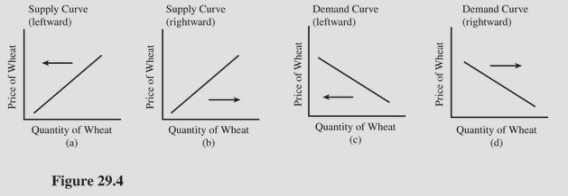 Select the letter of the diagram in Figure 28.1 that best represents the effect of each event on the United States wheat market,ceteris paribus: The federal government decides to no longer purchase wheat from farmers.(See Figure 29.4. )
 (Multiple Choice)
4.7/5 (70)
(70) The Agricultural Adjustment Act of 1933 was based on the belief that farm incomes would improve if
(Multiple Choice)
4.9/5 (87)
(87) If the price of corn falls by 25 percent on world markets,causing American corn consumption to increase by 10 percent,ceteris paribus,the price elasticity of demand for corn in the United States would be
(Multiple Choice)
4.8/5 (92)
(92) During the early 1900s,U.S.farm goods were heavily subsidized by the government.
(True/False)
4.8/5 (82)
(82) Farm support programs most often take the form of price floors,which cause excess demand.
(True/False)
4.7/5 (82)
(82) 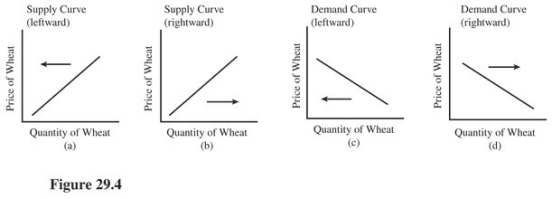 Select the letter of the diagram in Figure 28.1 that best represents the effect of each event on the United States wheat market,ceteris paribus: The European Union tightens restrictions on the agricultural products that can be imported from the United States.(See Figure 29.4. )
 (Multiple Choice)
4.9/5 (69)
(69) 
Filters
- Essay(0)
- Multiple Choice(0)
- Short Answer(0)
- True False(0)
- Matching(0)