



 Chat with AI
Exam 30: The Labor Market

Exam 1: Economics: the Core Issues152 Questions
Exam 2: The Useconomy: a Global View146 Questions
Exam 3: Supply and Demand164 Questions
Exam 4: The Role of Government153 Questions
Exam 5: National Income Accounting152 Questions
Exam 6: Unemployment147 Questions
Exam 7: Inflation152 Questions
Exam 8: The Business Cycle153 Questions
Exam 9: Aggregate Demand149 Questions
Exam 10: Self-Adjustment or Instability140 Questions
Exam 11: Fiscal Policy151 Questions
Exam 12: Deficits and Debt151 Questions
Exam 13: Money and Banks146 Questions
Exam 14: The Federal Reserve System146 Questions
Exam 15: Monetary Policy149 Questions
Exam 16: Supply-Side Policy: Short-Run Options147 Questions
Exam 17: Growth and Productivity: Long-Run Possibilities143 Questions
Exam 18: Theory Versus Reality146 Questions
Exam 19: Consumer Choice136 Questions
Exam 20: Elasticity141 Questions
Exam 21: The Costs of Production151 Questions
Exam 22: The Competitive Firm148 Questions
Exam 23: Competitive Markets150 Questions
Exam 24: Monopoly147 Questions
Exam 25: Oligopoly145 Questions
Exam 26: Monopolistic Competition144 Questions
Exam 27: Natural Monopolies: Deregulation144 Questions
Exam 28: Environmental Protection144 Questions
Exam 29: The Farm Problem132 Questions
Exam 30: The Labor Market137 Questions
Exam 31: Labor Unions144 Questions
Exam 32: Financial Markets146 Questions
Exam 33: Taxes: Equity Versus Efficiency146 Questions
Exam 34: Transfer Payments: Welfare and Social Security146 Questions
Exam 35: International Trade149 Questions
Exam 36: International Finance142 Questions
Exam 37: Global Poverty141 Questions
Select questions type


If Anh's elasticity of labor supply is 1.5 and she increases her supply of labor by 5 percent,then the wage rate must have
(Multiple Choice)
4.8/5  (71)
(71) Table 30.1 Number of workers (per hour) Total output (per hour) Marginal physical product (output per worker) Total revenue (dollars per hour) Marginal revenue product (dollars per hour worker) 1 4 \ldots \ldots 2 19 3 15 4 19 5 22 Assume that the product price is $4 per unit and that the hourly wage for workers is $12.Neither price nor wage changes with output.In Table 30.1,the marginal revenue product of the second worker hired is
(Multiple Choice)
4.8/5 (79)
(79) Which of the following would not shift the market demand for labor,ceteris paribus?
(Multiple Choice)
4.7/5 (95)
(95) The argument is sometimes made that the United States should not trade with low-wage countries.The reasoning is that more highly paid U.S.workers cannot compete,and U.S.jobs are lost.What is wrong with this argument?
(Essay)
4.8/5 (92)
(92) For a minimum wage to have any impact on a labor market,it must be set at a level
(Multiple Choice)
4.8/5 (87)
(87) A profit-maximizing firm should continue to hire workers until the MRP has declined to the level of the market wage rate in a competitive labor market.
(True/False)
4.9/5 (76)
(76) If the marginal revenue product of labor improves,which of the following shifts in the labor market should occur?
(Multiple Choice)
4.8/5 (76)
(76) Table 30.2 Nurrber of stylists (per week) Total output (per week) Marginal physical product (output per stylist) Total revenue (dollars per week) Marginal revenue product (dollars per stylist) 0 c \ldots \ldots 1 6t 2 80 3 9d 4 94 Table 30.2 shows how many hairstyling appointments a hair salon can schedule per week based on the number of stylists.In the spaces provided,compute the marginal physical product (MPP)of the hair stylists,total revenue,and marginal revenue product of the stylists,assuming that a hair stylist charges $60 per appointment.In Table 30.2,suppose a hairstylist is paid $600 per week.How many hairstylists should a profit-maximizing salon hire?
(Multiple Choice)
4.8/5 (88)
(88) If the MPP of an additional unit of labor is 3 units per hour,product price is constant at $8 per unit,and the wage rate is $26 per hour,then
(Multiple Choice)
4.9/5 (77)
(77) When the minimum wage is set below the market equilibrium wage,it does not affect the market.
(True/False)
4.8/5 (69)
(69) Table 30.2 Nurrber of stylists (per week) Total output (per week) Marginal physical product (output per stylist) Total revenue (dollars per week) Marginal revenue product (dollars per stylist) 0 c \ldots \ldots 1 6t 2 80 3 9d 4 94 Table 30.2 shows how many hairstyling appointments a hair salon can schedule per week based on the number of stylists.In the spaces provided,compute the marginal physical product (MPP)of the hair stylists,total revenue,and marginal revenue product of the stylists,assuming that a hair stylist charges $60 per appointment.In Table 30.2,as more stylists are hired,
(Multiple Choice)
4.8/5 (80)
(80) Workers typically require higher wages in order to work additional hours because of the
(Multiple Choice)
4.9/5 (85)
(85) Table 30.5 Output (urits) Labor (urits) Output (urits) Capital (urits) 10 1 20 1 26 2 56 2 38 3 86 3 Assume that in Table 30.5 the cost of labor is $4 per unit and the cost of capital is $6 per unit.In Table 30.5,what is the cost efficiency of the second unit of capital?
(Multiple Choice)
4.8/5 (64)
(64) The efficiency decision involves choosing the input combination or process that
(Multiple Choice)
4.7/5 (79)
(79) 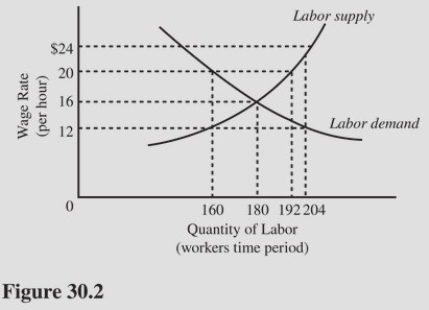 In Figure 30.2,a minimum wage of $20 will result in a
Cost efficiency is achieved when the MPP of a worker relative to the worker's wage is the same for all workers.
(True/False)
5.0/5 (72)
(72) 
Filters
- Essay(0)
- Multiple Choice(0)
- Short Answer(0)
- True False(0)
- Matching(0)