



 Chat with AI
Exam 32: Financial Markets

Exam 1: Economics: the Core Issues152 Questions
Exam 2: The Useconomy: a Global View146 Questions
Exam 3: Supply and Demand164 Questions
Exam 4: The Role of Government153 Questions
Exam 5: National Income Accounting152 Questions
Exam 6: Unemployment147 Questions
Exam 7: Inflation152 Questions
Exam 8: The Business Cycle153 Questions
Exam 9: Aggregate Demand149 Questions
Exam 10: Self-Adjustment or Instability140 Questions
Exam 11: Fiscal Policy151 Questions
Exam 12: Deficits and Debt151 Questions
Exam 13: Money and Banks146 Questions
Exam 14: The Federal Reserve System146 Questions
Exam 15: Monetary Policy149 Questions
Exam 16: Supply-Side Policy: Short-Run Options147 Questions
Exam 17: Growth and Productivity: Long-Run Possibilities143 Questions
Exam 18: Theory Versus Reality146 Questions
Exam 19: Consumer Choice136 Questions
Exam 20: Elasticity141 Questions
Exam 21: The Costs of Production151 Questions
Exam 22: The Competitive Firm148 Questions
Exam 23: Competitive Markets150 Questions
Exam 24: Monopoly147 Questions
Exam 25: Oligopoly145 Questions
Exam 26: Monopolistic Competition144 Questions
Exam 27: Natural Monopolies: Deregulation144 Questions
Exam 28: Environmental Protection144 Questions
Exam 29: The Farm Problem132 Questions
Exam 30: The Labor Market137 Questions
Exam 31: Labor Unions144 Questions
Exam 32: Financial Markets146 Questions
Exam 33: Taxes: Equity Versus Efficiency146 Questions
Exam 34: Transfer Payments: Welfare and Social Security146 Questions
Exam 35: International Trade149 Questions
Exam 36: International Finance142 Questions
Exam 37: Global Poverty141 Questions
Select questions type


The advantage to a corporation of issuing bonds instead of stock is that
(Multiple Choice)
4.9/5  (81)
(81) If interest rates are high,the future payoff for every dollar saved is low.
(True/False)
4.8/5 (73)
(73) Profits used by a corporation for investment or unforeseen contingencies are known as retained earnings.
(True/False)
4.9/5 (81)
(81) The present discounted value of a future payment will decrease when interest rates decrease.
(True/False)
4.8/5 (73)
(73) The liquidity of an asset refers to the ability of the asset to be converted into cash.
(True/False)
4.7/5 (90)
(90) The market value of a bond on any given day is also known as its par value.
(True/False)
4.8/5 (75)
(75) The total monetary returns associated with stock ownership result from dividends and capital gains.
(True/False)
4.9/5 (90)
(90) In a publicly traded corporation,which of the following is responsible for business debts and activities?
(Multiple Choice)
4.9/5 (87)
(87) Venture capitalists share in the risks and rewards by financing new ventures.
(True/False)
5.0/5 (90)
(90) Financial intermediaries increase the probability of a risky venture being funded by concentrating the risk among a few investors.
(True/False)
4.8/5 (93)
(93) 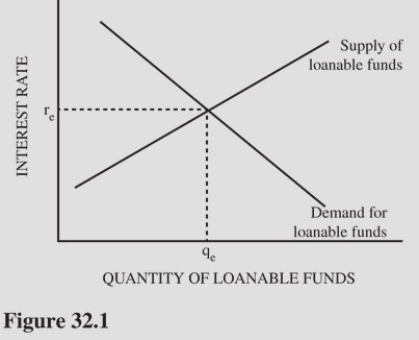 Figure 32.1 represents the market for loanable funds.The equilibrium interest rate
 (Multiple Choice)
5.0/5 (89)
(89) Suppose you purchase shares in Acme Gadget Company for $10 per share.The company believes there is a 20 percent chance it will fail to earn a discounted future profit of $1.85.What is the expected rate of return on your investment?
(Multiple Choice)
4.9/5 (76)
(76) The amount of corporate profits not paid out in dividends is known as
(Multiple Choice)
4.9/5 (73)
(73) If the price of an existing bond increases,the current yield increases.
(True/False)
4.7/5 (78)
(78) When the risk factor associated with a stock increases,the expected rate of return increases.
(True/False)
5.0/5 (79)
(79) List the factors that influence the supply of loanable funds and the factors that influence the demand for loanable fund.
(Essay)
4.8/5 (88)
(88) 
Filters
- Essay(0)
- Multiple Choice(0)
- Short Answer(0)
- True False(0)
- Matching(0)