



 Chat with AI
Exam 18: The Urinary System

Exam 1: An Introduction to Anatomy and Physiology90 Questions
Exam 2: The Chemical Level of Organization105 Questions
Exam 3: Cell Structure and Function126 Questions
Exam 4: The Tissue Level of Organization88 Questions
Exam 5: The Integumentary System103 Questions
Exam 6: The Skeletal System218 Questions
Exam 7: The Muscular System115 Questions
Exam 8: The Nervous System149 Questions
Exam 9: The General and Special Senses118 Questions
Exam 10: The Endocrine System100 Questions
Exam 11: The Cardiovascular System: Blood84 Questions
Exam 12: The Cardiovascular System: the Heart115 Questions
Exam 13: The Cardiovascular System: Blood Vessels and Circulation121 Questions
Exam 14: The Lymphatic System and Immunity105 Questions
Exam 15: The Respiratory System101 Questions
Exam 16: The Digestive System129 Questions
Exam 17: Metabolism and Energetics77 Questions
Exam 18: The Urinary System114 Questions
Exam 19: The Reproductive System118 Questions
Exam 20: Development and Inheritance97 Questions
Select questions type


Electrolyte balance primarily involves balancing the rates of ________ across the digestive tract with rates of ________ at the kidneys.
(Multiple Choice)
5.0/5  (78)
(78) Which of the following are components of a renal corpuscle?
(Multiple Choice)
4.9/5 (84)
(84) Where does exchange among the subdivisions of the ECF primarily occur?
(Multiple Choice)
4.9/5 (71)
(71) To achieve fluid balance, ion concentration gradients are eliminated by
(Multiple Choice)
4.9/5 (83)
(83) Organs of the urinary system that are actively involved with urine transport are the
(Multiple Choice)
4.9/5 (74)
(74) What is the primary role of the carbonic acid-bicarbonate buffer system?
(Multiple Choice)
4.9/5 (82)
(82) Regarding sodium balance, which is (are) the most important site(s) for regulating sodium ion losses?
(Multiple Choice)
4.8/5 (64)
(64) A 72-year-old male patient complains of having difficulty while urinating. A very likely explanation may be that
(Multiple Choice)
4.8/5 (80)
(80) Urine ejection cannot occur unless which event(s) takes place?
(Multiple Choice)
4.7/5 (81)
(81) 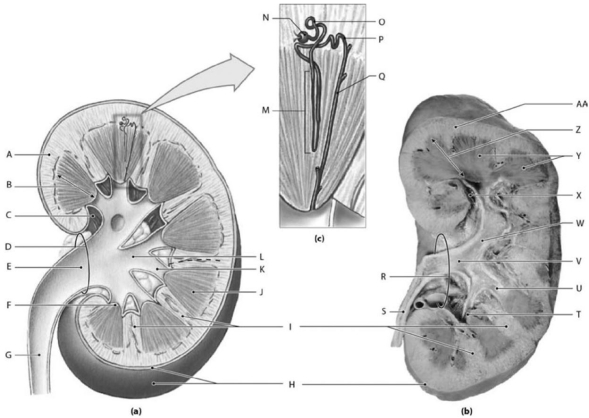 Photo Credit: Ralph T. Hutchings
Figure 18-1 The Structure of the Kidney
Use Figure 18-1 to identify the labeled part.
-Label G represents which of the following structures?
Photo Credit: Ralph T. Hutchings
Figure 18-1 The Structure of the Kidney
Use Figure 18-1 to identify the labeled part.
-Label G represents which of the following structures? (Multiple Choice)
4.9/5 (66)
(66) Sylvia is suffering from severe edema (an abnormal buildup of serous fluid between tissue cells) in her arms and legs. Her physician prescribes a diuretic (a substance that will increase the volume of urine produced). Why might this help to alleviate Sylvia's problem?
(Essay)
4.9/5 (90)
(90) The large, funnel-shaped chamber that connects to the ureter is called the
(Multiple Choice)
4.9/5 (80)
(80) Which is true regarding the general characteristics of normal urine?
(Multiple Choice)
4.7/5 (65)
(65) Following is a list of components of the renal tubule system.
1) ascending limb of nephron loop
2) ureter
3) distal convoluted tubule
4) descending limb of nephron loop
5) minor calyx
6) proximal convoluted tubule
7) papillary duct
8) renal pelvis
Choose the correct order of components through which the initial filtrate of urine flows from the renal corpuscle and is conducted to the urethra to be excreted as urine.
(Multiple Choice)
4.8/5 (92)
(92) 
Filters
- Essay(0)
- Multiple Choice(0)
- Short Answer(0)
- True False(0)
- Matching(0)