



 Chat with AI
Exam 3: Cell Structure and Function

Exam 1: An Introduction to Anatomy and Physiology90 Questions
Exam 2: The Chemical Level of Organization105 Questions
Exam 3: Cell Structure and Function126 Questions
Exam 4: The Tissue Level of Organization88 Questions
Exam 5: The Integumentary System103 Questions
Exam 6: The Skeletal System218 Questions
Exam 7: The Muscular System115 Questions
Exam 8: The Nervous System149 Questions
Exam 9: The General and Special Senses118 Questions
Exam 10: The Endocrine System100 Questions
Exam 11: The Cardiovascular System: Blood84 Questions
Exam 12: The Cardiovascular System: the Heart115 Questions
Exam 13: The Cardiovascular System: Blood Vessels and Circulation121 Questions
Exam 14: The Lymphatic System and Immunity105 Questions
Exam 15: The Respiratory System101 Questions
Exam 16: The Digestive System129 Questions
Exam 17: Metabolism and Energetics77 Questions
Exam 18: The Urinary System114 Questions
Exam 19: The Reproductive System118 Questions
Exam 20: Development and Inheritance97 Questions
Select questions type


During transcription, a sequence of three nitrogenous bases along the new mRNA strand represents a(n) ________ that is complementary to the corresponding triplet along the gene.

Free
(Multiple Choice)
4.8/5  (75)
(75) Correct Answer: Verified
E
In which type of solution would equilibrium exist?
Free
(Multiple Choice)
4.9/5 (83)
(83) Correct Answer:Verified
VerifiedA
 Photo Credit: Steve Gschmeissner / Photo Researchers, Inc.
Figure 3-1 A Red Blood Cell
Use Figure 3-1 to answer the following question:
Choose the correct description for the preceding image.
Photo Credit: Steve Gschmeissner / Photo Researchers, Inc.
Figure 3-1 A Red Blood Cell
Use Figure 3-1 to answer the following question:
Choose the correct description for the preceding image.Free
(Multiple Choice)
4.9/5 (87)
(87) Correct Answer:Verified
VerifiedE
Which structure leaves the nucleus during transcription of protein synthesis?
(Multiple Choice)
4.8/5 (73)
(73) The stage in a cell's life cycle in which the DNA of the chromosomes gradually uncoils and nucleoli reappear, is called
(Multiple Choice)
4.9/5 (82)
(82) The DNA triplet is the same sequence as the ________, except that U replaces T.
(Multiple Choice)
4.8/5 (68)
(68) Three nitrogenous base sequences on mRNA, which are complementary to gene triplets, are called
(Multiple Choice)
4.9/5 (80)
(80) Looking at a tissue through a microscope, you notice that all of the cells along the free surface of the tissue have microvilli along the free edges of the cells. This would tell you that this tissue has what function?
(Multiple Choice)
4.9/5 (86)
(86)  Figure 3-6 Nucleus
Use Figure 3-6 to answer the following question:
Identify the component of the nucleus in which rRNA synthesis and the assembly of ribosomal subunits occur.
Figure 3-6 Nucleus
Use Figure 3-6 to answer the following question:
Identify the component of the nucleus in which rRNA synthesis and the assembly of ribosomal subunits occur. (Multiple Choice)
4.8/5 (71)
(71) 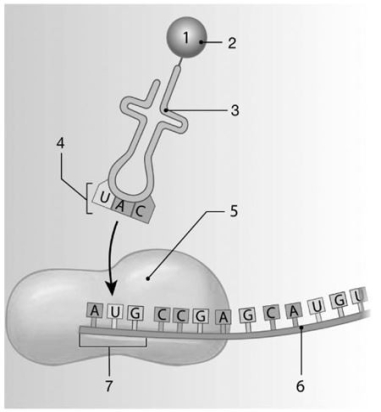 Figure 3-7 Translation
Use Figure 3-7 to answer the following questions:
-Identify the anticodon in the image.
Figure 3-7 Translation
Use Figure 3-7 to answer the following questions:
-Identify the anticodon in the image. (Multiple Choice)
5.0/5 (86)
(86) Which of the following contains an unusual double membrane?
(Multiple Choice)
5.0/5 (79)
(79) In cells that are not dividing, chromosomes form a loose network of fibers known as
(Multiple Choice)
4.7/5 (78)
(78) Which property of a membrane determines which molecules may enter or leave?
(Multiple Choice)
4.8/5 (76)
(76) There are chemicals that bind to microfilaments and block the elongation of actin in a cell. This would damage
(Multiple Choice)
4.9/5 (81)
(81)  Figure 3-4 Protein Synthesis
Use Figure 3-4 to answer the following questions:
-The cell seen in the preceding diagram could be
Figure 3-4 Protein Synthesis
Use Figure 3-4 to answer the following questions:
-The cell seen in the preceding diagram could be (Multiple Choice)
4.9/5 (74)
(74) The stage of the cell cycle during which DNA replication and synthesis of histones occur is called
(Multiple Choice)
4.8/5 (75)
(75) 
Filters
- Essay(0)
- Multiple Choice(0)
- Short Answer(0)
- True False(0)
- Matching(0)