



 Chat with AI
Exam 3: Cell Structure and Function

Exam 1: An Introduction to Anatomy and Physiology90 Questions
Exam 2: The Chemical Level of Organization105 Questions
Exam 3: Cell Structure and Function126 Questions
Exam 4: The Tissue Level of Organization88 Questions
Exam 5: The Integumentary System103 Questions
Exam 6: The Skeletal System218 Questions
Exam 7: The Muscular System115 Questions
Exam 8: The Nervous System149 Questions
Exam 9: The General and Special Senses118 Questions
Exam 10: The Endocrine System100 Questions
Exam 11: The Cardiovascular System: Blood84 Questions
Exam 12: The Cardiovascular System: the Heart115 Questions
Exam 13: The Cardiovascular System: Blood Vessels and Circulation121 Questions
Exam 14: The Lymphatic System and Immunity105 Questions
Exam 15: The Respiratory System101 Questions
Exam 16: The Digestive System129 Questions
Exam 17: Metabolism and Energetics77 Questions
Exam 18: The Urinary System114 Questions
Exam 19: The Reproductive System118 Questions
Exam 20: Development and Inheritance97 Questions
Select questions type


The concentration of ________ determines the osmotic pressure of a solution.
(Multiple Choice)
4.8/5  (88)
(88) When a protein is synthesized on fixed ribosomes, it is threaded into the lumen of which structure(s)?
(Multiple Choice)
4.8/5 (77)
(77) The chemical cochicine, from a flowering plant, blocks the building of tubulin proteins into microtubules. This would cause cell damage by
(Multiple Choice)
4.9/5 (73)
(73) The folds of the internal membrane within mitochondria are called
(Multiple Choice)
4.9/5 (81)
(81) The cytoplasmic division that forms two daughter cells is called
(Multiple Choice)
4.7/5 (80)
(80) The job of a sperm cell, or spermatozoan, is to get to the egg as soon as possible and fertilize it. Sperm cells would be expected to have a lot of
(Multiple Choice)
4.9/5 (77)
(77) What is the benefit of having some of the cellular organelles enclosed by a membrane similar to the plasma membrane?
(Essay)
4.9/5 (72)
(72)  Figure 3-2 A Process
Use Figure 3-2 to answer the following questions:
-Using the preceding image, determine the correct sequence of events in the primary process, which begins when target molecules (ligands) bind to receptors in the plasma membrane. 1. Target molecules are removed and absorbed into the cytoplasm.
2) The membrane containing the receptor molecules detaches from the lysosome.
3) Pockets pinch off, forming coated vesicles.
4) Areas coated with ligands form deep pockets in the membrane surface.
5) The vesicle fuses with the plasma membrane.
6) Coated vesicles fuse with lysosomes.
Figure 3-2 A Process
Use Figure 3-2 to answer the following questions:
-Using the preceding image, determine the correct sequence of events in the primary process, which begins when target molecules (ligands) bind to receptors in the plasma membrane. 1. Target molecules are removed and absorbed into the cytoplasm.
2) The membrane containing the receptor molecules detaches from the lysosome.
3) Pockets pinch off, forming coated vesicles.
4) Areas coated with ligands form deep pockets in the membrane surface.
5) The vesicle fuses with the plasma membrane.
6) Coated vesicles fuse with lysosomes. (Multiple Choice)
4.8/5 (86)
(86) During which phase of cell division do the chromatids line up along the equator of the cell?
(Multiple Choice)
4.8/5 (84)
(84) Examination of a sample of cells reveals large numbers of mitochondria compared to most other cells. Which of the following is a likely reason for this?
(Multiple Choice)
4.8/5 (86)
(86) The concept that each cell of an organism maintains homeostasis is part of our understanding of
(Multiple Choice)
4.9/5 (91)
(91) Paired structures made of microtubules that are perpendicular to each other are called the
(Multiple Choice)
4.9/5 (74)
(74) Which of these transport mechanisms do not fit into the rest of the group listed?
(Multiple Choice)
5.0/5 (67)
(67) The nucleus ultimately controls the synthesis of which of the following molecules?
(Multiple Choice)
4.8/5 (81)
(81) A mechanism in which two substances move in opposite directions across the cell membrane is called
(Multiple Choice)
4.9/5 (75)
(75) 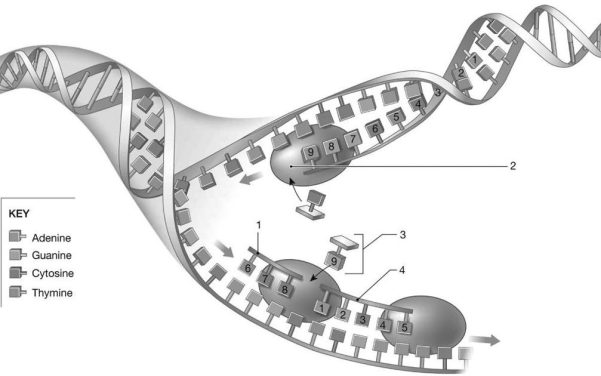 Figure 3-8 A Process
Use Figure 3-8 to answer the following questions:
-Identify the process featured in the image.
Figure 3-8 A Process
Use Figure 3-8 to answer the following questions:
-Identify the process featured in the image. (Multiple Choice)
5.0/5 (95)
(95) 
Filters
- Essay(0)
- Multiple Choice(0)
- Short Answer(0)
- True False(0)
- Matching(0)