



 Chat with AI
Exam 3: Cell Structure and Function

Exam 1: An Introduction to Anatomy and Physiology90 Questions
Exam 2: The Chemical Level of Organization105 Questions
Exam 3: Cell Structure and Function126 Questions
Exam 4: The Tissue Level of Organization88 Questions
Exam 5: The Integumentary System103 Questions
Exam 6: The Skeletal System218 Questions
Exam 7: The Muscular System115 Questions
Exam 8: The Nervous System149 Questions
Exam 9: The General and Special Senses118 Questions
Exam 10: The Endocrine System100 Questions
Exam 11: The Cardiovascular System: Blood84 Questions
Exam 12: The Cardiovascular System: the Heart115 Questions
Exam 13: The Cardiovascular System: Blood Vessels and Circulation121 Questions
Exam 14: The Lymphatic System and Immunity105 Questions
Exam 15: The Respiratory System101 Questions
Exam 16: The Digestive System129 Questions
Exam 17: Metabolism and Energetics77 Questions
Exam 18: The Urinary System114 Questions
Exam 19: The Reproductive System118 Questions
Exam 20: Development and Inheritance97 Questions
Select questions type


Which of these is an example of carrier-mediated transport that does not require energy input?
(Multiple Choice)
4.9/5  (72)
(72) Briefly explain the process of active transport as it relates to the sodium-potassium pump.
(Essay)
4.8/5 (83)
(83) 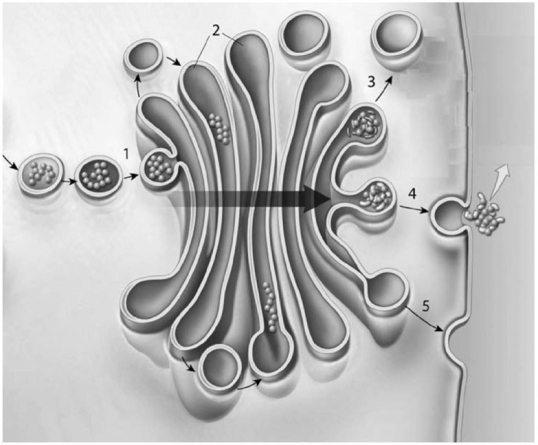 Figure 3-4 Protein Synthesis
Use Figure 3-4 to answer the following questions:
-Identify the organelle shown in the figure, which is described as stacks of flattened membranes containing chambers.
Figure 3-4 Protein Synthesis
Use Figure 3-4 to answer the following questions:
-Identify the organelle shown in the figure, which is described as stacks of flattened membranes containing chambers. (Multiple Choice)
5.0/5 (94)
(94) Which molecule carries an amino acid to the site of protein synthesis during translation?
(Multiple Choice)
4.9/5 (84)
(84) Identify the phase of mitosis, which ends when daughter chromosomes move to the centrioles at opposite poles of the cell.
(Multiple Choice)
4.8/5 (79)
(79) A process that requires ATP energy to move a substance independently of its concentration gradient is called
(Multiple Choice)
4.8/5 (79)
(79) Flu viruses enter into a prospective host cell (along the respiratory tract) and direct it to produce many copies of the viruses. As those viruses bud off of the infected cell, they take the cell membrane of the host cell with them. How might this kill the host cell?
(Multiple Choice)
4.8/5 (88)
(88) The mRNA sequence that is complementary to the sequence UAG on a tRNA is
(Multiple Choice)
4.9/5 (81)
(81) Which of the following consists of a set of flattened membranous disks?
(Multiple Choice)
4.9/5 (72)
(72) Palytoxin is a very potent toxin from a particular seaweed in Hawaii that locks the carrier proteins of the ion pump system of the cell in an open position. What result would this have on cell function?
(Multiple Choice)
4.8/5 (83)
(83) Mutations are permanent alterations in which of the following?
(Multiple Choice)
4.9/5 (85)
(85) A cell must expend energy to accomplish substance movement during
(Multiple Choice)
4.8/5 (75)
(75) The process of binding a specific molecule and then bringing it into the cell in a vesicle is called
(Multiple Choice)
4.8/5 (80)
(80) A solution that contains a higher solute concentration than the cytoplasm of a cell is called
(Multiple Choice)
4.8/5 (87)
(87) 
Filters
- Essay(0)
- Multiple Choice(0)
- Short Answer(0)
- True False(0)
- Matching(0)